


Having a job and practical skills in life is of special importance, because in addition to meeting the needs of the individual and the family, it also provides the foundation for independence, self-respect, and moral growth. Islamic teachings place great emphasis on effort, lawful earning, and making use of one’s personal abilities.
The Prophets and the Ahl al-Bayt (peace be upon them) demonstrated these values in practice through their own work and professions. Gaining employment and skills is also a means of divine blessing and God’s pleasure.
In this article, important points from the book of Ayatollah Sistani regarding the necessity of having a job and skills have been republished. Reading it is recommended for anyone interested in an independent and successful life.
The Importance of Having a Job and a Profession
It is narrated in a hadith that the Messenger of God (PBUH) said: “God Almighty loves a believing servant who is engaged in work”.[1]
It is reported that the Amir al-Muminin, Imam Ali (AS), said: “Engage in trade, for it frees you from needing what is in the hands of others, and God Almighty loves an honest and trustworthy craftsman”.[2]
In another hadith, the Messenger of God (PBUH) said: “Whoever seeks worldly provision through lawful means in order to avoid asking others, strives to provide for his family, and cares for his neighbors with kindness and compassion, will meet God Almighty on the Day of Resurrection with a face shining like the full moon”.[3]
It is narrated that a man came to Imam Sadiq (AS) and said: I am neither able to work well with my hands nor to engage in trade, and I am a poor and needy man. Imam Sadiq (AS) said to him: “Work, and carry loads on your own head (and endure hardship in seeking provision), and make yourself independent of others”.[4]
Mualla ibn Khunays says: Imam Sadiq (AS) saw me when I was late in going to the market. He said: “Go early in the morning to seek your dignity”.[5]
It is also narrated that Imam Musa al-Kazim (AS), while working on the land and with his blessed feet soaked in sweat, said: “The Noble Messenger (PBUH), the Amir al-Muminin (AS), and my forefathers (AS) all worked with their own hands. This is the way of the Prophets, the Messengers, their successors, and the righteous”.[6]
It is reported from Imam Sadiq (AS) that he said: “One of the companions of the Messenger of God (PBUHH) fell into financial difficulty. His wife said to him: If only you would go to the Messenger of God (PBUHH) and ask him for help. The man went to the Prophet. When the Prophet saw him, he said:
Whoever asks us for help, we will give to him, and whoever seeks self-sufficiency, God Almighty will make him self-sufficient. The man thought to himself that the Prophet meant him, so without saying anything, he returned home and told his wife what had happened.
His wife asked him again to go to the Messenger of God (PBUHH) and inform him of their living conditions. The man went to the Prophet a second time. When the Prophet saw him, before he spoke, he said the same words. Once again, the man returned home without asking.
He went a third time, and the same thing happened. When he left the Prophet, he borrowed an axe, went to the mountain, gathered some firewood, brought it back, and sold it for half a measure of flour.
The next day, he gathered more firewood and sold it, and he continued working and saving his earnings until he bought his own axe. Gradually, he came to own two camels and a servant and became wealthy and self-sufficient.
One day he went to the Messenger of God (PBUHH) and told him how he had asked and what he had heard from him. The Prophet (PBUHH) said: “Did I not tell you that whoever asks us for help, we will give to him, and whoever seeks self-sufficiency, God Almighty will make him self-sufficient?”[7]
The Necessity of Employment and Avoiding Laziness
It is narrated from Ibn Abbas who said: “Whenever the Messenger of God (PBUHH) looked at someone and was pleased with him, he would ask: Does he have a job? If they said no, he would say: He has fallen from my esteem. It was asked: Why, O Messenger of God? He replied: Because if a believer has no job or profession, he will use his religion as a means of earning his livelihood”.[8]
In a hadith, it is narrated that Imam Sadiq (AS) asked about the work of Muadh, the cloth seller. It was said: He has given up trade. The Imam (AS) said: “This is the work of Satan, this is the work of Satan. Whoever abandons trade has lost two-thirds of his intellect. Does he not know that a caravan came from Syria, and the Prophet (PBUH) bought goods from it, traded with them, made a profit, and repaid his debts with it?”.[9]
The narrator says: We were sitting with Imam Sadiq (AS) when Ala ibn Kamil entered, sat facing the Imam (AS), and said: Pray that God grants me abundant provision. Imam Sadiq (AS) said: “I will not pray for that. Go and seek work, as God Almighty has commanded you, and earn your living through effort”.[10]
In a narration from Imam Baqir (AS), he said: “I do not like for a man to be lazy and idle in his worldly affairs, for whoever is lazy in his worldly affairs will be even lazier and weaker in his affairs of the Hereafter”.[11]
Making the Best Use of Minimal Resources
It is narrated that one of the Ansar faced a need and informed the Prophet (PBUHH). The Prophet said: “Bring whatever you have in your house, and do not consider anything worthless”. That man went home and brought a mat and a bowl.
The Prophet (PBUH) said: “Who will buy these?” A man said: I will buy them for one dirham. The Prophet (PBUH) said: “Who will offer more?”.
Another man said: Two dirhams. The Prophet (PBUH) said: “They are yours”. Then he said to the man from the Ansar: “With one dirham, buy food for your family, and with the other dirham, buy an axe”.
When the man brought the axe, the Prophet said: “Who has a handle for this axe?”. One of those present said: I do. The Prophet took it, fixed the handle into the axe with his own hands, and said to the Ansari: “Go and gather firewood, and do not consider any thorn, fresh or dry, too small to collect”. The man did so, and after fifteen days he returned, and his living conditions had improved. The Prophet said: “This is better for you than entering the place of gathering on the Day of Resurrection with marks of charity (taken from people) visible on your face”.[12]
Emphasis on Business and Trade
It is narrated from Imam Sadiq (AS) that the Amir al-Muminin (AS) said: “Engage in trade, and God will bless you. I heard from the Messenger of God (PBUH) who said: Provision is divided into ten parts; nine parts are in trade, and one part is in other than trade”.[13]
It is narrated that Imam Sadiq (AS) gave a man 1,700 dinars as a partnership investment and said: “Trade with this money for me. Be aware that I have no desire for the profit itself, although it is hoped that this capital will yield profit. Rather, I have given it to you because I love that God Almighty sees me as someone who does not leave money idle, but puts it into circulation and productive activity”.
The narrator says: After some time, I saw the Imam and said: I earned 100 dinars in profit for you. Imam Sadiq (AS) was very pleased and said: “Add it to my capital”.[14]
Emphasis on Agriculture and Farming
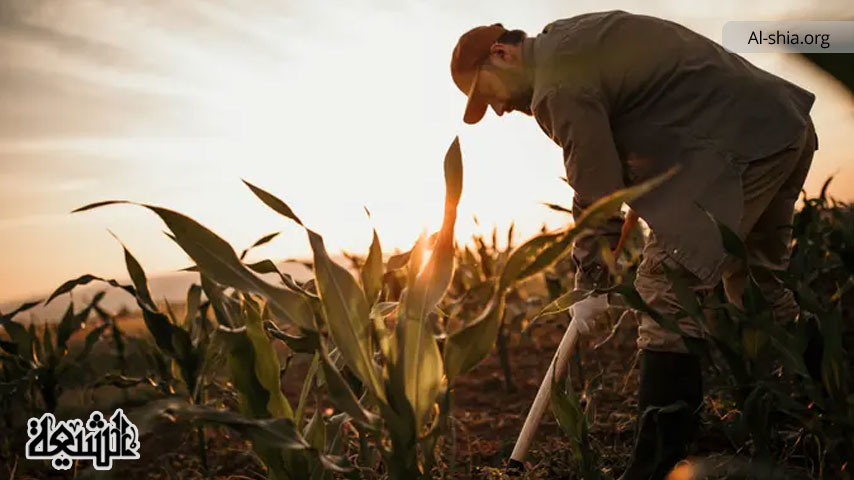
It is narrated from Imam Sadiq (AS) that he said: “Farmers are the treasures of God Almighty on earth, and among all forms of work, there is no work more beloved to God Almighty than agriculture”.[15]
In another hadith, he said: “Engage in farming and plant trees. By God, people have not performed any lawful act purer and cleaner than these”.[16]
It is narrated from the Messenger of God (PBUH) that he said: “There is no Muslim who plants a sapling or sows a crop from which a human, a bird, or an animal eats, except that it will be recorded as charity for him until the Day of Resurrection”.[17]
It is reported from Imam Sadiq (AS) that the Messenger of God (PBUH) was asked: What is the best form of wealth? He replied: “A seed that its owner plants, takes good care of, and on the day of harvest pays its due rights”.[18]
It is narrated that the Amir al-Muminin (AS) said: “People who are in need despite having water and land are far from the mercy of God”.[19]
Conclusion
Having a job and skills paves the way toward independence and self-respect and frees a person from dependence on others. Acting upon Islamic teachings in this regard, as emphasized in the book of Ayatollah Sistani, leads to blessing, moral growth, and divine satisfaction.
Notes
[1] . Kulayni, Furu al-Kafi, vol.5, p.113, hadith 1.
[2] . Hurr al-Amili, Wasail al-Shia, vol.17, chapter 1, p.11, hadith 6.
[3] . Nuri, Mustadrak al-Wasail, vol.13, chapter 5, p.17, hadith 11.
[4] . Hurr al-Amili, Wasail al-Shia, vol.17, chapter 9, p.38, hadith 5.
[5] . Hurr al-Amili, Wasail al-Shia, vol.17, chapter 1, p.10, hadith 2.
[6] . Hurr al-Amili, Wasail al-Shia, vol.17, chapter 9, pp. 38–39, hadith 6.
[7] . Majlisi, Bihar al-Anwar, vol.100, chapter 1, p.14, hadith 66.
[8] . Majlisi, Bihar al-Anwar, vol.100, chapter 1, p.9, hadith 38.
[9] . Tusi, Tahdhib al-Ahkam, vol.7, chapter 1, p.4, hadith 11.
[10] . Hurr al-Amili, Wasail al-Shia, vol.17, p.20, hadith 3.
[11] . Kulayni, al-Kafi, vol.5, p.85, hadith 4.
[12] . Majlisi, Bihar al-Anwar, vol.100, chapter 1, p.10, hadith 44.
[13] . Hurr al-Amili, Wasail al-Shia, vol.17, chapter 1, p.12, hadith 12.
[14] . Hurr al-Amili, Wasail al-Shia, vol.17, chapter 11, p. 43, hadith 1.
[15] . Hurr al-Amili, Wasail al-Shia, vol.17, chapter 10, pp. 41–42, hadith 3.
[16] . Hurr al-Amili, Wasail al-Shia, vol.19, chapter 3, pp. 32–33, hadith 1.
[17] . Nuri, Mustadrak al-Wasail, vol.13, chapter 9, p.26, hadith 4.
[18] . Hurr al-Amili, Wasail al-Shia, vol.19, chapter 3, p.35, hadith 9.
[19] . Hurr al-Amili, Wasail al-Shia, vol.17, chapter 9, pp. 40–41, hadith 13.
References
- Hurr al-Amili, Muhammad ibn al-Hasan, Wasail al-Shia, Qom, Al al-Bayt (AS) Foundation for the Revival of Heritage, 1414 AH.
- Kulayni, Muhammad ibn Yaqub, Al-Kafi, Tehran, Dar al-Kutub al-Islamiyya, 1363 SH.
- Kulayni, Muhammad ibn Yaqub, Furu al-Kafi, Beirut, Dar al-Adwa, 1405 AH.
- Majlisi, Muhammad Baqir, Bihar al-Anwar al-Jamia li-Durar Akhbar al-Aimma al-Athar, Beirut, Dar Ihya al-Turath al-Arabi, 1362 SH.
- Nuri, Hussain, Mustadrak al-Wasail wa Mustanbat al-Masail, Beirut, Al al-Bayt (AS) Foundation for the Revival of Heritage, 1366 SH.
- Tusi, Muhammad ibn al-Hasan, Tahdhib al-Ahkam fi Sharh al-Muqnia by Shaykh al-Mufid, Tehran, Dar al-Kutub al-Islamiyya, 1365 SH.
Source of the article | Adapted from: Hussaini Sistani, Seyed Ali, Tashih al-Masail Jami, Mashhad, Office of the Grand Marja Ayatollah Seyed Ali Sistani, 1446 AH, 2nd Edition, vol.3, pp. 35–46.



![The Event of Ghadir and Imam al-Mahdi [afs]](https://en.al-shia.org/wp-content/uploads/2026/06/17221.jpg)