
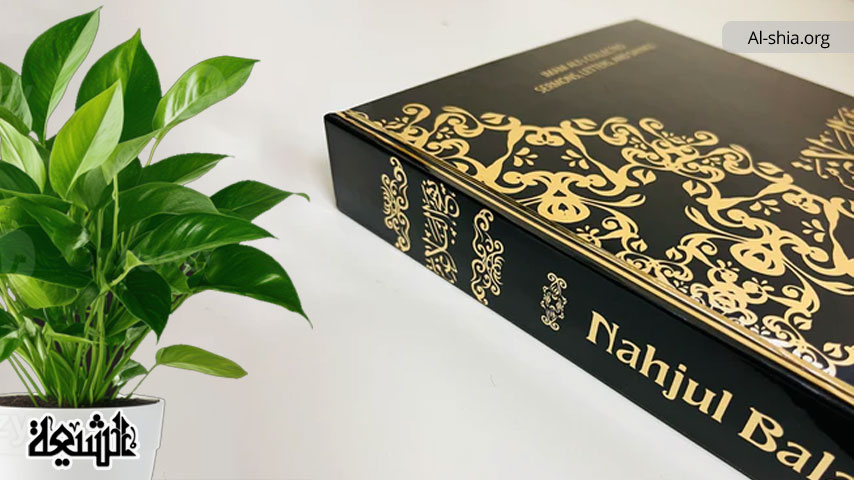

All the sermons in Nahj al-Balagha possess not only unparalleled eloquence and articulation but also rich and valuable content. Without a doubt, every sermon of Imam Ali (AS) is beautiful and captivating, and each one, after the divine verses, represents the highest level of oratory.
For this reason, choosing the most beautiful sermon in Nahj al-Balagha is extremely difficult and perhaps impossible. Below, we introduce several well-known sermons of Imam Ali (AS) that could be considered worthy of the title of the most beautiful sermon in Nahj al-Balagha.
The Most Beautiful Sermons in Nahj al-Balagha
Before presenting the most beautiful sermon in Nahj al-Balagha, it is appropriate to briefly introduce the book itself. Nahj al-Balagha was compiled by the late Sayyid Radi, a Shia scholar of the fourth century AH.
He explains that his motivation for compiling the book was to gather the most eloquent and articulate sayings of Amir al-Muminin (AS) and to demonstrate his virtues, especially in the field of eloquence. This very fact makes the selection of the most beautiful sermon in Nahj al-Balagha an almost impossible task.
In this book, Sayyid Radi mentions 241 sermons, 79 letters, and 489 wise sayings of Amir al-Muminin (AS). Depending on his purpose, he also abridged some sermons and letters, presenting them partially rather than in full.
1. Sermon of Shaqshiqiyyah
The third sermon of Nahj al-Balagha is known as the Shaqshiqiyyah Sermon. In this speech, Imam Ali (AS) addresses the crucial issue of the caliphate and the succession after the Prophet (PBUHH). Politically, and in terms of addressing the significant matter of leadership after the Prophet (PBUHH), this sermon can be considered the most beautiful sermon in Nahj al-Balagha.
The name of this sermon comes from its final phrase, in which Amir al-Muminin (AS), responding to Ibn Abbas’s request to continue the sermon, said:
تِلْكَ شِقْشِقَةٌ هَدَرَتْ ثُمَّ قَرَّتْ
Which is translated thus: “This was a flame that blazed from the heart and then subsided”.[1] In this way, he rejected Ibn Abbas’s request to continue speaking.[2]
In this sermon, the Imam (AS) strongly criticizes the caliphs and addresses the Muslims:
أَمَا وَ اللَّهِ لَقَدْ تَقَمَّصَهَا فُلَانٌ وَ إِنَّهُ لَيَعْلَمُ أَنَّ مَحَلِّي مِنْهَا مَحَلُّ الْقُطْبِ مِنَ الرَّحَى
“Be aware! By God, so-and-so donned the caliphate like a garment, fully knowing that my position relative to it is like the axis to the millstone”.[3]
Among the sermons in Nahj al-Balagha, there are other instances where Imam Ali (AS) speaks about his enemies and exposes their wrongdoing and oppression. Yet, it can confidently be said that, politically, the Shaqshiqiyyah Sermon is the most beautiful sermon in Nahj al-Balagha.
2. Sermon of Gharra
Another of Imam Ali’s (AS) most beautiful speeches is the eighty-third sermon of Nahj al-Balagha, known as the Gharra Sermon. This magnificent and eloquent sermon of the Imam (AS), which expresses the most precise knowledge regarding the attributes of God with the most articulate sentences, can also be considered one of the most beautiful sermons in Nahj al-Balagha.
Abu Nuaym Isfahani, in Hilyat al-Awliya, presents an important portion of this sermon and explains the reason it was delivered: “The Imam (AS) led the funeral of a Muslim. When the body was placed in the grave, the mourners cried out and wailed. The Imam (AS) said: By God! If they could see what the deceased sees, they would forget to weep for him (and weep for themselves!)”.
Then, observing that the group was ready to receive divine advice, the Imam (AS) rose and delivered this sermon.[4]
This speech represents a complete course in human development, and only few people can study it carefully without being deeply moved. Sayyid Radi notes that when the Imam (AS) delivered this sermon, people’s bodies trembled, tears flowed, and hearts were filled with fear and agitation.[5]
These observations indicate that, in terms of preaching and moral instruction, this sermon can also be considered the most beautiful sermon in Nahj al-Balagha.
3. Sermon of Ashbah
The Ashbah Sermon can also be regarded as one of the most beautiful sermons in Nahj al-Balagha. Regarding the reason for delivering this sermon, Masadah ibn Sadaqah reports from Imam Sadiq (AS): Imam Ali (AS) delivered this sermon on the pulpit of Kufa because someone asked him to describe God in such a way that they could imagine seeing Him with their own eyes, hoping to increase their understanding. The Imam, angered by this, called everyone to gather; the mosque was filled with people, and he ascended the pulpit, his face expressing anger.[6]
Ibn Abi al-Hadid considers this sermon one of the most eloquent and profound, and perhaps the most beautiful sermon in Nahj al-Balagha, representing the highest level of eloquence and articulation. He writes: “When one examines these divine words and sacred expressions, the eloquence of the Arabs pales in comparison. Comparing the words of the Arabs’ finest orators to this sermon is like comparing dust to pure gold. Even if the Arabs could produce similarly eloquent expressions, how could they convey such profound content?”.[7]
Regarding the name Ashbah, scholars have debated its meaning. Some suggest that Ashbah refers to angels, as a significant portion of this sermon discusses angels, which led to its naming as the Ashbah Sermon.[8]
4. Sermon of Qasiah
Another important sermon in Nahj al-Balagha is the sermon 192, known as the Qasiah Sermon. It is extremely eloquent, forceful, and striking, which is why it was given the name Qasiah (forceful), even though the word Qasiah does not appear in the sermon itself.[9]
Due to the firmness of its words and the grandeur and weight of its expressions, this sermon is considered one of the most beautiful in Nahj al-Balagha. In it, Imam Ali (AS), with powerful and compelling words, rebukes Satan for his arrogance in refusing to prostrate to Adam (AS), noting that he was the first to manifest prejudice and pride. He warns people against following the path and behavior of Satan, namely arrogance and pride.[10]
As for the reason this sermon was delivered, it is said that the people of Kufa, during the later years of Imam Ali’s (AS) caliphate, were engulfed in numerous social corruptions. Among the most significant were tribal rivalries and the persistence of pre-Islamic prejudices, which sometimes led to widespread bloodshed.[11]
5. Sermon of Al-Muttaqin
Another sermon worthy of mention is the beautiful and impactful Sermon of Al-Muttaqin (The Pious). Many consider this sermon the most beautiful in Nahj al-Balagha in describing the qualities of pious and God-fearing individuals.
The context of the sermon is as follows: One of Imam Ali’s (AS) companions, named Hammam, a devout and pious man, asked the Imam (AS): “O Amir al-Muminin, describe the pious to me so vividly that it is as if I can see them with my eyes”.
The Imam (AS) initially paused and then replied: “O Hammam, adopt God-consciousness and do good deeds, for God is with those who are mindful of Him and with those who do good”.
However, Hammam was not satisfied with this brief description and insisted on a more detailed explanation. Eventually, Imam Ali (AS) decided to describe the characteristics of the pious in greater detail.[12]
In the final part of the sermon, a remarkable event is recounted in which Hammam was so moved by the speech that he cried out, became overwhelmed, and surrendered his soul to the Creator. Following this, the Imam remarked: “Powerful admonitions have such an effect on those who are receptive”.[13]
This event demonstrates the profound impact of Imam Ali’s (AS) words on Hammam’s heart and indicates that this sermon can be regarded as the most beautiful in Nahj al-Balagha for its depiction of devoted and virtuous individuals.
Conclusion
Nahj al-Balagha is a book compiled with the goal of gathering the most eloquent and articulate sayings of Imam Ali (AS). His words in this book are filled with literary beauty as well as deep and inspiring religious knowledge. This richness makes it challenging to select the most beautiful sermon. Nevertheless, the sermons of Shaqshiqiyyah, Gharra, Ashbah, Qasiah, and Al-Muttaqin are among the most well-known and can be considered candidates for the title of the most beautiful sermons in Nahj al-Balagha.
Notes
[1] . Sharif al-Radi, Nahj al-Balagha, Sermon 3.
[2] . Makarem Shirazi, The Message of Imam (AS), vol.1, p.318.
[3] . Sharif al-Radi, Nahj al-Balagha, Sermon 3.
[4] . Hosseini, Sources of Nahj al-Balagha, vol.2, p.110.
[5] . Sharif al-Radi, Nahj al-Balagha, p.114.
[6] . Sharif al-Radi, Nahj al-Balagha, p.124.
[7] . Ibn Abi al-Hadid, Sharh Nahj al-Balagha, vol.6, p.425.
[8] . Makarem Shirazi, The Message of Imam, vol.4, p.18.
[9] . Makarem Shirazi, The Message of Imam (AS), vol.7, p.352.
[10] . Sharif al-Radi, Nahj al-Balagha, p.285.
[11] . Makarem Shirazi, The Message of Imam (AS), vol.7, p.353.
[12] . Sharif al-Radi, Nahj al-Balagha, p.303.
[13] . Sharif al-Radi, Nahj al-Balagha, p.306.
References
- Hussaini, Abdul Zahra, Sources of Nahj al-Balagha and Its Chains of Transmission, Beirut, 1409 AH.
- Ibn Abi al-Hadid, Abdul Hamid ibn Hibatullah, Qom: Ayatollah al-Uzma al-Marashi al-Najafi Library, 1363 SH.
- Makarem Shirazi, Naser, The Message of Imam Amir al-Muminin (AS), Tehran: Dar al-Kutub al-Islamiyyah, 1375 SH.
- Sharif Radi, Muhammad ibn Hussain, Nahj al-Balagha, Qom, Iran: Dar al-Hijrah Institute, 1366 SH.
Source of the article | Adapted from: Makarem Shirazi, Naser, The Message of Imam Amir al-Muminin (AS), v 1, 3, and 7, Tehran: Dar al-Kutub al-Islamiyyah, 1375 SH.

![The Event of Ghadir and Imam al-Mahdi [afs]](https://en.al-shia.org/wp-content/uploads/2026/06/17221.jpg)