
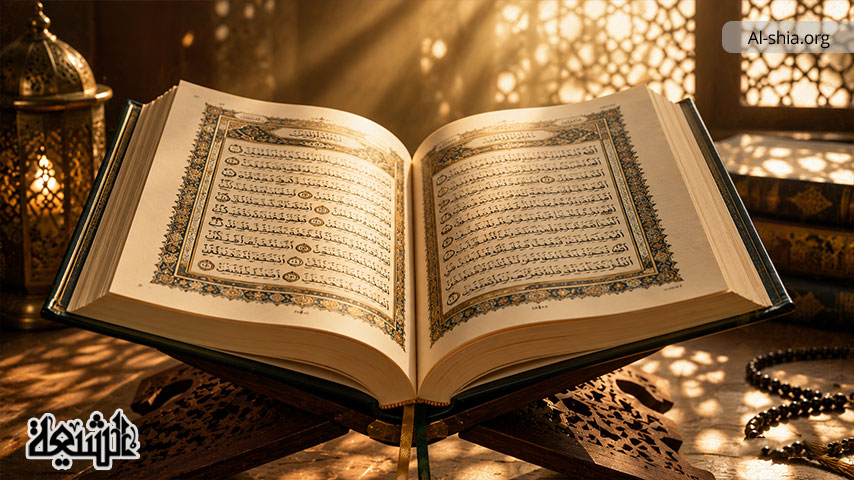

The Qur’an stands as the eternal miracle of Islam and the ultimate source of divine guidance for humanity. Yet, throughout Islamic intellectual history, a recurring theological debate has centered on its preservation: has the Holy Qur’an remained exactly as it was revealed, or has it been subject to alteration, omission, or distortion? Over time, Shi‘a Muslims in particular have been accused of holding the view that the Qur’an has been distorted or supplemented.
This article examines the Shi‘a stance on the alleged distortion of the Qur’an, clarifying the distinction between the preservation of the Qur’anic text itself and the interpretive and historical discussions surrounding its exegesis and transmission.
Understanding the Concept of Taḥrīf (Distortion)
To understand the Shia perspective on the Holy Qur’an, one must first navigate the precise theological definitions associated with the concept of distortion. The term Taḥrīf literally means inclining, bending, or altering something from its original direction. In relation to speech, it denotes changing words from their intended meaning or interpreting them in a manner different from their proper sense[1]. Applied to the Qur’an, the term refers to altering a word from its intended meaning. The Qur’an uses this term to describe the conduct of some among the Jews regarding the Torah: “they pervert words from their meanings” (Qur’an 5:13)[2].
In other words, the term Taḥrīf in relation to the Holy Qur’an can refer to several different concepts:
- Distortion of meaning through incorrect interpretation.
- Changing the order of words or chapters.
- Addition of material not revealed by God.
- Omission or deletion of revealed verses[3].
Preservation of the Qur’an
The preservation of the Holy Qur’an occupies a central place in Shi‘a theology. Twelver Shi‘a Muslims firmly believe that the Qur’an revealed to Prophet Muhammad (PBUHH) has been safeguarded from alteration, omission, and addition, and that the text available today is identical to the one received by the Prophet. This belief is founded upon explicit Qur’anic verses, the continuous mass transmission (Tawātur) of the Qur’an throughout Islamic history, and the statements of leading Shi‘a scholars who have consistently affirmed its authenticity and integrity. Consequently, the mainstream Shi‘a position rejects any claim of textual distortion (Taḥrīf) and regards the Holy Qur’an as the complete and preserved word of Allah.
The strongest proof cited by Shi‘a scholars against the possibility of textual distortion is the Qur’an itself. Allah states: “Indeed We have sent down the Reminder, and indeed We will preserve it.”[4]
Shi‘a scholars argue that this verse contains a divine guarantee of preservation. Since Allah Himself has undertaken the protection of His Book, it is impossible for the Holy Qur’an to be lost, corrupted, or altered in a manner that would compromise divine guidance. In other words, according to the Allah’s testimony and His pledge in this verse, no changes or distortions have occurred in the Holy Qur’an[5].
The Position of the Mainstream Shiʿi Scholars
The mainstream Shia doctrine, particularly within the Twelver (Ithna Ashari) school of thought, maintains an unwavering belief in the complete textual preservation of the Qur’an. This position asserts that the Holy Scripture currently in the hands of Muslims is identical to the version revealed to the Prophet Muhammad (PBUHH), containing neither deletions nor additions. This conviction is not merely a matter of tradition but is grounded in rigorous theological reasoning and the explicit teachings of the Infallible Imams (Ma’sumin).
Central to this doctrine is the Holy Qur’an’s self-declaration of divine protection. As noted in the previous section, Shia theology relies heavily on the verse: “Indeed We have sent down the Reminder, and indeed We will preserve it”[6]. According to the Allah’s testimony and His pledge in this verse, no changes or distortions have occurred in the Holy Qur’an. In addition to Allah’s pledge to the preservation of the Qur’an, Muslims have protected it from the beginning and have been earnest in its writing and preserving it[7].
Since the third century up to the present day, Shiʿi scholars have addressed the subject of the negation of Taḥrīf in their works across various disciplines. In books of doctrine, they discuss it whenever they mention beliefs concerning the Holy Qur’an. In books of hadith, they examine narrations that may give the impression of Taḥrīf by analyzing their chains of transmission and meanings[8].
Scholars argue that if God were to allow the text to be corrupted, His promise of guardianship would be rendered void. Furthermore, the doctrine of Isma (infallibility) extends to the preservation of the revelation. Since the Prophet Muhammad (PBUHH) and the Twelve Imams were divinely protected from error in conveying the message, their silence regarding a corrupted text serves as proof of its integrity[9]. Had the Qur’an been altered, the Imams would have been religiously obligated to restore the original version, as they were the ultimate guardians of the law.
Thus, contrary to popular misconceptions or wrong allegation against Shi‘a, many of the most influential early and contemporary Shi‘a scholars explicitly rejected textual distortion of the Qur’an. The following statements illustrate the views of several prominent early Shiʿi scholars regarding the preservation of the Holy Qur’an:
Shaykh Muḥammad ibn ʿAlī ibn Bābawayh al‑Qummī, known as al‑Ṣadūq (d. 381 AH), says: “Our belief is that the Qur’an which God revealed to His Prophet (peace be upon him and his family) is what lies between the two covers; it is what is in people’s hands. It is not more than that. The number of its surahs for the people is one hundred and fourteen. … And whoever attributes to us the belief that it is more than that is a liar.”[10]
Shaykh Abu Ja’far al-Ṭūsi, in the introduction to his Qur’anic commentary, writes: “As for the discussion concerning its addition and omission, it is also not appropriate in this context, for the addition of anything to the Qur’an is unanimously regarded as false. As for omission from it, the apparent view of the Muslims is likewise contrary to it, and this is the position most consistent with the sound view of our school.”[11]
According to Al-Faḍl ibn al-Hasan al-Ṭabarsi, known as Amīn al-Islām (d. 548 AH): “As for the discussion concerning the addition to and omission from the Qur’an, it is not appropriate to the subject of Qur’anic exegesis. Regarding addition, there is consensus on its falsehood. As for omission, a group of our companions and some of the literalists among the generality have narrated that there were alteration and omission in the Qur’an. However, the correct position of our companions is contrary to this view[12].
Meanwhile, modern Shiʿi scholars have consistently upheld the doctrine of the Holy Qur’an’s preservation and integrity. For instance, Allāmah Ṭabāṭabāʾī, the author of Tafsīr al-Mīzān argued that accepting reports of textual distortion would undermine the authority of Islam itself: “The clearest proof that the Qur’an we have with us today is the same that was revealed to the Prophet and that no alteration has taken place in its text is that very superiority which the Qur’an claimed for itself at the time of its revelation and which still exists.”[13]
In addition, the leading contemporary Shi‘a authorities, including Ayatollah al-Sistani and numerous other jurists, continue to affirm that the Qur’an is entirely preserved and free from textual corruption.
However, it is pertinent to mention that the controversy and misconception largely stems from certain narrations found in some early Shi‘a hadith collections that, at first glance, appear to suggest omissions or alterations in the Holy Qur’an. Similar narrations are also found in some Sunni hadith sources and have likewise been the subject of scholarly discussion and interpretation. Critics often cite such reports while overlooking the principles of hadith criticism employed by Muslim scholars.
In Shi‘a Islam, no hadith collection is considered entirely authentic; rather, every narration must be evaluated according to its chain of transmission, its conformity with the Holy Qur’an, and rational and theological principles. Consequently, reports that appear to indicate textual distortion have generally been rejected as weak, interpreted metaphorically, or understood as referring to distortion of meaning and interpretation rather than to alteration of the Qur’anic text itself.
Another misconception concerns the belief that Imam Ali (a.s.) possessed a different Qur’an. Shi‘a scholars explain that Imam Ali compiled a personal codex shortly after the Prophet’s death. However, this codex differed primarily in arrangement and included explanatory notes regarding revelation contexts and interpretation[14]. It was not a different Qur’an containing additional chapters or verses. The textual content remained the same revelation received by the Prophet Muhammad (PBUHH).
Conclusion
The mainstream Twelver Shi‘a position is unequivocal: the Holy Qur’an has not been textually altered, distorted, or corrupted. From early authorities such as Shaykh al-Ṣadūq, al-Mufīd, al-Murtaḍā, al-Ṭūsī, and al-Ṭabarsī to contemporary scholars such as Allāmah al-Ṭabāṭabāʾī and Ayatollah Ma‘rifat, the dominant Shi‘a view affirms that the Qur’an available today is the complete and authentic revelation sent by Allah to Prophet Muhammad (PBUHH). While isolated narrations and minority opinions have occasionally existed, they have never represented the accepted doctrine of Twelver Shi‘ism. The overwhelming scholarly consensus within Shi‘a Islam holds that the Qur’an remains preserved exactly as promised by Allah, serving as the eternal and unaltered guide for humanity.
Notes
[1] . Rāghib al-Iṣfahānī. (1991). Mufradāt Alfāẓ al-Qurʾān, p. 228.
[2] . Farāhīdī. (1988). Kitāb al-ʿAyn, vol. 3, p. 211; Azharī. (2002). Tahdhīb al-Lughah, vol. 5, p. 12.
[3] . Maʿrifat. (2011). Al-Tamhīd fī ‘Ulūm al-Qur’an, vol. 8, pp. 19-22.
[4] . Qur’an 15:9.
[5] . Faqih Imani. (1997). An Enlightening Commentary into the Holy Qur’an, vol. 8, p. 304.
[6] . Qur’an 15:9.
[7] . Faqih Imani. (1997). An Enlightening Commentary into the Light of the Holy Qur’an, vol. 8, p. 304.
[8] . al-Ḥusaynī al-Mīlānī. (2005). al-Taḥqīq fī Nafī al-Taḥrīf ʿan al-Qurʾān al-Sharīf, p. 15.
[9] . Ibn Ṭāwūs. (n.d). Sa‘d al-Su‘ūd lil-Nufūs Manḍūd p. 315.
[10] . Maʿrifat. (2011). Al-Tamhīd fī ‘Ulūm al-Qur’an, vol. 8, p. 56.
[11] . Ṭūsi. (n.d). al-Tibyān fī Tafsīr al-Qur’an, vol. 1, p. 3.
[12] . Ṭabarsi. (1993). Majma` al-Bayān fī Tafsīr al-Qur’an, vol. 1, p. 15.
[13] . Ṭabāṭabāʾī. (n.d). The Qur’an in Islam: Its Impact and Influence on the Life of Muslims, p. 101.
[14] . Shahristani. (1409 AH). Mafātīh al-Asrār, vol.1 p.15.
References
Holy Qur’an (with the English translation: Qarai, Ali Quli (2005). The Qur’an: With a Phrase-by-Phrase English Translation (2nd edition). London: Islamic College for Advanced Studies (ICAS) Press.
- Al-Azharī, Muḥammad ibn Aḥmad. (2000). Tahdhīb al-Lughah (1st edition). Beirut: Dār Iḥyāʾ al-Turāth al-ʿArabī.
- Al-Rāghib al-Iṣfahānī, al-Ḥusayn ibn Muḥammad. (1991). Mufradāt Alfāẓ al-Qurʾān (1st edition). Beirut: Dār al-Qalam.
- Faqih Imani, Sayyid Kamal et al (1997). An Enlightening Commentary into the Holy Qur’an (1st edition). Translated by Sayyid Abbas Sadr-‘Ameli. Isfahan: Iman Ali Library and Research Centre.
- Farāhīdī, Khalīl ibn Aḥmad. (1988). Kitāb al-ʿAyn (2nd edition). Qom: Hijrat Press
- Ibn Ṭāwūs, ‘Ali ibn Mūsa. (n.d). Sa‘d al-Su‘ūd lil-Nufūs Manḍūd (1st edition). Qom: Dar al-Zakhayir.
- Maʿrifat, Muḥammad Hādī. (2011). Al-Tamhīd fī ‘Ulūm al-Qur’an (3rd edition). Qom: Al-Tamhīd Institute.
- Sayyid ʿAli al-Ḥusaynī al-Mīlānī. (2005). al-Taḥqīq fī Nafī al-Taḥrīf ʿan al-Qurʾān al-Sharīf. Qom: Markaz al-Ḥaqā’iq al-Islamiyyah.
- Shahristānī, Muḥammad ibn ʿAbd al-Karīm. (1409 AH). Mafātīh al-Asrār wa Maṣābīh al-Abrār. Tehran: Markaz-i Intishārāt-i Nusakh-i Khaṭī.
- Ṭabarsi, Faḍl ibn al-Hasan. (1993). Majma` al-Bayān fī Tafsīr al-Qur’an (3rd edition). Tehran: Naser Khosrow.
- Ṭabāṭabāʾī, Muḥammad Ḥusayn. (n.d). The Qur’an in Islam: Its Impact and Influence on the Life of Muslims. India: World Islamic Network (WIN).
- Ṭūsi, Muḥammad ibn Ḥasan. (n.d). al-Tibyān fī Tafsīr al-Qur’an (1st edition). Beirut: Dar Ihya’ al-Turath al-‘Arabi.

![The Event of Ghadir and Imam al-Mahdi [afs]](https://en.al-shia.org/wp-content/uploads/2026/06/17221.jpg)