

The Sermon of Ghadir occupies a special place in Islamic thought, particularly within Twelver Shi‘i Islam, as a significant declaration concerning divine guidance, leadership, and the continuity of the Prophet Muhammad’s mission. Islam teaches that divine guidance is a mercy through which humanity learns to distinguish truth from falsehood, justice from oppression, and righteousness from wrongdoing. Within Twelver Shi‘i Islam, this understanding of divine guidance continues through the institution of Imamate, which provides a central framework for understanding the relationship between the Prophet Muhammad (PBUHH), Imam Ali ibn Abi Talib (a.s.), the subsequent Imams, and the awaited Imam al-Mahdi (may Allah hasten his reappearance).
The objective of this research is to examine the portrayal of Imam al-Mahdi (a.s.) in the Sermon of Ghadir and identify the theological, spiritual, and ethical lessons its descriptions convey to Muslims.
The Sermon of Ghadir: A Declaration of Guidance and Leadership
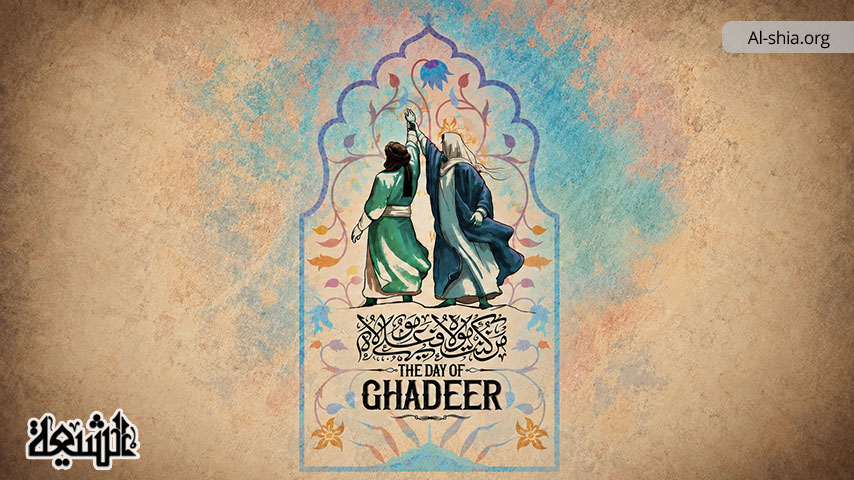
Ghadir Khumm is traditionally associated with the Prophet Muhammad’s return from his Farewell Pilgrimage. On 18 Dhu al-Hijjah, 10 AH, according to the Muslim historical sources, the Prophet (PBUHH) addressed the assembled Muslims at a location known as Ghadir Khumm.
The importance of the Sermon of Ghadir begins with the principle that the Prophet’s message was not merely an invitation to private belief. Islam also established a moral and religious community requiring guidance, knowledge, and responsible leadership. Muslims need the Qur’an, the Prophet’s example, sound understanding, and institutions that help preserve the integrity of religious teachings. The question of who should guide the community after the Prophet (PBUHH) therefore became one of the most consequential questions in Islamic history.
The event of Ghadir is connected to the Qur’an, which commands the Holy Prophet (PBUHH) to communicate what has been revealed to him[1], and announces the completion of religion and the completion of divine blessing[2]. Shi‘i scholars and some Sunni exegetical sources associate these verses with the event of Ghadir, although the circumstances of revelation and the precise relationship between the verses and the event are interpreted differently across scholarly traditions.
The Sermon of Ghadir publicly established Imam Ali’s wilayah, a term that encompasses guardianship, authority, and spiritual allegiance. The Prophet’s statement, “For whoever I am his mawla, Ali is his mawla,”[3] is understood within this tradition as an announcement of Imam Ali’s leadership rather than merely an expression of personal affection.
In essence, the core message of the sermon delivered by the Noble Prophet in Ghadir was the public declaration of Ali Ibn Abi Talib (a.s) as the guardian (Wali), the master (Mawla), the leader (Imam), and the commander (Amir) of all believing men and women, the deputy and the executor of his affairs (Wasi), and his successor (Khalifa)[4].
Yet the implications of the Sermon of Ghadir do not end with Imam Ali (a.s). The doctrine of Imamate connects the first Imam with the line of Imams from his descendants, culminating in Imam al-Mahdi.
Interestingly, on the same day the Noble Prophet (PBUHH) introduced the Commander of the Faithful through a divine inspiration as the divine leader of the Muslim Ummah immediately after him, he also took allegiance to the guardianship (Wilayah) and divine leadership of all the Infallible Imams from the audiences[5]. Thus, Ghadir becomes a starting point for reflecting on the continuity of guidance, the preservation of religious knowledge, and the hope for a world in which justice prevails.
Imam al-Mahdi (ajfs) in the Sermon of Ghadir
The Sermon of Ghadir is a foundational text in Islamic theology, establishing not only the Prophet’s succession but also the essential characteristics of the ultimate custodian of divine guidance. In this profound discourse, the Holy Prophet (PBUHH) outlines the attributes of the Twelfth Imam, Imam al-Mahdi (ajfs), portraying him as more than a political leader.
1. Imam al-Mahdi: The Chosen One of God
Among the characteristics of Imam al-Mahdi discussed in the Sermon of Ghadir is “the Chosen one of God” (Khiyaratullah and Mukhtaruhu)[6]. This description establishes divine selection as the source of the Imam’s religious authority.
This distinction is critical as it negates the notion that divine leadership is a socio-political construct acquired through human consensus. Instead, it posits that the Imam is an entity chosen by the Divine Will prior to his creation[7].
For general Muslim audiences, this characteristic invites reflection on the difference between outward power and moral authority. The belief that Allah chooses His guides reminds believers that worldly status is not the ultimate measure of human worth.
The description of Imam al-Mahdi as the chosen one must also be understood within the theological boundaries of Islamic monotheism. In Twelver Shi‘i belief, the Imam’s authority is granted by Allah; he is not an independent deity or a partner with God. Divine selection signifies responsibility and service under God’s authority, not independence from the Creator.
Thus, the Sermon of Ghadir encourages believers to look beyond the outward appearance of leadership and to consider the relationship between authority, moral excellence, and accountability before Allah.
2. Imam al-Mahdi: The Inheritor of Knowledge
Another significant characteristic of Imam al-Mahdi discussed in the Sermon of Ghadir is his description as Wārith al-ʿilm, or the inheritor of knowledge[8]. The study interprets this inheritance as the transmission of the Prophet’s religious knowledge through the Imams of the Ahl al-Bayt.
Within the framework of the Sermon of Ghadir, Imam al-Mahdi’s inheritance of knowledge signifies the continuity of prophetic guidance after the end of Prophethood. In Twelver Shi‘i theology, the Imams preserve and explain the religious guidance brought by the final Prophet. Imam al-Mahdi’s position as the last Imam represents the culmination of this understanding.
3. Imam al-Mahdi: The Last Proof
In another section of the Sermon of Ghadir, Imam Mahdi (a.s) is described as Remaining Proof[9]. The title Baqi Hujjat (Remaining Proof) emphasizes the perpetuity of divine guidance.
The expression “there is no Hujjah after him” signifies the finality of the Imamate and establishes Imam al-Mahdi (ajf) as the ultimate Divine Proof over creation. During his occultation (Ghaybah), he remains the enduring Hujjah of God, while his reappearance will make his authority manifest. This affirms the completeness and sufficiency of the Imam’s guidance until the end of time, excluding the legitimacy of any subsequent claim to divinely appointed authority.
4. Imam al-Mahdi: The Trustee of God
In the Sermon of Ghadir, Imam al-Mahdi is described by the Prophet (PBUHH) as Amīn, The Trustee of God[10]. In relation to the Imam, this attribute signifies his role as the custodian of the Divine Mysteries (Asrar al-Ilahiyyah).
The description of Imam al-Mahdi as a trustee also emphasizes trustworthiness. A trustee is entrusted with a responsibility that must not be abused. This characteristic offers an important lesson for everyday life: Muslims should strive to become trustworthy in their words, relationships, employment, financial dealings, and public responsibilities.
In this way, the Sermon of Ghadir encourages both confidence in divine guidance and care in determining what genuinely represents it.
5. Imam al-Mahdi: The Supporter of Religion
In the historical Sermon of Ghadir, Imam al-Mahdi is referred to Nāṣir, the supporter or helper of the religion of Allah[11]. This characteristic presents the awaited Imam as one whose mission is connected with preserving the truth of religion and making its guidance effective in human society.
Religion can be weakened when its teachings are misrepresented, when people exploit religious authority for personal gain, or when believers separate religious language from ethical behaviour. The Sermon of Ghadir, as interpreted in the supplied study, presents Imam al-Mahdi’s mission as the restoration and strengthening of divine guidance.
6. Imam al-Mahdi: The Administrator of Justice
Justice is among the most important themes associated with Imam al-Mahdi. He is identified as a divine ruler and administrator of justice, whose mission culminates in the defeat of oppression and the establishment of a just order[12]. This characteristic is central to understanding why the belief in his reappearance remains a source of hope for many Muslims.
The Qur’an repeatedly commands justice. Allah says: “Indeed Allah commands justice and kindness.”[13] This verse offers a comprehensive overview of Islamic teachings on social issues, humanitarian concerns, and ethical matters. It begins by emphasizing that Allah commands all people to uphold justice[14].
Within Twelver Shi‘i eschatology, Imam al-Mahdi’s reappearance is associated with the restoration of justice after widespread oppression. This hope does not mean that believers should ignore present injustice or wait passively for a future transformation. On the contrary, the expectation of a just future should strengthen their commitment to justice in the present.
The Sermon of Ghadir therefore directs attention towards a society in which authority serves truth, knowledge serves humanity, and justice protects the dignity and rights of people.
7. Imam al-Mahdi: The Rightly Guided and Ultimately Victorious
In this historical Sermon of Ghadir, The Holy Prophet (PBUHH) introduced the Twelfth Imam as Rashīd and Sadīd, meaning rightly guided and steadfast, and presents him as the ultimate victor in his divinely appointed mission[15]. These descriptions communicate confidence that divine guidance will not ultimately be defeated by oppression or falsehood.
The Sermon of Ghadir inspires believers to await this fulfilment with hope and responsibility, striving to uphold truth, justice, and righteousness while preparing for the promised victory of Imam al-Mahdi (ajfs).
Practical Lessons Muslims Can Learn from the Sermon of Ghadir
The theological characteristics discussed above become most meaningful when translated into practical guidance. The Sermon of Ghadir can be approached as a source of reflection on how Muslims should understand faith, knowledge, allegiance, justice, and hope.
- Strengthen Our Relationship with the Qur’an: The first lesson is the importance of remaining connected to the Qur’an. The Sermon of Ghadir is understood in relation to the completion of the Prophet’s mission and the continuity of guidance. The Qur’an remains the central revealed source through which Muslims learn about Allah, worship, moral responsibility, and the purpose of human life. Therefore, believers should make regular Qur’anic reading part of their lives.
- Learn About the Ahl al-Bayt and Their Teachings: The second lesson is the importance of studying the lives and teachings of the Ahl al-Bayt. The Sermon of Ghadir places Imam Ali at the centre of its declaration, while the doctrine of Imamate connects him to the subsequent Imams. Learning about these figures should include their knowledge, worship, courage, humility, generosity, and concern for justice. Their lives should not be reduced to historical names or occasions for celebration. They provide moral examples through which Muslims can reflect on their own conduct.
- Make Justice a Daily Commitment: The third lesson is that allegiance to divine guidance should be reflected in justice. The Sermon of Ghadir, when considered alongside the mission attributed to Imam al-Mahdi, calls attention to the relationship between legitimate authority and the protection of people’s rights. Justice begins in ordinary circumstances. It means refusing to cheat in examinations, avoiding fraud in business, respecting agreements, giving people their due, and not allowing anger or personal preference to determine how others are treated.
- Promote Unity, Respect, and Good Character: The fourth lesson is the importance of good character and responsible relations among Muslims. The history and interpretation of the event of Ghadir Khumm have been subjects of disagreement between Sunni and Shi‘i scholars. Yet disagreement does not remove the obligation to speak truthfully, avoid insults, and treat others with dignity. Unity does not require pretending that theological differences do not exist. It requires handling those differences responsibly and refusing to turn them into excuses for injustice or hostility. The Sermon of Ghadir therefore challenges Muslims to combine conviction with humility, religious commitment with good character, and devotion with service to humanity.
Living the Message of Ghadir During the Occultation
The Sermon of Ghadir, understood through the doctrine of continuing Imamate, encourages believers to remain committed to divine guidance. Occultation does not remove the responsibility to worship Allah, seek knowledge, uphold justice, and fulfil the rights of others.
A Muslim who awaits Imam al-Mahdi should cultivate sincerity in worship, honesty in dealings, patience in difficulty, and compassion towards those in need. Families can nurture these values by teaching children about the Qur’an and the Ahl al-Bayt. Educators can promote knowledge and critical thinking.
The Sermon of Ghadir also reminds believers that religious commitment must extend beyond words. Expressing love for Imam Ali and Imam al-Mahdi is meaningful when that love encourages better conduct. Celebrating Ghadir should inspire reflection on the responsibilities associated with allegiance to divine guidance.
Ultimately, awaiting Imam al-Mahdi is not an excuse to withdraw from society. It is an invitation to participate in building a more just, compassionate, and truthful community. Through prayer, knowledge, good character, and service, believers can make their commitment to the message of Ghadir visible in everyday life.
Conclusion
The Sermon of Ghadir occupies a central position in Twelver Shi‘i understanding of divine guidance and Imamate. Its declaration concerning Imam Ali is understood as the foundation of a continuing line of leadership that culminates in Imam al-Mahdi, the awaited Imam whose mission is associated with the establishment of justice.
The Sermon of Ghadir identifies numerous characteristics of Imam al-Mahdi, including his divine selection, inheritance of knowledge, status as the proof of Allah, support for religion, and role in administering justice. Considered together, these characteristics present a vision of leadership in which knowledge, authority, moral integrity, and justice are inseparable.
For the Muslims, the message of the Sermon of Ghadir extends beyond historical remembrance. It calls for deeper engagement with the Qur’an, learning from the Ahl al-Bayt, protecting the rights of others, cultivating good character, and preparing responsibly for a more just future.
The Sermon of Ghadir should therefore inspire both reflection and action. Its enduring lesson is that faith in divine guidance carries moral responsibilities. Those who await Imam al-Mahdi should strive to embody the justice, truthfulness, compassion, and integrity associated with his mission.
May Allah strengthen our faith, unite our hearts upon truth, guide us towards righteous action, and hasten the reappearance of Imam al-Mahdi. Amin.
Notes:
[1] . Qur’an 5:67. See: Ibn Kathīr, Tafsīr al-Qur’an al-Azīm, vol. 4, p. 1172; Fakhr Rāzī, Tafsīr al-Kabīr, vol. 12, p. 401; Suyūṭī, Al-Dur al-Manthūr, vol. 2, p. 298.
[2] . Qur’an 5:3. See: Khaṭīb Baghdadi, Tārikh Baghdad, vol. 8, p. 290; Ibn ‘Asākir, Tārikh Damashq, vol. 42, p. 233.
[3] . Kulayni, Al-Kāfī, vol. 1, p. 295; Majlisi, Biḥār al-Anwār, vol. 31, p. 411; Ḥākim Ḥaskāni, Shawā’id al-Tanzīl, vol. 1, p. 201.
[4] . Majd, The Sermon of Prophet Muhammad (PBUH&HF) at Ghadir Khum, p. 3
[5] . Farajpur, Dars Goftārhā-e Tavvajuh bih Imam-I Zamān, p. 11
[6] . Ibn Ṭāwūs, al-Yaqīn fī Ikhtiṣāṣ Mawlānā Ali (a.s), p. 357.
[7] . Majlisi, Biḥār al-Anwār, vol. 26, p. 259.
[8] . Ibn Ṭāwūs, al-Yaqīn fī Ikhtiṣāṣ Mawlānā Ali (a.s), p. 357.
[9] . Tabarsi, Al-Ihtijaj, vol. 1, p. 64.
[10] . Ibid.
[11] . Ibn Tawus, al-Yaqīn fī Ikhtiṣāṣ Mawlānā Ali (a.s), p. 357.
[12] . Tabarsi, Al-Ihtijaj, vol. 1, p. 64.
[13] . Qur’an 16:90.
[14] . Faqih Imani, An Enlightening Commentary into the Light of the Holy Qur’an vol. 8, p. 552.
[15] . Tabarsi, Al-Ihtijaj, vol. 1, p. 64.
References
- Fakhr Rāzī. (1985). Tafsīr al-Kabīr. Beirut: Dār al-Fikr.
- Faqih Imani, Sayyid Kamal et al. (1997). An Enlightening Commentary into the Holy Qur’an. 1st edition. Translator: Sayyid Abbas Sadr-‘Ameli. Isfahan: Iman Ali Library and Research Centre.
- Farajpur, Ḥāmid. (2025). Dars Goftārhā-e Tavvajuh bih Imam-i Zamān. 1st edition. Qom: Maw‘ūd Thaqalayn Institute.
- Ḥākim Ḥaskāni, Ubaidullah ibn Abdullah. (1990). Shawā’id al-Tanzīl Li-Qawā’id al-Tafḍīl fī al-Ᾱyāt al-Nāzilat Fī Ahl al-Bayt. 1st edition. Tehran: Ministry of Culture and Islamic Guidance Publishing House.
- Ibn Asakir, Hibatullah, Ali Ibn Hasan. (1415 AH). Tārikh Damashq. 1st edition. Beirut: Dar al-Fikr.
- Ibn Kathīr Damashqi, Ismā’īl. (1987). Tafsīr al-Qur’an al-Azīm. Beirut: Dār al-Ma’rifah.
- Ibn Ṭāwūs, Ali ibn Musa. (1992). al-Yaqīn fī Ikhtiṣāṣ Mawlānā Ali (a.s) bi Imrati al-Mu’minīn. 1st edition. Qom: Dar al-Kitab Institute.
- Khaṭīb Baghdadi, Ahmad Ibn Ali. (1417 AH). Tārikh Baghdad or Madinat al-Salaam. 1st edition. Beirut: Dar al-Kutub al-‘Ilmiyah.
- Kulayni, Muhammad ibn Ya‘qūb. (1986). Al-Kāfī. 4th edition. Tehran: Dar al-Kutub al-Islamiyyah.
- Majd, Vahid. (2005). The Sermon of Prophet Muhammad (PBUH&HF) at Ghadir Khum. Tehran: Naba Cultural Organization.
- Majlisi, Muhammad Baqir ibn Muhammad Taqi. (1982). Biḥār al-Anwār. 2nd edition. Beirut: Dar Ihya al-Turath al-Arabi.
- Suyūti, Jalāl al-Din. (1993). Al-Dur al-Manthūr Fī al-Tafsīr al-Mathur. Beirut: Dār al-Fikr.
- Ṭabarsi, Aḥmad ibn Ali. (1982). al-Ihtijaj `ala Ahl al-Lujaj. 1st edition. Mashhad: Murtaza Press.