
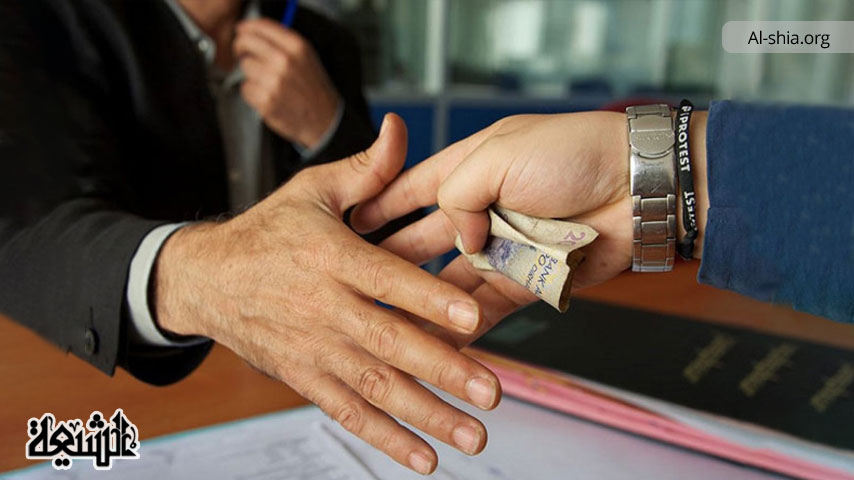

The official website of Ayatollah Sistani has published several questions addressed to him regarding giving bribes, along with his responses, as follows:
- Question: What is the ruling on giving a bribe?
Answer: Bribery is forbidden (Haram). - Question: If a teacher takes money in order to give a passing grade to a student who has not obtained sufficient marks, what is the ruling on this money?
Answer: It is not permissible. - Question: What is the ruling on giving a bribe in cases where obtaining one’s rightful due depends on paying it?
Answer: From a religious (shari) perspective, bribery specifically applies to the realm of judicial rulings, and both giving and taking it are forbidden. However, outside the context of judicial judgment, giving money in order to obtain one’s rightful due is permissible, although taking it on the part of the other person, who is obligated to deliver that right, is forbidden. - Question: In general, under what conditions is giving a bribe permissible in government offices?
Answer: If the duty of the authorities is to carry out a person’s legitimate work, but they do not do so without receiving money, then paying money in order to obtain one’s rightful due is permissible, even though receiving it is forbidden for that person. - Question: What is the ruling if reaching one’s right is not dependent on giving a bribe, but the payment merely speeds up the process? And what if it is paid under the title of charity or a gift?
Answer: If the objective is legitimate and it does not lead to the violation of anyone else’s rights, there is no problem with it, and the same ruling applies under other such titles.
In light of this new istifta (religious inquiry) regarding giving bribes, a conditional payment of money is not considered an instance of bribery and is not forbidden, provided that two conditions are met:
- The payment is made in order to obtain one’s rightful due; that is, the person making the payment is genuinely entitled to that right and has committed no negligence or wrongdoing.
- The payment does not result in the violation of anyone else’s rights.
Instances of Bribery
Based on the points mentioned above, even if the person paying the money is entitled to the right, if the payment leads to the violation of the rights of another individual or individuals, whether those rights are minor or major, and whether they are personal, social, financial, bodily, or otherwise, then it is considered bribery and is forbidden.
Otherwise, there is no problem with making such a payment, and it is not regarded as bribery. Therefore, another important criterion in determining whether bribery has occurred or not is whether the rights of others have been violated.
The Ruling on the Recipient of the Money
An important point that must be noted in this istifta is that even when the above two conditions are met, meaning that the person paying the money has not committed a forbidden act or bribery and has paid the amount solely to obtain their legitimate right (without violating the rights of others). The person who receives the money has committed a forbidden act. The money obtained in this way is considered illicit wealth and an instance of accepting bribes.
It is evident that the recipient of the money is required to perform their duties and responsibilities as part of their job, and they are not permitted to receive any additional payment in exchange for work or duties that are already assigned to them.
For this reason, followers (Muqallids) should be aware that in determining whether bribery has occurred, the act of paying and the act of receiving money may be subject to two different rulings, each based on its own distinct juristic criteria and evidence.
People’s Rights and Their Importance
Based on the criterion mentioned in the above questions regarding the violation of others’ rights in the context of bribery, it should be stated that the necessity of observing the rights of others and avoiding their infringement is among the issues that have received special emphasis in Islam and in the words and conduct of religious leaders.
Under the title of people’s rights (Haqq al-Nas), numerous recommendations and warnings have been given concerning their observance. In what follows, after a brief definition and explanation of rights and people’s rights, some examples are mentioned:
People’s rights refer to matters that belong specifically to a particular person or group, such as the rights that individuals have over their property, lives, and honor, whether their own or those of others.
People’s rights encompass a wide range that includes not only material rights but also the moral and spiritual rights of individuals. From the Islamic perspective, any violation of these rights is considered an infringement of people’s rights.
Unfortunately, it is often observed that some individuals, even those who are aware of the prohibition of violating others’ rights and generally observe it, are negligent when it comes to minor or seemingly insignificant rights and pass over them with indifference, despite being obligated to respect them.
Believers must pay attention to the fact that God’s reckoning on the Day of Resurrection is not based on measures such as kilograms or tons, but rather on a mustard seed and even a Particle.
That is, if a person violates another’s right to the extent of a mustard seed, or even a particle, God will bring it forth and account for it on the Day of Judgment. God says in the Holy Quran:
إِنْ تَكُ مِثْقَالَ حَبَّةٍ مِنْ خَرْدَلٍ فَتَكُنْ فِي صَخْرَةٍ أَوْ فِي السَّمَاوَاتِ أَوْ فِي الْأَرْضِ يَأْتِ بِهَا اللَّهُ
“Even if it should be the weight of a mustard seed, and [even though] it should be in a rock, or in the heavens, or in the earth, Allah will produce it”.[1]
That is, if a good or evil deed is as heavy as a mustard seed, even if it is hidden within a rock, or anywhere in the heavens or the earth, God will present it for reckoning on the Day of Judgment.
Mustard is a plant with very small black seeds, to the extent that it has become proverbial for smallness;[2] whenever people wish to emphasize how tiny something is, they give the example of a mustard seed. In another verse, the Quran uses an example even smaller than a mustard seed and states:
فَمَنْ يَعْمَلْ مِثْقَالَ ذَرَّةٍ خَيْرًا يَرَهُ وَمَنْ يَعْمَلْ مِثْقَالَ ذَرَّةٍ شَرًّا يَرَهُ
“So whoever does an atom’s weight of good will see it, and whoever does an atom’s weight of evil will see it”.[3]
Therefore, no rational person doubts the necessity of observing the rights of others. Undoubtedly, respecting people’s rights in all fields, in a general and comprehensive manner, is one of the fundamental principles of Islamic law, and it has been emphasized in the words of Islamic leaders with eloquent and profound expressions.
The greatness and importance of observing people’s rights are such that, in the words of Amir al-Muminin Ali (AS), they are even given precedence over the rights of God and are considered prior to them: “Indeed, God, the Glorified, has made the rights of His servants a precondition for His own rights; so whoever upholds the rights of God’s servants, that will lead him to upholding the rights of God”.[4]
The Consequences of Violating Others’ Rights
Just as Islam strongly insists on observing rights, it severely condemns ignoring people’s rights and infringing upon them, describing such actions with striking terms and considering them among the gravest forms of injustice. This is because injustice to oneself or neglect of God’s rights can, in many cases, be forgiven through repentance and seeking forgiveness.
However, the sin of injustice toward others cannot be erased merely by seeking forgiveness; in addition to repentance, one must also obtain the satisfaction of the rightful owner. The Noble Prophet (PBUHH) says: “God bestows His favor upon the people of Arafat and boasts of them before the angels, saying: O My angels! Look at My servants who have come to Me disheveled and dust-covered from every distant path. I call you to witness that I have answered their supplications, accepted their intercessions, forgiven their sinners for the sake of their righteous ones, and granted the righteous whatever they asked, except for the rights they owe one another”.[5]
Arafat is a vast, uninhabited plain south of the city of Mecca in Saudi Arabia, where Muslims gather during the rites of the Hajj pilgrimage. The greatness of Arafat and God’s mercy upon His servants on that day are so immense that they are incomparable to any other time or place.
Some narrations even state that if God does not forgive a person’s sins in the month of Ramadan or on the Night of Decree, which is better than a thousand months, He will not forgive them until the following year and another Night of Decree, unless that person is present at Arafat.
In one narration, among the greatest sins on that day is despairing of God’s mercy and forgiveness;[6] yet despite the greatness of this land and the status of its people before God, He will still not overlook the sin of violating people’s rights in that place.
Likewise, Amir al-Muminin Ali (AS) states: “Be aware! Injustice is of three kinds: an injustice that will never be forgiven; an injustice that will not go unpunished; and an injustice that is forgiven and not questioned about.
- As for the injustice that will never be forgiven, it is associating partners with God. God Almighty says: Indeed Allah does not forgive that partners should be ascribed to Him. God never forgives associating partners with Him (and will not pardon those who set up equals with Him);
- As for the injustice that is forgiven, it is the injustice a servant commits against himself through minor sins;
- And as for the injustice that will not go unpunished, it is the injustice of servants against one another, for which retribution will be severe”.[8]
These recommendations and warnings are given because observing people’s rights has a direct connection with many religious rulings. If a person fails to observe them, they have, in reality, disregarded religious principles. For this reason, Imam Sadiq (AS) says: “Whoever honors the religion of God will also honor the rights of his brothers; and whoever belittles the religion of God will give no importance to his brothers”.[9]
A Remarkable Story About Observing the Rights of Others
If we take a look at the lives and conduct of great scholars, we see that they were extremely meticulous in observing the rights of others, even when those rights were small or seemingly insignificant, and they fully adhered to them. It is narrated about the late Muqaddas Ardabili, who was one of the great scholars and well known for his piety and God-consciousness, that:
“Muqaddas Ardabili would frequently travel from Najaf al-Ashraf to Kazimayn for the purpose of pilgrimage. On these journeys, he would rent a donkey or a mule, ride it, and reach Kazimayn.
On one of these trips, when he intended to depart from Kazimayn toward Najaf, a man from Baghdad handed him a letter (along with a small package) to deliver to someone in Najaf. He took the letter, dismounted from the animal, and continued the journey on foot. When he was asked about the reason for this, he replied: I did not seek permission from the owner of the animal to ride it while carrying the additional weight of this letter”.[10]
In light of the points discussed, it becomes clear that in the issue of bribery, observing the rights of others holds such an important position in Islam that failing to observe them is considered an instance of forbidden bribery.
Conclusion
Giving bribes is considered one of the major sins in Islam. Therefore, it is necessary for Muslims to be fully aware of the rulings and details related to this issue so that they do not fall into this sin and divine disobedience.
In a recent istifta addressed to Ayatollah Sistani regarding bribery, he stated that outside judicial matters, where it is absolutely impermissible, paying money or giving a gift is not considered bribery provided that two conditions are met:
first, that the person making the payment is truly entitled to the right, and second, that the rights of no one else are violated. However, in all cases, it is considered bribery for the recipient, and it is certainly forbidden.
Notes
[1] . Luqman:16.
[2] . Makarim Shirazi, Tafsir Namuneh, vol.17, p.51.
[3] . Al-Zalzalah:7–8.
[4] . Amadi, Gharar al-Hikam, vol.1, p.283.
[5] . Majlisi, Bihar al-Anwar, vol.72, p.243.
[6] . Mirza Nuri, Mustadrak al-Wasail, vol.10, p.30.
[7] . Al-Nisa:48.
[8] . Sharif al-Rida, Nahj al-Balagha, Sermon 176.
[9] . Tusi, Al-Amali, vol.1, p.210.
[10] . Eshtahrdi, Sargozasht-ha-ye Ibrat Angiz, Story of Muqaddas Ardabili.
References
- The Holy Quran.
- Amadi, Abd al-Wahid ibn Muhammad. Gharar al-Hikam wa Durar al-Kalim. Translated by Sayyid Hashim Rasuli Mahallati. Tehran: Daftar Nashr Farhang Islami.
- Majlisi, Muhammad Baqir. Bihar al-Anwar al-Jami li Durar Akhbar al-Aimma al-Athar (AS). Beirut: Dar Ahya al-Turath al-Arabi.
- Makarim Shirazi, Naser. Tafsir Namuneh. Tehran: Dar al-Kutub al-Islamiyyah Publications.
- Mirza Nuri, Hussain ibn Muhammad Taqi. Mustadrak al-Wasail. Qom: Al al-Bayt (AS) Institute; First Edition, 1408 AH.
- Muhammadi Eshtahrdi, Muhammad. Sargozasht-ha-ye Ibrat Angiz [Stories of Moral Lessons]. Qom: Rouhani Publications; Second Edition, 1378 SH.
- Sharif al-Radi. Nahj al-Balagha. Arranged by Subhi al-Salih. Qom: Dar al-Hijra, 1414 AH.
- Tusi, Muhammad ibn Hasan. Al-Amali. Translated by Sadiq Hasan Zadeh. Qom: Andisheh Hadi Publications; First Edition, 1388 SH.
Source of the article | Adapted from: Sadeqi-Fadaki, Sayyid Jafar. The Image of Shiism from the Perspective of the Ahl al-Bayt (AS), Qom, World Assembly for Shia Studies, 1386 SH. pp. 313–318.

![The Event of Ghadir and Imam al-Mahdi [afs]](https://en.al-shia.org/wp-content/uploads/2026/06/17221.jpg)