

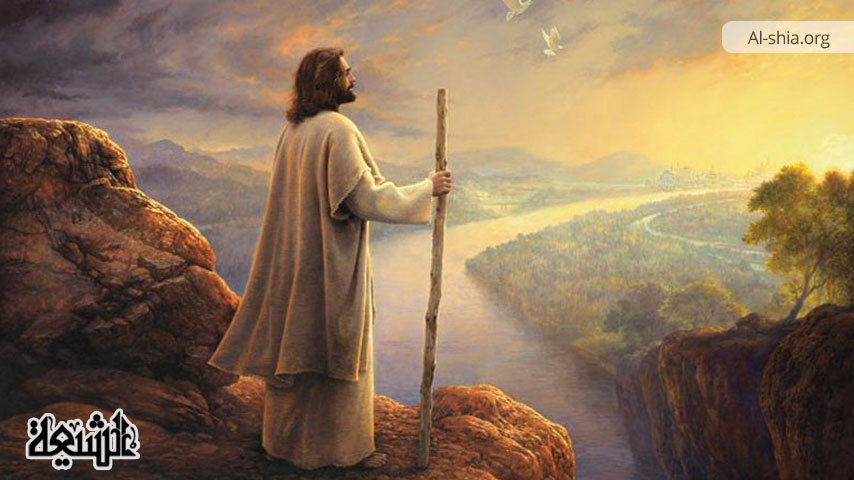

Prophet Jesus (AS) and Imam Ali (AS) share certain spiritual and ethical characteristics, some of which are mentioned in this article with reference to Sermon 160 of Nahj al-Balagha. In this sermon, the asceticism of Jesus (AS) and Imam Ali (AS), and especially their view of the world and its qualities, are examined with precision.
Knowledge of God and explaining the models of simple living and asceticism among God’s prophets is the main theme of this sermon. It also refers to the ascetic lives of several divine prophets such as the Prophet Muhammad (PBUHH), Prophet David, Prophet Moses, and Prophet Jesus (AS).
The Description of Prophet Jesus (AS) in Sermon 160 of Nahj al-Balagha
The ethical and spiritual qualities of Prophet Jesus (AS) are clearly visible in Nahj al-Balagha, especially in Sermon 160. Sermon 160 is a historical, theological, and ethical address, and in part of it, the characteristics of the Prophet of Islam, Muhammad al-Mustafa (PBUHH), Prophet Moses, Prophet David, and Prophet Jesus (AS) are examined.
In the fourth section of this sermon, the Imam uses the tool of historia,[1] or in other words, the exemplary representation of legendary figures and great personalities. He presents the divine prophets as models and guides who are complete and sufficient for humanity.
Because of his asceticism, piety, and steadfastness on the divine path, Prophet Jesus (AS) is introduced in Sermon 160 as an exemplary figure among the prophets.
Imam Ali (AS) states in Sermon 160: “If you wish, I will tell you of another example of detachment, regarding Jesus (AS): His pillow was a stone; he wore coarse, rough clothing; and he ate dry bread. His food was hunger, the lamp of his night was the moon, and his winter shelter was the east and west of the earth (he would sit in the sun in the mornings toward the west and in the afternoons toward the east).[2] The fruits and flowers he enjoyed were those that grew for animals from the earth. He had no wife to occupy him, no child to grieve him, no wealth to draw his attention, and no greed to humiliate him. His mount was his two feet, and his servant was his two hands”.
The Asceticism of Prophet Jesus (AS) in the Narrations
In a narration from Prophet Jesus (AS), a similar meaning is conveyed with the addition of this statement: “I possess nothing of the riches of this world, yet no one on the face of the earth is more free of want than I am”.[3]
Imam Sadiq (AS) also said: “In the Gospel it is written that Jesus (AS) said to God: ‘O Lord! Grant me a loaf of barley bread in the morning and another in the evening, and give me no more, lest I rebel”.[4]
Comparing the Asceticism of Imam Ali (AS) and Prophet Jesus (AS)
From the account of the ascetic life of the blessed Jesus (AS) in Sermon 160, and through the luminous words of the Imam (AS), we understand that Prophet Jesus (AS) held a lofty rank in asceticism and piety.
Nevertheless, in one narration, the Messenger of God (PBUHH) describes Imam Ali (AS) as possessing the complete set of spiritual qualities found among the prophets and says regarding Imam Ali’s (AS) asceticism: “Whoever wishes to look at Adam and his knowledge, Noah and his piety, Abraham and his foresight, his patience, Moses and his awe, and Jesus and his worship, should look at Ali ibn Abi Talib (AS)”.[5]
It is clear that the Imam Ali (AS), embodies a comprehensive integration of varied spiritual excellences, uniting within his character the virtues manifested across the prophetic tradition. Especially in asceticism and worship, he shares notable similarities with Prophet Jesus (AS).
The World in the View of Imam Ali (AS) and Prophet Jesus (AS)
Through examining the sayings and teachings of Jesus (AS), we find that the world and all its attachments, wealth, status, property, homes, and more, held no value in his eyes.
Prophet Jesus (AS) and the Imam Ali (AS) regarded the world and its attachments like an old woman who displays herself in the most beautiful and perfect form to those engrossed in worldly desires. In the sayings of Jesus (AS) it is related: “I saw the world as an old woman whose teeth had fallen out, yet she had adorned herself with jewelry. She was asked: How many husbands have you taken? She replied: They cannot be counted. They asked: Did your husbands die, or did they divorce you? She said: I killed them all. They said: Woe to the rest of your future husbands who do not take heed from the fate of your past ones and are not wary of you!”.[6]
The Imam Ali (AS), in his nightly supplications, whispered words similar to those of Prophet Jesus (AS) and said: “O world! O world! Get away from me. Do you display yourself to me, or are you infatuated with me so that one day you might enter my heart? Never … Tempt someone other than me, for I have no need of you whatsoever. I have divorced you three times, so there is no return. Your life is short, your worth is little, and your hope is base. Ah, for the smallness of provision, the length of the journey, the distance of the destination, and the greatness of the Day of Resurrection”.[7]
These two luminous passages, filled with divine knowledge and attention toward the higher realm, clearly show how Prophet Jesus (AS) viewed the world and how he behaved toward it. From this, it becomes evident that when Imam Ali (AS) says of Prophet Jesus (AS): “His pillow was a stone, he wore coarse and rough clothing, and he ate dry bread,” such detachment from the world has no cause other than genuine faith in God and a gaze fixed upon the higher realm. His renunciation of the world stemmed from the richness of his soul through divine knowledge, not from poverty.
Evidence of These Similarities in a Prophetic Narration
The similarities between Imam Ali (AS) and Jesus (AS) are fully clarified through this narration from the Prophet of Islam (PBUHH). He said: “O Ali! Your likeness among my community is that of Jesus son of Mary. The people were divided into three groups concerning him: a group remained faithful, these were the disciples; a group were his enemies, these were the Jews; and a group exaggerated about him, and as a result abandoned faith. My community will soon be divided into three groups concerning you as well: one group will be your Shia and followers, these are the believers; one group will be your enemies, these are the doubters; and one group will exaggerate concerning you, these are the deniers [of God]. O Ali! You and your followers and the lovers of your followers will be in Paradise, and your enemies and those who exaggerate about you will be in the Fire”.[8]
Evidence of These Similarities in the Verses of the Quran
In the blessed Surah al-Nisa (Quran 4), there is a verse that also refers to a similarity between Jesus (AS) and Imam Ali (AS). In this noble verse, God says: “There is none among the People of the Book but will surely believe in him before his death; and on the Day of Resurrection, he will be a witness against them”.[9]
By studying the narrations, we find that this verse refers to the fact that the People of the Book will believe in Jesus (AS) at the time of their death. It should be noted that this word of God in the Quran refers to the confirmation of Jesus (AS), not his vision; however, this point about the similarity of the visions of Jesus and Ali (AS) can be obtained from narrations.
For example, in the Tafsir Sharif of Furat al-Kufi, under this verse, which apparently speaks of Jesus (AS), it is narrated that the Prophet of Islam (PBUHH) said to Imam Ali (AS): “O Ali! Just as those who denied Jesus (AS) come to believe in him at the moment of death upon seeing him, though such belief brings them no benefit, so too are you like him: your enemy will behold you before his death”.[10]
Conclusion
In a section of Sermon 160, Imam Ali (AS) refers to the asceticism of Prophet Jesus (AS) in order to introduce a proper model for the people. He presents Jesus (AS) as one who was indifferent to the world and its various outward forms. Prophet Jesus (AS) saw the world and its appearances in his eyes as an old woman who had no attractive features, just as the Imam Ali (AS), in his many sayings, described the world and its outward forms as blameworthy and of no real worth to him.
A narration from the Messenger of God (PBUHH) also states that the similarities between Prophet Jesus (AS) and Imam Ali (AS) extend to their friends, enemies, and to those who exaggerate about them.
Notes
[1] . Historia.
[2] . Subhi Salih, Nahj al-Balagha, Sermon 160.
[3] . Fahd Hilli, Uddat al-Dai, p.119.
[4] . Khuyi, Minhaj al-Baraah fi Sharh Nahj al-Balagha, vol.9, p.372.
[5] . Deylami, Irshad al-Qulub, p.217.
[6] . Deylami, Ghurar al-Akhbar, vol.1, p.186.
[7] . Subhi Salih, Nahj al-Balagha, Wisdom 77.
[8] . Ibn Shadhan, Miat Manqaba min Manaqib Amir al-Muminin wa al-Aimmah, p.80, virtue No. 48.
[9] . Al-Nisa:159.
[10] . Furat al-Kufi, Tafsir Furat, vol.1, p.116.
References
- The Holy Quran
- Deylami, Hasan ibn Muhammad, Ghurar al-Akhbar wa Durar al-Athar fi Manaqib Abi al-Aimmah al-Athar (AS), Dalilna, Qom, 1384 SH.
- Deylami, Hasan ibn Muhammad, Irshad al-Qulub ila al-Sawab, al-Sharif al-Radi Publications, Qom, 1412 AH.
- Fahd Hilli, Ahmad ibn Muhammad, Uddat al-Dai wa Najah al-Sai, Dar al-Kutub al-Islami, 1410 AH.
- Furat al-Kufi, Abul-Qasim, Tafsir al-Furat al-Kufi, Organization for Printing and Publishing, Ministry of Islamic Guidance, Tehran, 1410 AH.
- Ibn Shadhan, Muhammad ibn Ahmad, Miat Manqaba min Manaqib Amir al-Muminin Ali ibn Abi Talib wa al-Aimmah min Dhurriyatihim (AS) from Sunni Sources, Imam Hadi (AS) School, Qom, 1407 AH.
- Khuyi, Habibullah ibn Muhammad, Minhaj al-Baraah fi Sharh Nahj al-Balagha, edited by Ibrahim Miyanji, Dar al-Ilm Publications, 1344 SH.
- Subhi Salih, Sharh Nahj al-Balagha, Beirut, 1387 AH.
Source of the article | Adapted from:
Makarim Shirazi, Naser, The Message of Imam Amir al-Muminin (AS), compiled and edited by a group of scholars, Dar al-Kutub al-Islamiyyah, Tehran, 1386 SH, first edition, vol.6, p.237.




![The Event of Ghadir and Imam al-Mahdi [afs]](https://en.al-shia.org/wp-content/uploads/2026/06/17221.jpg)