
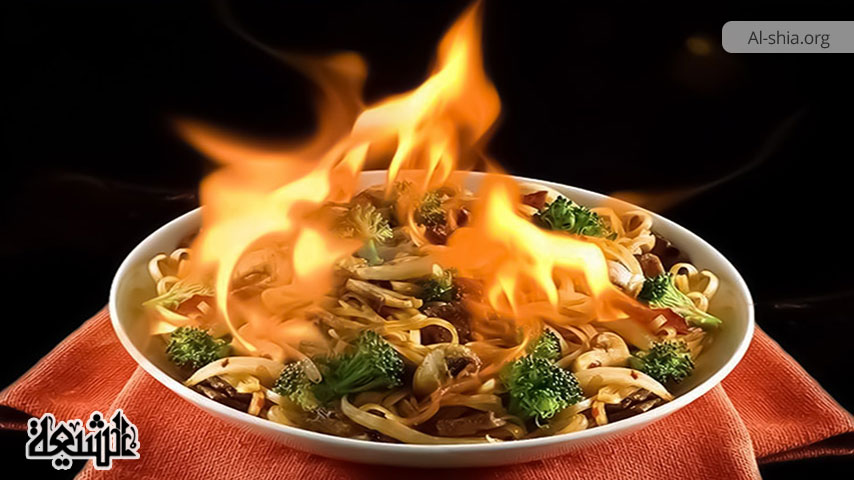

Islam has always placed great emphasis on maintaining the health of both body and soul, considering care for physical and spiritual well-being necessary and essential for everyone. Attention to lawful (Halal) food is frequently seen in the Holy Quran and in the narrations of the Infallibles (AS).
In general, these teachings encourage and direct human beings to reflect on the food they consume from various material and spiritual angles, as well as the consequences that follow from it in all social, worldly, and spiritual dimensions. They also emphasize avoiding impure substances, encouraging the use of wholesome foods, adhering to moderation, and offering numerous guidelines for safeguarding health and preventing different physical and spiritual illnesses.
If people, inspired by the Quranic instructions, control and manage their nutrition, pay attention to various aspects such as moderation in nutrition, eating halal food and not overdoing it, avoiding impermissible and forbidden morsels, and other such recommendations, and recognize the goal of living a healthy and desirable life in this world;
and believe that everything is placed at the disposal of man by the will and will of God and that humans are obligated to benefit from them as good trustees, they will certainly achieve a healthy life.
On the other hand, it should be noted that not paying attention to dietary instructions can lead to various physical and mental diseases.[1]
Imam Ali (AS), regarding the idea that people should not sacrifice their health and life for worldly desires and gluttony, says: “Do not seek life in order to eat; rather seek food in order to live”.[2]
It should be mentioned that forbidden morsels is generally divided into two categories: food that is inherently forbidden to eat, and food that is lawful in itself but has been acquired through forbidden means, such as unlawful wealth. Both forms are prohibited and carry negative consequences.
1. The Non-Acceptance of Supplication
Supplication (dua) is a means of drawing closer to the Almighty God, and God has placed many effects and blessings in it: forgiveness of sins, increased sustenance, the removal of calamities, healing of physical and spiritual illnesses, and many other matters.
However, sometimes certain factors prevent prayers from being answered, one of which is earning unlawful wealth or consuming forbidden morsels, as mentioned in various narrations. The Noble Prophet (PBUHH) said: “Whoever eats a forbidden morsel, his supplication will not be answered for forty days”.[3]
He also said: “Whoever wishes his supplication to be answered should purify his food and his earnings”.[4]
2. Hardening of the Heart as a Consequence of Forbidden Morsel
The food a person eats is like a seed planted in the earth. If the food is unlawful and impure, its effect is to darken and cloud the heart, which is the sovereign of the body. When the heart becomes hardened and dark, there is no hope of goodness in such a person.[5]
Hard-heartedness is a very dangerous spiritual disease; it is a state in which a person does not accept the truth and does not humble himself before it. The Qur’an states that turning to sin leads to hardness of the heart: “But their hearts became hardened”.[6]
The Quran shows that hardness of the heart is a temporary condition that afflicts human hearts. It is not inherent to human nature but rather the result of deviations and moral corruption that appear in a person’s life through misuse of free will, distancing the heart from the capacity to receive guidance.[7]
A hardened heart is not affected by advice, admonition, or even the most tragic scenes. As Imam Husayn (AS) said to the army of disbelief: “Your bellies have been filled with the unlawful, and your hearts have been sealed. Why then do you not act justly? Why do you not listen?”.[8]
3. Rejection of Deeds
In Islamic teachings, righteous action is the most valuable form of spiritual commerce and the best means of attaining God’s pleasure and closeness. One of the necessary conditions for its acceptance is avoiding forbidden morsels, because the Almighty God is Pure and accepts only what is pure. Forbidden morsel negatively affects one’s deeds and destroys their spiritual value.
As a result, from acts of worship, such as prayer, fasting, hajj, charity, and other acts, nothing remains except the outward form. This is the very truth to which Imam Ali (AS), in his will to Kumayl ibn Ziyad, refers when he says: “O Kumayl, the tongue expresses what is in the heart, and the heart is nourished by what one consumes. Look carefully at what your heart and body are fed with, for if it is not lawful, God will not accept your glorification or gratitude”.[9]
4. Negative Effects on Offspring
It is said that forty days before the formation of a fetus, a person should pay close attention to the lawfulness of what he eats and drinks. Imam Baqir (AS) said: “When a person acquires wealth unlawfully, its corruption reaches even the reproductive organ”.[10]
And Imam Sadiq (AS) said: “Unlawful earnings become evident in one’s offspring”.
5. Being Deprived of the Love of the Ahl al-Bayt (AS)
Love and affection for the Ahl al-Bayt (AS) carry many blessings. To benefit from them, one must obey their commands and avoid what they forbid, because love is not merely an emotion but must be reflected in a person’s actions.
Therefore, sin and disobedience are incompatible with true love. It is narrated that a follower of the Ahl al-Bayt (AS) in Medina sent his wife to Lady Fatimah al-Zahra (AS) to ask whether her husband was among their true Shia. The Lady replied: “If you act upon what we command and refrain from what we forbid, then you are among our Shia; otherwise, you are not”.[11]
It is clear that one of the teachings of the Ahl al-Bayt (AS) is avoiding forbidden food. As Imam Sadiq (AS) said: “He is not my follower who consumes the unlawful wealth of a believer”.[12]
6. Destruction of Good Deeds
Unlawful earnings are like a fire that turns a person’s good deeds into ashes, leaving nothing behind.[13] Regarding this, a narration from the Prophet (S) states: “On the Day of Resurrection, a group will come with good deeds like mountains, but God will turn them into scattered dust, and they will be commanded to enter the Fire”. Salman asked, “O Messenger of God, describe them for us.”
He said: “They would pray, fast, and show fear of God at night, but whenever something unlawful was presented to them, they would seize it”.[14]
7. Poverty, Deprivation, and Loss of Blessings
Another consequence of earning and consuming unlawful food is poverty. This may refer to spiritual poverty, meaning that success in worship and righteous deeds is taken away, or that the spiritual effect of one’s actions is lost. It may also refer to material poverty, meaning that blessings are removed from one’s livelihood.
Imam Musa al-Kazim (AS) said: “Unlawful wealth does not grow and does not increase. If it does increase, it has no blessing. Whatever a person gives from it in the way of God receives no reward, and whatever he leaves behind is provision for him toward the Fire of Hell”.[15]
8. Being Deprived of Paradise
One of the consequences of forbidden morsels is being deprived of Paradise, for Paradise is the home of the pure, and as long as a person is tainted by sin, he will not enter it. Forbidden morsel deprives a person of the boundless blessings of Paradise, blessings no eye has seen, no ear has heard, and no heart has imagined.
The Prophet (S) said: “Paradise is forbidden to any body nourished by unlawful food, and a body that has grown from the unlawful will not smell the fragrance of Paradise”.[16]
In another narration he said: “Indeed, God has forbidden Paradise to any body that has been fed with unlawful food”.[17]
9. Divine Wrath and the Curse of the Angels
God’s mercy sometimes encompasses all creation and sometimes descends specifically upon certain righteous servants. God has appointed causes through which His special mercy descends, and He has also warned of factors that prevent His mercy and even bring about His anger and the curse of the angels.
One of the major factors that blocks divine mercy and brings God’s wrath and angelic curse is the forbidden morsel. The Prophet (PBUHH) said: “When a morsel of unlawful food enters a person’s stomach, every angel in the heavens and the earth curses him. As long as that morsel remains in his stomach, God does not look upon him. Whoever eats a morsel of unlawful food incurs God’s anger; if he repents, God may forgive him, but if he dies without repentance, the Fire is more fitting for him”.[18]
10. Punishment in Barzakh and on the Day of Resurrection
A person’s state in the next world is the embodiment of his actions in this world, and every action possesses its own particular form and consequence. Forbidden morsels also have a specific manifestation, including the form described in a narration from Imam Sadiq (AS), who relates that the Prophet (S) said during the Miraj: “I passed by a group who had before them tables of wholesome meat and impure meat. They would eat the impure and leave the wholesome”. I said: “Who are these, O Jibrail?” He said: “These are those from your community, O Muhammad, who eat the unlawful and abandon the lawful”.[19]
11. Regret on the Day of Resurrection
Regret (Hasrah) means sorrow and grief over what has been lost and what has caused remorse. The Day of Resurrection is called the Day of Regret, when the realities of all matters become clear.
On that day, a person will bite his fingertips in regret for having deprived himself of eternal happiness through negligence and sin. He acquired wealth through unlawful means, left it behind for his heirs, and those heirs used that wealth in obedience to God, thereby entering Paradise, while he himself suffers divine punishment because of it.[20]
Regarding this, Imam Ali (AS) said: “Truly, the greatest regret on the Day of Resurrection is for those who acquired wealth through disobedience to God, then left it for someone else to inherit, and that person spent it in obedience to God and entered Paradise because of it, while the first entered Hell for having earned it unlawfully”.[21]
Conclusion
Paying attention to Islamic teachings about eating and drinking is one of the most important factors in achieving physical and spiritual health. The dietary recommendations of Islam not only ensure bodily well-being but also guarantee mental and spiritual wellness.
The Holy Quran commands the consumption of lawful food and prohibits forbidden morsels, and it describes the consequences of forbidden morsel, such as loss of divine blessings, deprivation from many acts of worship, destruction of good deeds, punishment in Barzakh and Hell, and the curse of the angels and divine wrath.
Notes:
[1] . Ghaffar, Healthy Nutrition from the Perspective of the Quran, p. 98.
[2] . Ibn Abi al-Hadid, Sharh Nahj al-Balagha, vol.20, p. 333.
[3] . Qommi, Safinat al-Bihar, vol.1, p. 67.
[4] . Hilli, Uddat al-Dai, p. 139.
[5] . Dastghayb, Major Sins, vol.1, p. 432.
[6] . Al-Anam:13.
[7] . Ziyyabadi, Qasawat: The Deadly Disease of Humankind, p. 25.
[8] . Qommi, Dama al-Suhum, p. 125.
[9] . Harani, Tuhaf al-Uqul, p. 174.
[10] . Tusi, al-Amali, p. 680.
[11] . Majlisi, Bihar al-Anwar, vol.65, p. 154, hadith 11.
[12] . Hurr al-Amili, Wasail al-Shiah, vol.17, p. 81, hadith 22042.
[13] . Kazemipour, Illicit Food, p. 30.
[14] . Nuri, Mustadrak al-Wasail, vol.13, p. 63, hadith 14755.
[15] . Majlisi, Ayn al-Hayat, p. 398.
[16] . Kazemipour, Illicit Food, p. 25–26.
[17] . Abi Firas, Majmuat Waram, vol. 1, p. 61.
[18] . Fattal Nishaburi, Rawdat al-Waizin, vol. 2, p. 457, hadith 6.
[19] . Majlisi, Bihar al-Anwar, vol. 72, p. 172, hadith 9.
[20] . Poorqasem Miyanaji, Permissible and Impermissible Foods, p. 186.
[21] . Dashti, Nahj al-Balagha, Wisdom 429.
References
- The Holy Quran.
- Abi Firas, Waram, Majmuat Waram, Faqih Library, Qom, n.d.
- Dashti, Mohammad, Nahj al-Balagha, 2nd edition, Farhang-e Mardom Publications, Isfahan, 2001.
- Dastghayb, Seyyed Abd al-Hossein. Major Sins (Gunahan-e Kabirah), edited by Seyyed Mohammad Hashem Dastghayb, Shiraz: Kanun-e Tarbiat, n.d.
- Fattal Nishaburi, Mohammad ibn Hasan, Rawdat al-Waizin, Razi Publications, Qom, n.d.
- Ghaffar, Farzaneh, Healthy Nutrition from the Perspective of the Quran, Zanjan University of Medical Sciences Journal, vol.22, No.90 (March–April 2014), p. 97–[end].
- Harani, Hasan ibn Shubah, Tuhaf al-Uqul, 2nd edition, Islamic Publications Institute affiliated with the Society of Seminary Teachers, Qom, 1404 AH.
- Hilli, Ahmad b. Muhammad b. Fahd, Uddat al-dai wa najah al-sai, Beirut, Dar al-Adwa, 1366 SH.
- Hurr al-Amili, Shaykh Mohammad ibn al-Hasan, Wasail al-Shiah ila Tahsil Masail al-Shariah, 1st edition, Al al-Bayt Institute for the Revival of Heritage, Qom, 1409 AH.
- Ibn Abi al-Hadid, Abd al-Hamid ibn Hibatullah, Sharh Nahj al-Balagha, Qom, The Library of Grand Ayatollah al-Uzma Marashi al-Najafi, 1363 Sh.
- Kazemipour, Hamid, Illicit Food (Loqmeh-ye Haram), 1st edition, Sami Publications, Tehran, Spring 2005.
- Majlisi, Mohammad Baqir ibn Mohammad Taqi, Bihar al-Anwar, corrected 2nd edition, Al-Wafa Institute, Beirut, 1404 AH.
- Majlisi, Muhammad Baqir, Ayn al-Hayat, Qom, Anwar al-Huda Publications, 1382 SH.
- Nuri, Mirza Hossein, Mustadrak al-Wasail wa Mustanbat al-Masail, 1st edition, Al al-Bayt Institute for the Revival of Heritage, Qom, 1408 AH.
- Poorqasem Miyanaji, Mojgan, Permissible and Impermissible Foods and Their Consequences from the Perspective of the Quran and Hadith, M.A. Thesis, Osul al-Din College, Qom, 2007.
- Qommi, Shaykh Abbas, Dama al-Sahm, Translated as Nafas al-Mahmum, trans. Mirza Abulhassan Sharani, Tehran, 1995.
- Qommi, Shaykh Abbas, Safinat al-Bihar wa Madinat al-Hikam wa al-Athar, 2nd edition, The Islamic Research Foundation of Astan Quds Razavi, Mashhad, 2005.
- Tusi, Mohammad ibn al-Hasan, Al-Amali, 1st edition, Dar al-Thaqafah Publications, Qom, 1414 AH.
- Ziyyabadi, Seyyed Mohammad, Qasawat: The Deadly Disease of Humankind, Tehran: Dar al-Kutub al-Islamiyyah, n.d.


![The Event of Ghadir and Imam al-Mahdi [afs]](https://en.al-shia.org/wp-content/uploads/2026/06/17221.jpg)