
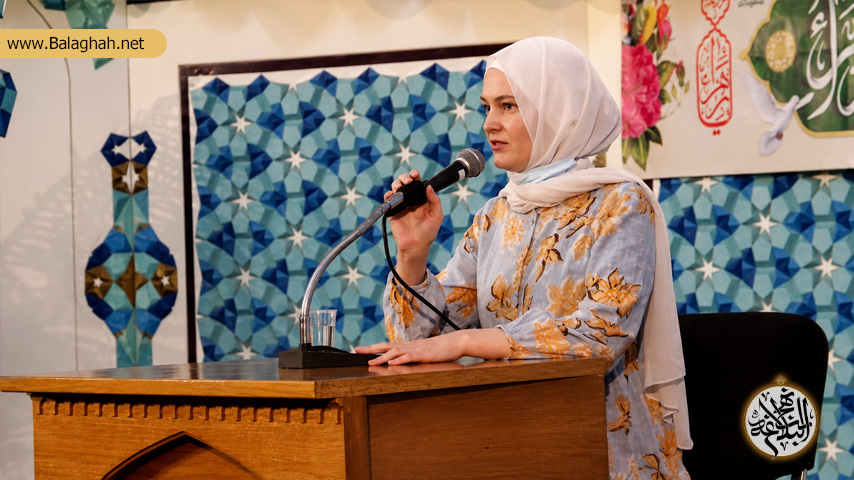

Hijab is often discussed through media portrayals, political debates, and cultural assumptions rather than the lived experiences of Muslim women. Hijab through the eyes of newly converted Muslim women presents the experiences of women from non-Muslim backgrounds who studied Islam and voluntarily chose Islamic dress. While many initially viewed hijab as restrictive or oppressive, their perspectives changed through studying the Qur’an, learning about Islam, and personal reflection. Their accounts highlight hijab as a matter of faith, dignity, identity, informed choice, and freedom from appearance-related pressures.
This article is entirely adapted from Kamran Pourabbas’s Salām bar Ḥaqīqat[1] [Salam to Truth: A Collection of Short Accounts of Newly Converted Muslim Women from Around the World]. The purpose of this article is to explore hijab through the eyes of newly converted Muslim Women and to understand how their perceptions developed from initial assumptions about restriction to personal experiences of faith, freedom, dignity, and identity.
Part I — Before Hijab: Perceptions and Questions
1. What Did Hijab Mean to Them Before Islam?
Before becoming acquainted with Islam, many of these women encountered hijab mainly through cultural and media portrayals that presented it as a symbol of oppression, coercion, restriction, or isolation. From this perspective, they found it difficult to understand why a woman would voluntarily choose Islamic dress.
Their perceptions began to change when they met educated, professional, and socially active Muslim women. These encounters challenged the assumption that hijab prevented women from pursuing education, careers, research, the arts, or wider social participation. Instead, they saw that Muslim women who wore hijab could be active and productive members of society.
hijab through the eyes of newly converted Muslim women therefore reveals a journey from assumption to inquiry and, ultimately, to understanding. Rather than accepting stereotypes, these women began asking questions and exploring hijab through their own study and experience.
2. The Question That Changed Everything: “Why Hijab?”
For many newly converted Muslim women, understanding hijab began with a simple question: “Why hijab?” Rather than adopting Islamic dress without reflection, they explored its philosophy, modesty, the status of women, and the relationship between clothing and social interaction.
Daria Zhonar, an Italian convert to Islam, studied Islam and came to view hijab as a means of reducing self-display and inappropriate attention while promoting greater peace of mind. Although she lost some friends, she considered her decision to embrace Islam and hijab worthwhile[2].
Hijab through the eyes of newly converted Muslim women shows that this question also led them to reflect on women’s dignity, appearance, and the meaning of freedom. Their reflections helped them understand hijab not merely as clothing, but as part of a broader Islamic view of human dignity and individual worth.
Part II — Discovering a Different Meaning of Freedom
3. Hijab as a Conscious and Voluntary Choice
One of the most significant themes in the experiences of newly converted Muslim women is the voluntary nature of their decision to wear hijab. Their experiences challenge the assumption that women adopt Islamic dress only because of pressure from husbands, families, or society.
For many newly converted Muslim women, choosing hijab was a personal decision reached through reflection, religious understanding, and conviction.
Rebecca, an Australian convert to Islam, explains that before embracing Islam, she enjoyed parties and alcoholic drinks and was not particularly concerned with religious restrictions. When she eventually chose to wear hijab, she emphasized that the decision was entirely her own and that no one forced her to do so. She expressed satisfaction with her new way of life and said that she did not miss her previous lifestyle[3].
Similarly, Aikol Alikzanova, a beauty queen from Kyrgyzstan, publicly announced her decision to wear hijab and emphasized that it was her personal choice. Despite widespread reactions to her decision, she expressed happiness with it and stated that she would thereafter participate only in productions that allowed her to maintain her Islamic dress[4].
The experiences of newly converted Muslim women do not deny that coercion concerning hijab may occur in some families or societies. Rather, they demonstrate the importance of respecting women’s individual choices in both directions. Just as forcing a woman to wear hijab against her will is unjust, dismissing or restricting a woman who freely chooses hijab is equally unfair.
A balanced understanding therefore requires listening to women themselves. The central issue is not simply whether a woman wears hijab, but whether she is allowed to make an informed and meaningful choice concerning her own religious commitment.
4. Freedom from the Pressure of Appearance
In many societies, women’s freedom is sometimes measured by the extent to which they can reveal their bodies or appearance. Some newly converted Muslim women, however, developed a different understanding of freedom.
They observed that modern society can also impose powerful expectations upon women. The fashion industry, advertising, and social media may encourage women to remain young, slim, well-groomed, fashionable, and attractive. A woman who does not conform to such standards may feel that she is not accepted.
From the perspective of some newly converted Muslim women, hijab provides a means of distancing oneself from this constant competition over appearance. By adopting Islamic dress, they express that their worth should not be determined by their body size, hairstyle, or degree of physical attractiveness.
Fatimah Anastasia Yezhova, a Russian woman who converted to Islam, describes hijab as “freedom itself” because she believes that it prevents others from intruding into her private sphere. For her, Islamic dress is part of her new identity and a means of establishing personal boundaries[5].
Therefore, in the discussion of hijab through the eyes of newly converted Muslim women, freedom does not necessarily mean the absence of all boundaries. Rather, it can mean the ability to choose those boundaries consciously. These women want to decide for themselves how and to what extent they are seen by others.
5. Security, Boundaries, and Self-Confidence
Security is another concept repeatedly mentioned by many newly converted Muslim women. By security, they do not mean physical safety alone. It can also include psychological peace, reduced unwanted attention, and a sense of control over how they present themselves in society.
Fatimah, a Ukrainian woman who converted to Islam, regards hijab as a shield that protects her from improper gazes. She says that when she enters society wearing hijab, she feels stronger and more self-confident[6]. Sophia likewise chose hijab with inner conviction and a sense of security after becoming acquainted with Islam[7].
These statements do not mean that hijab alone eliminates all social harms or removes responsibility for misconduct from the person who commits it. Responsibility for an inappropriate gaze or improper behavior always rests with the person responsible for it. Nevertheless, these women have the right to speak about their personal experiences and to regard their clothing as a source of peace and a means of establishing boundaries in their interactions.
At first glance, it may also be assumed that covering one’s appearance reduces a woman’s self-confidence. Yet the experience of some newly converted Muslim women is different. They say that after choosing hijab, they became less concerned about how others judged their appearance.
When a woman does not feel that she must constantly conform to changing standards of beauty, she may devote more energy to her intellectual, moral, and social development. In this case, self-confidence shifts from seeking others’ approval of appearance to inner satisfaction and faithfulness to personal beliefs.
Women’s experiences in this regard are not identical. One woman may feel comfortable with a different form of dress, while another may regard hijab as a source of self-confidence. Genuine respect for women exists when their different experiences are heard and no one decides in advance for everyone what kind of clothing must necessarily lead to freedom or self-confidence.
Part III — From Appearance to Identity
6. Beyond Appearance: Being Valued for Character
One of the most prominent themes in hijab through the eyes of newly converted Muslim women is the distinction between having one’s character recognized and having one’s body displayed.
These women do not wish to become invisible or to be excluded from society. Rather, they want their thoughts, morals, talents, and abilities to receive attention before their appearance.
From this perspective, hijab does not mean denying beauty. Beauty can be a blessing and part of a person’s identity, but it should not become the sole criterion by which she is valued. When a woman’s body is used to advertise products, attract audiences, or generate profit, her character and abilities may be pushed into the background.
Eva, a Dutch woman who converted to Islam, regards hijab as a form of power that prevents materialistic and bodily objectification. She believes that this form of dress frees women from media outlets that portray them merely as bodies and enables them to preserve their authentic selves[8].
The phrase “hijab is a form of power” is therefore an important description of the experiences presented in the source. Eva sees this power in resisting a body-centered gaze, taking pride in faith, devoting oneself to God, and becoming free from media pressure. In her view, hijab enables a woman not to define herself solely through the eyes of others[9].
This power, however, does not mean superiority over other women. A woman who wears hijab has no right to demean anyone because of her manner of dress, just as others should not regard her as backward or coerced. Rather, power here means the ability to say “no”: no to the pressure of fashion, no to the commodification of the body, and no to the notion that a woman’s worth depends on how much attention she attracts.
For the women whose experiences are discussed here, hijab is thus connected to a fundamental question of human dignity: Can a woman be valued for who she is rather than primarily for how she looks?
7. Hijab as Modesty: More Than a Headscarf
For many newly converted Muslim women, hijab is not merely a headscarf or a long garment. Rather, it forms part of the broader concept of modesty. In their view, modesty also encompasses the way one speaks, looks, behaves, and interacts with others.
Lorena Ochoa Jasso, a Mexican woman who converted to Islam, says that hijab is a means of preserving women’s beauty, but it is not limited to clothing. In her view, hijab also shapes the way a person interacts with others and encourages modest behavior without attracting attention[10].
Marcela Daza, a Colombian woman, regards hijab as a powerful form of dress and a wordless language that presents her faith to the world. She also describes hijab as a reminder of her moral principles and says that this reminder sometimes acts more quickly than her conscience[11].
Accordingly, clothing acquires its full meaning when it is accompanied by morality, honesty, respect, and responsibility. Outward hijab, without respect for the rights of others, does not fully realize the ethical purpose of this teaching.
This understanding also explains why some of these women see hijab as more than a matter of appearance. For them, it is connected to the kind of person they wish to become and the values they want their outward appearance to remind them to practice.
8. Hijab as Identity and Personal Transformation
For many newly converted Muslim women, embracing Islam marks a new stage of life, with hijab serving as an outward expression of their inner transformation and newly adopted values. Over time, it may become an integral part of their identity rather than something temporary or imposed.
Hijab through the eyes of newly converted Muslim women also demonstrates that becoming Muslim does not require abandoning one’s cultural or national identity. A woman may remain connected to her Russian, Italian, Mexican, Dutch, French, or other cultural background while embracing Islam and wearing hijab. Since hijab is not limited to any particular ethnicity or country, Islamic and cultural identities can coexist harmoniously.
Part IV — Hijab in the Real World
9. From Personal Choice to Social Challenge
For many newly converted Muslim women, choosing hijab can bring opposition from family, friends, workplaces, and wider society. Negative perceptions of Islam may lead others to view hijab as a loss of freedom, making the decision more difficult. Yet many women respond through patience, dialogue, and respectful conduct, showing that embracing Islam and choosing hijab does not require abandoning family relationships, education, or social participation.
Hijab through the eyes of newly converted Muslim Women also reveals hijab as an expression of courage and conviction. Despite social pressure, these women draw strength from their faith, inner commitment, and spiritual satisfaction.
10. Hijab, Work, and Participation in Society
The experiences of newly converted Muslim women who wear hijab while actively participating in the media, universities, medicine, education, and social initiatives demonstrate that hijab does not necessarily conflict with social participation.
For these women, what may restrict their opportunities is not their manner of dress but discrimination and the denial of equal access to education, employment, and public life.
This raises an important question about freedom. Just as forcing a woman to adopt a particular form of clothing violates her freedom of choice, preventing a woman from studying, working, or participating in society because of her hijab is equally incompatible with freedom.
Newly converted Muslim women should be able to express their religious identity through hijab without being compelled to abandon it merely to gain social acceptance.
Through their active participation, these women seek to demonstrate that hijab is not a wall separating women from society. Rather, it provides a framework for the manner in which they participate. They want to remain faithful to their beliefs while being effective, skilled, and responsible members of society.
11. Women Who Came from Modeling and Media
The accounts of women who worked in modeling, music, cinema, or the media before embracing Islam reveal another dimension of the subject. More than others, these women experienced pressures related to weight, age, makeup, clothing, and attractiveness.
Some of them left modeling after embracing Islam and stated that they were satisfied with their decision. For this group, hijab was not merely a change of clothing; rather, it represented a redefinition of identity. They no longer wanted their bodies to constitute the most important part of their professional and social identities.
Of course, this experience cannot be generalized to everyone working in the arts and modeling. Some women may feel empowered in such professions, while others may experience pressure or objectification.
The main point in the discussion of hijab through the eyes of newly converted Muslim women is a woman’s right to change the course of her life. If a woman decides to adopt a different form of dress after years of artistic or modeling work, her choice should be respected just like the other choices women make.
Part V — A Broader Perspective on Modesty
12. Is Modesty Unique to Islam?
During their research, some newly converted Muslim women discovered that covering the head and the principle of modesty are not exclusive to Islam. Historical depictions of the Virgin Mary, the clothing worn by nuns, and the traditions of some Jewish and Christian women demonstrate that modest dress also has a history in earlier religions.
Armina Hasakic, a Bosnian woman who converted to Islam, emphasizes that the principles of hijab and modesty have existed in different religions and are not confined to the time of the Prophet of Islam (PBUHH). She wore a headscarf for the first time to show her father that hijab does not hinder activity or everyday life[12].
Leila Hosseini, a French woman from a Jewish background, says that even before embracing Islam, she regarded women who wore hijab as pure, dignified, and possessing a distinctive beauty. After studying the Qur’an and researching Islam, she adopted full hijab, although her family believed that by doing so she was depriving herself of certain freedoms[13].
For these women, discovering the broader history of modesty helped place Islamic hijab within a wider religious and human context. It also challenged the idea that modest dress is necessarily incompatible with dignity, freedom, or active participation in society.
Conclusion
An examination of hijab through the eyes of newly converted Muslim women demonstrates reflects a journey from negative assumptions about restriction to personal experiences of freedom, security, dignity, and religious identity. Many of these women changed their views after studying Islam, asking questions, and experiencing hijab for themselves.
Some regard it as protection from unwanted attention, while others see it as freedom from the pressures of the fashion and beauty industries or as an expression of faith and connection with God. Although their experiences differ according to culture and personal circumstances, informed and voluntary choice remains central.
Ultimately, hijab through the eyes of newly converted Muslim women challenges stereotypes and encourages people to listen to women’s own voices, recognizing them for their character, abilities, awareness, and responsible choices rather than judging them solely by appearance.
Notes:
[1] . Salām bar Ḥaqīqat (written in Persian) is a collection of personal accounts from newly converted Muslim women around the world, highlighting their journeys to Islam and their reflections on faith, identity, hijab, and religious commitment.
[2] . Pourabbas. Salām bar Ḥaqīqat, p. 16.
[3] . Ibid., p. 126.
[4] . Ibid., p. 29.
[5] . Ibid., p. 120.
[6] . Ibid., p. 116.
[7] . Ibid., p. 138.
[8] . Ibid., p. 90.
[9] . Ibid., p. 90.
[10] . Ibid., p. 130.
[11] . Ibid., p. 154.
[12] . Ibid., p. 148.
[13] . Ibid., p. 149.
Source: Pourabbas, Kamran. (1403 SH). Salām bar Ḥaqīqat: Majmūʿeh-ye Dāstānak-e Bānovān-e Tāzeh-Mosalmān az Sarāsar-e Jahān [Salam to Truth: A Collection of Short Accounts of Newly Converted Muslim Women from Around the World]. Tehran: Chakameh Mehr Publishing. First edition.

![The Event of Ghadir and Imam al-Mahdi [afs]](https://en.al-shia.org/wp-content/uploads/2026/06/17221.jpg)