

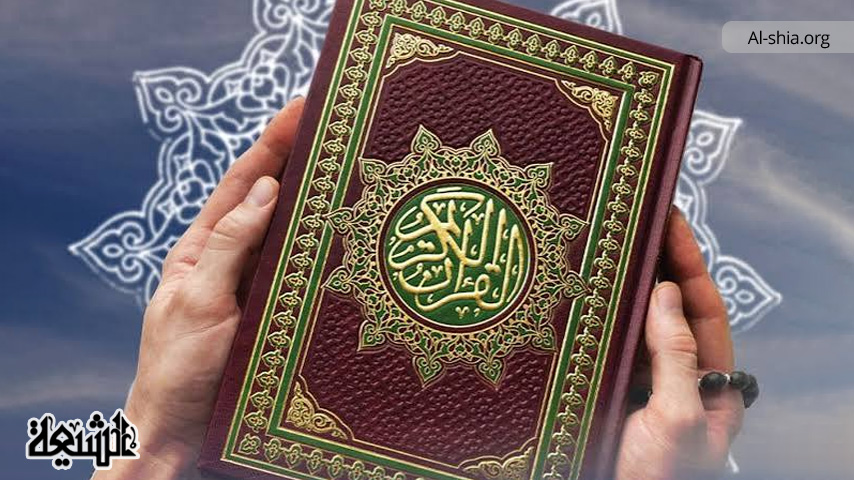

The Qur’an, the holy book of Islam, has been a central axis of guidance and wisdom for Muslims throughout history. Its preservation and interpretation have been of utmost importance to ensure its message remains authentic and relevant for future generations. Ahl al-Bayt (a.s), the purified Household of the Prophet Muhammad (a.s) hold a revered position, entrusted with the spiritual and moral guidance of the Muslim community.
This article aims to explore the significant role of Ahl al-Bayt (a.s) in preserving the Qur’an, highlighting their contributions to its compilation, interpretation, and protection throughout history.
The Relationship between the Qur’an and the Ahl al-Bayt (a.s)
In light of the Noble Qur’an and numerous traditions narrated from the Holy Prophet (PBUHH), it is established that the Prophet’s Household hold an exalted station before God and His Messenger. Therefore, they are considered an inseparable counterpart of the Qur’an, and holding firmly to both of them guarantees salvation from misguidance.
In other words, salvation in this world and the Hereafter lies in holding fast to the Qur’an and the Ahl al-Bayt (a.s). The Holy Prophet (PBUHH) states in one of his prominent sayings: “Verily, I am leaving among you the two weighty things (al-Thaqalayn): that which if you hold fast to, you shall never go astray after me. One of them is greater than the other: the Book of Allah, [which is] a rope extended from the heaven to the earth, and my progeny, my Ahl al-Bayt. These two shall never separate from each other until they arrive at the Pool (Kawthar) before me. Therefore, consider carefully how you will treat them after me.”[1]
The tradition of Two Weighty Things (Hadith al-Thaqalayn) constitutes explicit evidence that it is a testament from the Prophet to his community[2]. It establishes that the Noble Qur’an and the Prophet’s Household (a.s) are two great Divine trusts entrusted to us by the Prophet. Adherence to them serves as the means of salvation, while failure to do so will result in misguidance and error.
Furthermore, a close examination of the phrasing of this tradition makes it clear that adhering to only one of them without the other is insufficient for the guidance of humanity. In other words, the Noble Qur’an without the Ahl al-Bayt, or the Ahl al-Bayt without the Qur’an, cannot guarantee the guidance of humanity.
This is because these two—namely the Noble Qur’an and the Prophet’s Household—are counterparts and equals of one another. In reality, the Prophet Household (a.s) are introduced as the “Speaking Qur’an” for the elucidation and exegesis of the “Silent Qur’an.” They are indeed the divinely appointed guardians of Islam, who have been entrusted with the responsibility of safeguarding and interpreting the Noble Qur’an.
In essence, considering the numerous verses and traditions presented in this regard, this concept serves not merely as an indicator of the excellence of the Prophet’s Household (a.s), but rather establishes their special status within Islam in terms of scientific authority and their role in the preservation of the [Divine] mission.
The Practical Contributions of the Ahl al-Bayt (a.s) to the Preservation of the Qur’an
Beyond their spiritual status, the Prophet’s Household (a.s) played a functional role in the physical and intellectual preservation of the Qur’an. This section explores some of the practical efforts of the Prophet’s Household in this regard.
-
Ahl al-Bayt (a.s) and the Compilation of the Qur’an
During the lifetime of the Prophet Muhammad (PBUHH), the Qur’an was revealed gradually. In addition to its preservation in the hearts [of the believers], one of the fundamental bases for safeguarding the Noble Qur’an against any form of distortion or unauthorized alteration has been its codification and transcription, whereby its verses were recorded on various materials such as palm leaves, stones, and animal hides[3].
In other words, from the very beginning of the revelation of the Qur’anic verses, the Holy Prophet (PBUHH) would commit them to memory. Likewise, he tasked a number of Muslims who were literate with the transcription of the revelation; these individuals were designated as the “Scribes of Revelation”.
The first individual in Mecca to undertake the task of transcription, specifically the transcription of revelation, was Ali ibn Abi Talib, and he continued this practice until the final days of the Prophet’s life[4].
In this regard, Ali ibn Abi Talib (a.s), has stated: “Whenever I questioned him, he would answer me; and when I fell silent and my questions were exhausted, he would initiate [instruction] himself. No verse of the Qur’an was revealed to the Messenger of Allah (PBUHH) except that he recited it to me and dictated it to me, and I wrote it with my own hand. And he taught me its exegesis (ta’wil), its interpretation (tafsir), its abrogating (nasikh) and abrogated (mansukh) verses, its explicit (muhkam) and ambiguous (mutashabih) [verses], and its specific and general [injunctions]…[5]“
In addition, it becomes evident that the first codified Qur’an after the demise of the Holy Prophet (PBUHH) was compiled by Imam Ali (a.s)[6]. This was, of course, based on the directive of the Messenger of Allah to him during the final moments of his noble life, wherein he stated: “O Ali! The Qur’an is behind my bed in the scrolls, silk [parchments], and papers; take it and compile it, and do not let it be lost.[7]“
Thus, the role of Prophet’s Household (a.s) in compiling and codifying the Qur’an was crucial in preventing its distortion and loss. Their efforts ensured that the Qur’an remained authentic and unchanged, despite the various challenges and attempts to alter it.
-
Ahl al-Bayt (a.s) and the Recitation of the Qur’an
In addition to their endeavors in teaching correct recitation to Muslims and their unique measures regarding the fluent recitation of the Noble Qur’an, the Prophet’s Household (a.s) have also narrated numerous traditions concerning the excellence of Qur’anic recitation, its spiritual effects, and its divine rewards and recompense. Attention to the recitation of the Qur’an is among the continuous and emphatic recommendations of the Ahl al-Bayt (a.s) to Muslims, who have stated it to be part of a constant schedule and the daily routine of every Muslim.
It is noteworthy that the first authorship and compilation of a written work regarding recitation was undertaken by the disciples of the Pure Imams (a.s). The first individual to compile a book on the subject of recitation during the period of the Tabi’un (the Successors) was Aban ibn Taghlib (d. 141 AH), a disciple of Imam Zayn al-Abidin[8] (a.s).
The Commander of the Faithful (Peace be upon him), in his testament to his son, Muhammad Hanifah, stated: “It is incumbent upon you to recite the Qur’an, to act according to it, to adhere to its obligatory duties and its laws, its lawful and unlawful [provisions], its commands and prohibitions, and to perform the night vigil (Tahajjud) with it and recite it during your night and day. For it is the covenant of God the Exalted to His creation; thus, it is obligatory upon every Muslim to look into his covenant every day, even if it be fifty verses…[9]“
Imam Ja’far al-Sadiq (a.s) also expounded on the wisdom of attending to the Qur’an, stating that it is the covenant sent by God to His servants, and considered its recitation the daily duty of every Muslim, stating: “The Qur’an is the covenant of Allah to His creation; therefore, it is fitting for a Muslim man to look into his covenant and to recite from it fifty verses every day.[10]“
In light of this, the unwavering emphasis of the Ahl al-Bayt (a.s) on the correct recitation and daily engagement with the Noble Qur’an constitutes a pivotal mechanism in the preservation of the Divine scripture. Thus, the legacy of the Ahl al-Bayt is intrinsically linked to the enduring preservation and authentic transmission of the Qur’anic revelation.
-
Ahl al-Bayt (a.s) and the Memorization of the Qur’an
The Ahl al-Bayt (a.s) are the People of the Remembrance (Ahl al-Dhikr), the true bearers of the Qur’an. Historical evidence attests that they (a.s) had memorized the entire Qur’an from childhood, and its exegesis and interpretation have been transmitted and inherited among them.
In numerous traditions, the Ahl al-Bayt (a.s) have encouraged and exhorted Muslims to memorize the Noble Qur’an, placing special emphasis on the elevated status of the bearers—that is, the memorizers—of the Noble Qur’an. It is noteworthy that the true bearers of the Qur’an are those who have preserved both the wording and the meanings of the Qur’an and adorned themselves with its injunctions.
In the luminous discourses of the Ahl al-Bayt (a.s), reference has been made to the exalted station of the bearers and memorizers of the Noble Qur’an. Imam Ja’far al-Sadiq (a.s) narrates from the Holy Prophet (PBUHH) that he stated: “Verily, the people of the Qur’an [memorizer of the Qur’an] occupy the highest degree among human beings, save the prophets and messengers. Therefore, do not belittle the people of the Qur’an regarding their rights, for they hold a lofty station before God, the Mighty, the Compeller.[11]“
He also emphasized acting upon the Qur’an, stating: “The memorizer of the Qur’an who acts according to it is with the noble, righteous scribes [angels].[12]“
In essence, the emphasis of the Ahl al-Bayt (a.s) on the memorization and practical application of the Qur’an serves as a vital safeguard for the integrity and perpetuity of the Divine revelation. Consequently, the legacy of the Ahl al-Bayt is instrumental in maintaining the authenticity of the Qur’anic message, securing its transmission not merely as a written record, but as an active spiritual tradition across generations.
-
Ahl al-Bayt (a.s) and the Interpretation of the Qur’an
In reality, one of the significant duties of the Ahl al-Bayt (a.s) after the Holy Prophet (PBUHH) was the explanation and elucidation of the Qur’anic verses. The Infallible Imams from the noble Prophet’s Household were introduced by His Eminence (PBUHH) as the authoritative exegetes of the Noble Qur’an. They (a.s), one after another, explained and elucidated the Qur’an in their respective eras according to the exigencies of the time.
During his lifetime, the Holy Prophet gave special attention to Imam Ali (a.s), training him in all sciences, including Qur’anic exegesis, and appointed him as his successor after him. Likewise, the rest of the Infallible Imams (a.s), learned the science of exegesis and the Ta’wil of the Qur’anic verses from the Commander of the Faithful, Ali ibn Abi Talib (a.s), so that the people might refer to them.
Imam Ali (a.s) in this regard, says: “…Ask me regarding the Book of Allah. By Allah, there is no verse but that I know where it was revealed—whether by night or by day, or whether it was revealed in a plain or on a mountain.[13]“
In essence, the role of the Ahl al-Bayt (a.s) in the interpretation of the Qur’an is intrinsically linked to the preservation of its authentic message. By serving as the divinely appointed exegetes who inherited the Prophet’s knowledge, they provided the necessary exegetical framework to prevent misinterpretation and distortion of the text.
Conclusion
The examination of these multifaceted dimensions demonstrates that the role of the Ahl al-Bayt (a.s) in the preservation of the Noble Qur’an is comprehensive and indispensable. As the inseparable counterparts of the scripture, they were not only instrumental in its inscription and compilation but also served as the primary guardians of its recitation, memorization, and interpretation. By establishing the correct phonetic articulation, encouraging internalization through memorization, and providing the authoritative exegesis necessary to understand the Divine intent, they effectively shielded the Qur’an from textual corruption, distortion, and misinterpretation. Ultimately, the legacy of the Ahl al-Bayt ensures that the Qur’an remains preserved not merely as a historical text, but as a living, dynamic, and authentic guide for all of humanity.
Footnotes
[1] . Muslim (1991). Ṣaḥīḥ Muslim, vol. 7, p. 122; Tirmidhi, (1998). Sunan al-Tirmidhi, vol. 5, p. 478; Ibn Hanbal (1995). Musnad, vol 17, p. 170; Kulayni (1986). Al-Kāfī, vol. 2, p. 415, vol 3, p. 423; Shaykh Ṣadūq (1982). Ma`ani al-Akhbar, p. 58 (with different expressions).
[2] . Al-Milani, Sayyid Ali (1430 AH). Ḥadīth al-Thaqalayn, p. 170.
[3] . Ma’rifat (1392 Sh). ‘Ulūm-e Qur’āni, p. 36.
[4] . Ibid, p. 33.
[5] . Kulayni (1986). Al-Kāfī, vol. 1, p. 64, Hadith 1.
[6] . Hasakani (1411 AH). Shawahid al-Tanzil, vol. 1, p. 36, Hadith 23.
[7] . Majlisi (1982). Biḥār al-Anwār, vol. 89, p. 48, Hadith 7.
[8] . Turabi (1431 AH). Qur’an-e- Karim az Manẓar Ahl-e-Bayt (a.s), vol. 2, p. 31.
[9] . Hashimi al-Khu’i, Habib Allah (1979). Minhaj al-Bara’ah fi Sharh Nahj al-Balaghah, vol. 19, p. 314.
[10] . Kulayni (1986). Al-Kāfī, vol. 2, p. 609.
[11] . Ibid, vol. 2, p. 603, Hadith 1.
[12] . Ibid, vol. 2, p. 603, Hadith 2.
[13] . Hasakani (1411 AH). Shawahid al-Tanzil, vol. 1, p. 40, Hadith 30.
References:
- Al-Milani, Sayyid Ali (1430 AH). Ḥadīth al-Thaqalayn (1st edition). Qom: Al-Haqaeq Publishers.
- Hasakani, Ubayd Allah ibn Abd Allah (1411 AH). Shawahid al-Tanzil li Qawa’id al-Tafdhil. Tehran: Organization for Printing and Publication of the Ministry of Culture and Islamic Guidance.
- Hashimi al-Khu’i, Habib Allah (1979). Minhaj al-Bara’ah (4th edition). Tehran: Maktabat al-Islamiyyah Publications.
- Ibn Babawayh, Muhammad ibn Ali [Shaykh Ṣadūq] (1982). Ma`ani al-Akhbar (1st edition). Qom: Islami Publishers affiliated to the Group of Lecturers of Islamic Seminary of Qom.
- Ibn Hanbal, Ahmad ibn Muhammad (1995). Musnad al-Imam Ahmad ibn Hanbal (1st edition). Beirut: Mu’assasat al-Risalah.
- Kulayni, Muhammad ibn Ya`qoub (1986). Al-Kāfī (4th edition). Tehran: Dar al-Kutub al-Islamiyyah.
- Majlisi, Muhammad Baqir ibn Muhammad Taqi (1982). Biḥār al-Anwār (2nd edition). Beirut: Dar Ihya al-Turath al-Arabi.
- Ma’rifat, Muhammad Hadi (1392 Sh). ‘Ulūm-e Qur’āni (15th edition). Qom: Muasseseh-ye Farhang-e Tamhid.
- Muslim ibn Hajjaj (1991). Ṣaḥīḥ Muslim (1st edition). Beirut: Dar al-Fikr.
- Tirmidhi, Muhammad ibn ‘Isa (1998). Al-Jami’ al-Ṣaḥīḥ [Sunan al-Tirmidhi] (1st edition). Cairo: Dar al-Hadith.
- Turabi, Murtaḍa (1431 AH). Qur’an-e- Karim az Manẓar Ahl-e-Bayt (a.s). Translated by Mahdi Husaynian. Qom: World Ahl al-Bayt Assembly.





![The Event of Ghadir and Imam al-Mahdi [afs]](https://en.al-shia.org/wp-content/uploads/2026/06/17221.jpg)