

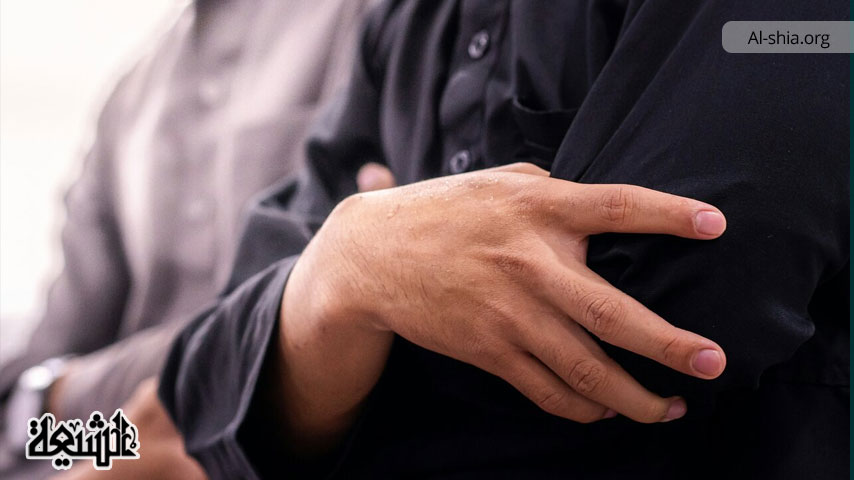

Praying with folded hands and saying of “Amen” after the recitation of Surat al-Hamd (al-Fatihah) are, according to the Shia school of thought, innovations (bidah) that have been added to the prayer by Sunnis and do not conform to the pattern of the prayer of the Prophet of Islam (PBUHH).
Shia jurists consider these two practices prohibited during prayer. They base their view and argument on narrations that report the Prophet of Islam (PBUHH) performing the prayer without placing one hand over the other and without saying “Amen”. There are also narrations transmitted from the Ahl al-Bayt (AS) in which these two innovations are explicitly forbidden.
Prayer: A Shared Tradition of the Abrahamic Religions
Salah refers to the specific act of worship known as prayer, and its original meaning is supplication. Prayer is among the acts of worship that have existed in every divine law and is a shared tradition of the Abrahamic religions.
In the Holy Quran it is stated:
فَخَلَفَ مِنْ بَعْدِهِمْ خَلْفٌ أَضَاعُوا الصَّلَاةَ وَاتَّبَعُوا الشَّهَوَاتِ فَسَوْفَ يَلْقَوْنَ غَيًّا
“But they were succeeded by an evil posterity who neglected the prayer, and followed [their base] appetites. So they will soon encounter [the reward of] perversity”.[1]
Regarding Jesus (AS), the Quran also states:
قَالَ إِنِّي عَبْدُ اللَّهِ آتَانِيَ الْكِتَابَ وَجَعَلَنِي نَبِيًّا. وَجَعَلَنِي مُبَارَكًا أَيْنَ مَا كُنْتُ وَأَوْصَانِي بِالصَّلَاةِ وَالزَّكَاةِ مَا دُمْتُ حَيًّا
“He said, Indeed I am a servant of Allah! He has given me the Book and made me a prophet. He has made me blessed, wherever I may be, and He has enjoined me to [maintain] the prayer and to [pay] the zakat as long as I live”.[2]
Therefore, prayer has existed in all divine laws. However, the point is that we Muslims do not follow the tradition and model of Moses and Jesus; rather, we follow the tradition of the Prophet of Islam (PBUHH) and take his prayer as our model. He said: “Pray as you have seen me pray”.[3]
Folding the Hands and Saying Amen
Prayer in Islam is a devotional act, and its components were defined by the Prophet of Islam (PBUHH). However, there are differences among Islamic schools regarding certain parts of the prayer, and some practices, such as praying with folded hands and saying of “Amen” after the recitation of Surat al-Hamd, have been added to the prayer.
As for when praying with folded hands began, it is said that this practice became prevalent during the time of Umar ibn al-Khattab. When some Iranian captives were brought before Umar, they stood before him with their hands placed on their stomachs.
Umar asked: What kind of posture is this? They replied: This is how we stand as a sign of respect before commanders and dignitaries. Thereupon, Umar ordered the people to pray with folded hands.[4]
With regard to saying of “Amen”, Shaykh al-Saduq states that saying “Amen” in prayer was adopted from the practices of Christians.[5] Shaykh al-Mufid also says that one should not say “Amen” after the recitation of Surat al-Hamd in the manner of the Jews and their Nasibi brethren.[6]
In the two hadiths cited below concerning the manner of the Prophet of Islam’s (PBUHH) prayer, it can be observed that in neither of them is there any slightest reference to praying with folded hands or saying “Amen” after the recitation of Surat al-Hamd.
Description of The Prayer of the Prophet of Islam (PBUHH)
In this article, we cite two hadiths concerning the manner of the Prophet of Islam’s (PBUHH) prayer, and we observe that in neither of them is there any slightest reference to praying with folded hands or saying “Amen” after the recitation of Surat al-Hamd.
It has been narrated through Sunni sources that Abu Humayd al-Saidi turned to the Companions of the Messenger of God (PBUHH) and said: I am the most knowledgeable among you about the prayer of the Prophet (PBUHH). They said: Why is that? You neither followed him more than we did nor kept his company more than we did. He replied: Yes, I did. They said: Then describe to us the manner of the Prophet’s (PBUHH) prayer.
Abu Humayd said: When the Messenger of God (PBUHH) stood up for prayer, he would raise his hands to the level of his shoulders and then say the takbir. When all his limbs were in a state of composure in their proper places, he would begin the recitation.
Then he would say the takbir and raise his hands to the level of his shoulders, after which he would bow, placing his palms on his knees, bowing in a balanced manner, neither raising his head nor lowering it excessively. Then he would raise his head from bowing, stand upright, and say: “Samia Allahu liman hamidah”. Then he would raise his hands to the level of his shoulders and say the takbir.
Next, he would go down to the ground for prostration, keeping his arms away from his sides in prostration. Then he would raise his head from prostration, bend his left foot, and sit on it.
He would spread the toes of his feet during prostration and perform the second prostration in the same manner. After the prostration, he would say the takbir and then bend his foot and sit on it, with each part of his body returning to a state of composure.
He would perform the next rakah in the same manner. After two rakahs, while standing, he would say the takbir and raise his hands to the level of his shoulders, just as he did for the opening takbir. He would act in the same way in the rest of his prayer until, after the final prostration, he would say the salam. He would place his left foot back and sit on his left side. They all said: Abu Humayd has spoken the truth; this is how the Prophet (PBUHH) used to pray.[7]
The Prophet’s Prayer as Narrated by Imam Sadiq (AS)
Through Shia sources as well, Hammad ibn Isa has narrated from Imam Sadiq (AS) that he said: “How unbecoming it is for a man that sixty or seventy years of his life pass and he has not performed even one prayer in its complete and proper form”.
Hammad said: I felt humbled within myself by this statement of the Imam (AS) and said: “May I be sacrificed for you, teach me the complete prayer”.
The Imam (AS) stood upright facing the qiblah. He let his hands hang down on his thighs with the fingers closed together, and placed his feet close to each other with a distance of three fingers between them. All the toes of his feet were facing the qiblah, and he did not turn them away from it. He stood with full humility and reverence. Then he said the takbir and recited Surat al-Hamd and Surat al-Tawhid in a measured and orderly manner (tartil).
Then he paused while standing for the length of one breath, after which he said the takbir while still standing. Then he went into bowing (ruku), placing both palms, with the fingers spread, on the hollows of his knees. He pushed his knees back so that his back became straight, such that if a drop of water or oil were poured onto his back, it would not incline to either side because of the straightness of his back.
The Imam held his neck straight in ruku and closed his eyes, and three times, in a measured manner, he said the glorification:
سُبْحانَ رَبِّی العَظِیمِ وَ بِحَمْدِهِ
“Subhana rabbi al-azim wa bi-hamdih”.
Then he stood upright, and when he was fully in the standing position he said:
سَمِعَ اللّه ُلِمَنْ حَمِدَهُ
“Samia Allahu liman hamidah”.
After that, while still standing, he said the takbir and raised his hands up to the level of his face, and then went down into prostration (sujud), placing his hands on the ground before his knees. He said three times:
سُبْحانَ رَبِّی العَظِیمِ وَ بِحَمْدِهِ
“Subhana rabbi al-azim wa bi-hamdih”.
In prostration, he did not place one part of his body upon another, and he prostrated upon eight points: the forehead, the two palms, the two knees, the two big toes of the feet, and the nose. Then he raised his head from prostration, and when he sat upright he said the takbir. He bent his left leg and sat upon it, and placed the top of his right foot upon the sole of his left foot, and said:
أَسْتَغْفِرُ ٱللَّهَ رَبِّی وَ أَتُوبُ إِلَیْهِ
“Astaghfiru Allaha rabbi wa atubu ilayh”.
While still seated, he said the takbir and then performed the second prostration in the same manner as the first, and he recited the same glorification in the second prostration as well. He did not use one part of his body to support another in bowing and prostration.
While in prostration, he kept his arms away from his body like wings and did not place his forearms on the ground. In this manner, he performed two rakahs of prayer. Then he said: “O Hammad, pray in this manner, and in prayer do not turn your attention to any side, do not play with your hands and fingers, and do not spit to your right, to your left, or in front of you”.[8]
The Juristic Ruling on Praying with Folded Hands
The four Sunni schools of jurisprudence, despite their differences, agree on the principle that praying with folded hands is not obligatory. At the same time, they differ among themselves in other respects.
a) Some hold that it is recommended (mustahabb) in an absolute sense, whether in obligatory or recommended prayers. This is the view of the Hanafis, Shafi is, and Hanbalis.
According to al-Nawawi’s report, Abu Hurayrah, Aishah, and some other Companions, as well as a group of the Tabiin such as Said ibn Jubayr al-Nakhai, Abu Majlad, and a number of jurists including Sufyan, Ishaq, Abu Thawr, Dawud, and the majority of scholars, also held this view.[9]
b) Others hold that it is permissible in recommended prayers but disliked (makruh) in obligatory prayers. Ibn Rushd al-Qurtubi has attributed this view to his imam, Malik.[10]
c) The third view is that one has a choice (takhyir), meaning that both options are permissible. Al-Nawawi has narrated this view from al-Awzai.[11]
d) Al-Nawawi reports that Abd Allah ibn al-Zubayr, al-Hasan al-Basri, al-Nakhai, and Ibn Sirin prohibited praying with folded hands.[12]
According to the well-known view among Shia jurists, praying with folded hands is unlawful and invalidates the prayer.[13] Al-Sayyid al-Murtada and Shaykh al-Tusi have claimed consensus on this ruling.[14]
Some Shia jurists have considered it unlawful but not invalidating the prayer.[15] Muhammad Hasan al-Najafi, in his book Jawahir al-Kalam, states that Abu al-Salah al-Halabi considered praying with folded hands to be disliked, while al-Iskafi considered refraining from it to be recommended.[16]
By referring to the narrations of the Ahl al-Bayt (AS), it becomes clear that they avoided praying with folded hands and regarded it as a practice of the Magians (Zoroastrians) in the presence of their kings.
Muhammad ibn Muslim narrates from Imam Sadiq or Imam Baqir (AS) that he said to the Imam: “A man places his right hand upon his left hand in prayer”. The Imam (AS) replied: “That is al-takfīr; do not do it”.[17] “That is, placing one hand over the other in prayer is what is called takfīr, and it should not be done”.
Zurarah narrates from Imam Baqir (AS) that he said: “You must devote your attention to your prayer … and do not practice takfir, for that is done by the Magians”.[18]
The Juristic Ruling on Saying “Amen” in Prayer
The Sunni schools, despite their internal differences, agree on the principle that saying “Amen” in prayer is not obligatory. According to the four Sunni schools of law, saying “Amen” in prayer is recommended (mustahabb).
However, in the Shia school, not only is saying “Amen” in prayer not recommended, but it invalidates the prayer, because it constitutes human speech, and there is no evidence for its being recommended in prayer.[19]
It should be noted that saying “Amen” after Surat al-Hamd is not unanimously agreed upon by all Sunni jurists, and there are even differences of opinion among the founders of the four Sunni schools.
For example, some Shafiis have said that if the rows of prayer are small and compact and the worshippers can hear one another, it is recommended to say “Amen” softly; but if the rows are many and they cannot hear the voice of the imam, it is recommended to say “Amen” aloud so that those in the distant rows can hear.
Two views have also been transmitted from Malik: one, similar to the view of Abu Hanifah, that the imam should say Amen after al-Hamd; and the second, that Amen should not be said at all.[20]
By referring to the hadith sources of the Ahl al-Bayt (AS), it becomes clear that, in following the model of the Prophet’s (PBUHH) prayer and in order to preserve the Prophetic tradition from distortion, they strongly opposed adding “Amen” to the prayer and prevented the Shia from saying it at the end of the recitation of Surat al-Hamd.
Kulayni narrates with his chain of transmission from Imam Sadiq (AS) that he said: “When you are praying behind an imam and he recites al-Hamd and finishes its recitation, then you should say: al-hamdu li-llahi rabb al-alamin, and do not say Amen”.[21]
Conclusion
In light of the narrations of Abu Humayd al-Saidi and Hammad ibn Isa, praying with folded hands and saying “Amen” after the recitation of Surat al-Hamd are not in accordance with the Prophetic tradition and the model of the Prophet’s (PBUHH) prayer.
Adding such practices to the prayer, which is a devotional act, constitutes a form of innovation. For this reason, the Ahl al-Bayt (AS) forbade the Shia from performing these acts and regarded them as erroneous.
According to the well-known view among Imami jurists, praying with folded hands is unlawful and invalidates the prayer. Likewise, Imami jurists maintain that saying “Amen” after the recitation of Surat al-Hamd is not only not recommended in prayer, but also invalidates the prayer.
Notes
[1] . Al-Maryam:59.
[2] . Al-Maryam:30, 31.
[3] . Ibn Shahrashub, Mutashabih al-Quran, vol.2, p.170.
[4] . Najafi, Jawahir al-Kalam, vol.11, p.19.
[5] . Ibn Babawayh, Man La Yahduruhu al-Faqih, vol.1, p.390.
[6] . Mufid, al-Muqniah, p.14.
[7] . Abu Dawud, Sunan, vol.1, p.194; Tirmidhi, al-Jami al-Sahih, vol.2, p.84.
[8] . Kulayni, al-Kafi, vol.3, p.311.
[9] . Nawawi, al-Majmu, vol.3, p.313.
[10] . Ibn Rushd, Bidayat al-Mujtahid, vol.1, p.137.
[11] . Nawawi, al-Majmu, vol.3, p.312.
[12] . Ibid, vol.3, p.311.
[13] . A Group of Authors, Fi Rihab Ahl al-Bayt, vol.21, p.12.
[14] . Alam al-Huda, Rasail al-Sharif al-Murtada, vol.1, p.219; Tusi, al-Khilaf, vol.1, p.323.
[15] . Mughniyyah, al-Fiqh ala al-Madhahib al-Khamsah, vol.1, p.111.
[16] . Najafi, Jawahir al-Kalam, vol.11, p.15.
[17] . Hurr Amili, Wasail al-Shiah, vol.7, p.266.
[18] . Ibid, vol.7, p.266.
[19] . Tusi, al-Istibsar, vol.1, p.318; Najafi, Jawahir al-Kalam, vol.10, p.2.
[20] . Ibn Qudamah, al-Mughni, vol.2, p.156.
[21] . Kulayni, al-Kafi, vol.3, p.314.
References
- The Holy Quran.
- A Group of Authors, Fi Rihab Ahl al-Bayt, Qom, al-Majma al-Alami li-Ahl al-Bayt (AS), Second edition, 1426 AH.
- Abu Dawud, Sulayman ibn al-Ashath, Sunan, Cairo, Dar al-Hadith, First edition, 1420 AH.
- Alam al-Huda, Ali, Rasail al-Sharif al-Murtada, Qom, Dar al-Quran al-Karim, 1405 AH.
- Hurr Amili, Muhammad ibn Hasan, Wasail al-Shiah, Qom, Muassasat Ahl al-Bayt, Third edition, 1416 AH.
- Ibn Babawayh, Muhammad ibn Ali, Man La Yahduruhu al-Faqih, Qom, Muassasat al-Nashr al-Islami, Second edition, 1404 AH.
- Ibn Qudamah, Abd Allah, al-Mughni, Riyadh, Dar Alam al-Kitab, Third edition, 1417 AH.
- Ibn Rushd, Muhammad, Bidayat al-Mujtahid, Tehran, al-Majma al-Alami lil-Taqrib bayn al-Madhahib al-Islamiyyah, First edition, 1431 AH.
- Ibn Shahrashub, Muhammad ibn Ali, Mutashabih al-Quran wa Mukhtalifuh, Qom, Dar Bidar, First edition, 1369 AH.
- Kulayni, Muhammad ibn Yaqub, al-Kafi, Tehran, Dar al-Kutub al-Islamiyyah, First edition, 1407 AH.
- Mufid, Muhammad ibn al-Numan, al-Muqniah, Qom, Jamaat al-Mudarrisin, Second edition, 1410 AH.
- Mughniyyah, Muhammad Jawad, al-Fiqh ala al-Madhahib al-Khamsah, Beirut, Dar al-Tayyar al-Jadid, First edition, 1421 AH.
- Najafi, Muhammad Hasan ibn Baqir, Jawahir al-Kalam fi Sharh Sharai al-Islam, Beirut, Dar Ihya al-Turath al-Arabi, Seventh edition, 1362 SH.
- Nawawi, Yahya ibn Sharaf, Al-Majmu Sharh al-Muhadhdhab, Beirut, Dar al-Fikr, 1417 AH.
- Tirmidhi, Muhammad ibn Isa, al-Jami al-Sahih, Cairo, Dar al-Hadith, First edition, 1419 AH.
- Tusi, Muhammad ibn Hasan, al-Istibsar, Tehran, Dar al-Kutub al-Islamiyyah, Fourth edition, 1363 SH.
- Tusi, Muhammad, al-Khilaf, Qom, Jamaat al-Mudarrisin, First edition, 1407 AH.
Source of the article | Adapted from: Abbas, Mohammad Damin, A Jurisprudential Study of Additions to Sunni Prayer from the Perspective of the Imami School, Danesh-Pazhohi Taammol (Biannual Journal of Scholarly Reflection), Year 5, No. 9, Spring and Summer 2020.



![The Event of Ghadir and Imam al-Mahdi [afs]](https://en.al-shia.org/wp-content/uploads/2026/06/17221.jpg)