
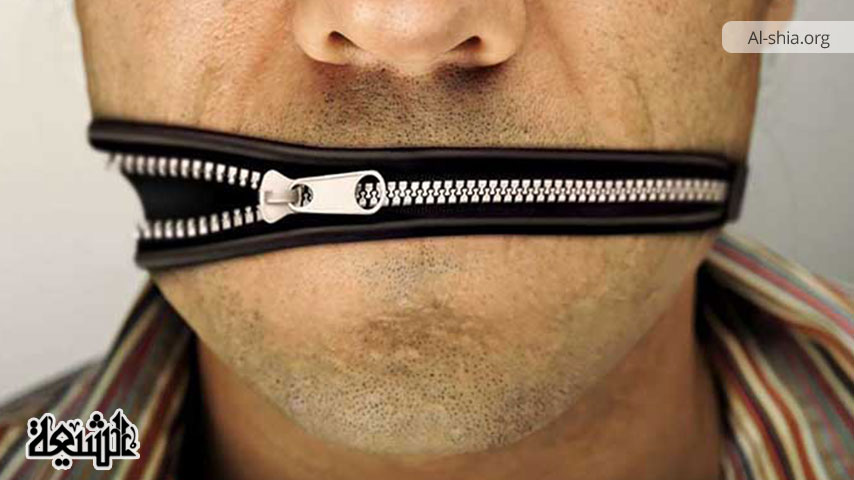

Speaking is one of the greatest blessings that God Almighty has bestowed upon human beings; a blessing that is explicitly mentioned in the Holy Quran: “He created man. He taught him speech”.[1]
This ability is the axis of communication, education, and upbringing, and the divine prophets were sent not with gold and silver, but with this very weapon of words and speech, in order to introduce God and existence to His servants.[2]
However, this blessing has both positive and negative dimensions, to the extent that Imam Ali (AS) regards it as both the best form of worship and the ugliest form of sin.[3]
What has always been emphasized and condemned in Islamic religious and ethical teachings is excess in the use of this blessing, which is referred to as excessive talking, verbosity, idle talk, and futile speech. Futile speech (laghw) refers to words that bring no benefit for this world and no benefit for the Hereafter; however, excessive talking is a broader concept.
In addition to useless speech, excessive talking also includes speaking more than what is necessary. In the Islamic worldview, excessive talking and verbosity, even if they do not involve sin or anything unlawful, are not approved, because they reduce opportunities for reflection and have harmful effects on a person’s character and social relationships.
This article seeks, through examining religious and ethical sources, to analyze the dimensions of the condemnation of excessive talking and verbosity, their individual and social harms, and finally to present practical strategies for controlling the tongue.
Conceptual Dimensions and the Condemnation of Excessive Talking and Verbosity
Excessive talking and verbosity refer to any speech that goes beyond what is sufficient and necessary; meaning that, if a person can convey their intention with one word, the second word is extra and counts as an instance of excessive talking.
The blameworthiness of this behavior stems from the deviation of speech from its primary purpose; that is, instead of being a means of guidance, remembrance, or goodness, speech turns into lahw (vain amusement) or laghw (idle talk).
As mentioned, laghw is an action or statement that has no benefit for this world or the Hereafter, whereas lahw is an entertaining activity that distracts a person from a reasonable and primary goal (nearness to God and spiritual perfection).
The Holy Quran, in condemning those who “buys diversionary talk that he may lead [people] astray from Allah’s way without any knowledge”,[4] regards excessive talking and verbosity as instances of “lahw al-hadith” (vain speech) and promises a humiliating punishment for those who engage in it: “For such there is a humiliating punishment”.[5]
Likewise, God Almighty explicitly approves of smallness in certain matters and dislikes their excess, and excessive talking and verbosity are among them. The Noble Prophet (PBUHH) said: “God loves three things: little speech, little sleep, and little eating. And He does not love three things and dislikes them: excessive talking, excessive sleeping, and excessive eating”.[6]
This clearly shows the ethical importance of speaking little. In contrast, matters such as knowledge,[7] remembrance,[8] charity,[9] and good deeds are the more desirable and more noble the more they increase. This distinction serves as a criterion for differentiating between beneficial speech and blameworthy excessive talking and verbosity.
Individual and Social Harms of Excessive Talking and Verbosity
The harmful effects of excessive talking and verbosity are not limited to wasting time; rather, they encompass the spiritual, personal, social, and otherworldly dimensions of a person.
1. Reduction of Opportunities for Reflection and Increase in Sin
One of the most important harms of excessive talking and verbosity is the reduction of mental focus and the loss of opportunities for reflection, such that a person’s intellectual energy is spent on useless words instead of concentration and contemplation.
Imam Sadiq (AS) considers thinking or reflection to be the sign of intelligence and silence to be the sign of thinking.[10] Therefore, speaking too much is a sign of weak intellect.
Moreover, an abundance of speech creates the ground for unintended slips. Imam Ali (AS), with a serious warning, emphasizes this point: “Avoid excessive speech, for the one who speaks too much will have many sins”.[11]
Excessive talking and verbosity set off a corrupting chain: “Whoever speaks much will slip much; whoever slips much will have little modesty; whoever has little modesty will have little piety; and whoever has little piety, his heart will die; and whoever’s heart dies will enter the Fire”.[12]
2. Loss of the Opportunity to Benefit from Others’ Speeches
Because of the desire for speaking, the excessively talkative person is constantly speaking and finds no opportunity to listen to others. While the wisdom of creation, by granting human beings one tongue and two ears, points to the need to speak less and listen more.
A person, throughout life, is in need of learning, reminders, and gaining experience; therefore, one should seek knowledge and benefit from the experiences and advice of others more than one seeks to instruct others. This lack of willingness to listen deprives the talkative person of others’ experiences.
3. Damage to Social Character and Becoming Disliked
Excessive and one-sided talking in friendly gatherings and within the family, even if it is enjoyable for the person themselves, takes away others’ opportunity to speak and ultimately leads to the excessively talkative person becoming disliked.
Talkative individuals are often unaware of the blameworthiness of their behavior or assume that they have not caused discomfort or objection in others, whereas others remain silent out of respect for the speaker, yet become weary of the lengthy speech.
Imam Ali (AS), emphasizing concise and beneficial speech, says: “The harm of speaking lies in being long-winded”.[13] Moreover, if a person turns to obscene and base speech, “you will gather the ignoble around you and drive the noble away from you”.[14]
4. Loss of Motivation for Action and Falling behind in Perfection
Another harm of excessive talking and verbosity is the loss of motivation for action. A person who speaks a lot about a subject, by taking pleasure in talking, fails to experience the pleasure of acting upon it, and as a result remains inactive and neglects action.
The conduct of true scholars and spiritual wayfarers also emphasizes speaking little and listening much in order to strengthen action. In this regard, it is narrated from Allama Tabatabai that in response to the question, “What should I do to attain presence of heart in prayer?” he said: “If you want to have presence of heart in prayer, speak less”.[15]
A true believer remains silent in order to stay safe, and speaks in order to benefit.[16]
Strategies for Controlling the Tongue and Treating Excessive Talking and Verbosity
Controlling the tongue is a continuous struggle, for the tongue is like a wild beast: if it is left unchecked, it will tear and harm. To restrain this beast, numerous practical and ethical strategies are found in religious texts and psychological recommendations. The main ones are mentioned below:
1. Self-control and Restraint (Purposeful Silence)
Practicing silence is the most fundamental step. This silence does not mean complete isolation; rather, it refers to refraining from corrupting, doubtful, empty, and meaningless speech, and the like.
Silence enables a person to bring their tongue under their control and to speak only what is right and pleasing to God. Imam Kazim (AS) also said: “Speaking little is great wisdom. Adhere to silence, for it brings good comfort and lightness, and it reduces sin”.[17]
2. Practicing the Skill of Active Listening
A person who feels troubled by their excessive talking and verbosity should treat this flaw by changing their communication style from monologue to dialogue and active listening. It should be noted that listening to others is itself a form of communication and gives others the right and space to speak.
3. Reflection before Speaking (Thinking, then speaking)
The speech of a believer comes after reflection. The Noble Prophet (PBUHH) said: “The tongue of the believer is behind his heart; when he wants to speak, he reflects upon it and then speaks. But the tongue of the hypocrite is in front of his heart; whenever he intends to speak, he utters it without reflecting upon it”.[18]
This instruction requires that words be weighed on the scale of thought and reflection before they leave the mouth, and that they be spoken only if there is goodness or benefit in them. Likewise, the Prophet’s (PBUHH) advice to Abu Dharr al-Ghifari that “nothing deserves prolonged imprisonment more than the tongue”[19] emphasizes the constant need for prudence before speaking.
4. Observing Brevity and Avoiding Verbosity
The conduct of the Infallible Imams (AS) shows that they would give answers that were complete yet concise. This method is one of the effective approaches in guidance and preaching that attracts people. Therefore, the best approach in responding and engaging in dialogue is to answer briefly and to the extent needed, rather than digressing into unnecessary side issues.
5. Adhering to the Noble Qualities of Speech
Instead of focusing on the quantity of speech, one should focus on its quality. Speech should possess qualities such as being upright, gentle, eloquent, appropriate, easy, pure, and good. Imam Sadiq (AS) also instructs his followers: “Be an adornment for us and do not be a cause of disgrace for us. Speak kindly to people, guard your tongues, and restrain them from excessive talk and obscene speech”.[20]
Conclusion
Excessive talking and verbosity are broader concepts than idle talk (laghw) and include any speech that goes beyond what is necessary. This trait has been condemned in religious teachings for multiple ethical, psychological, and social reasons.
From a religious perspective, excessive talking and verbosity deprive a person of opportunities for reflection and remembrance, and lead them into the trap of slips and an increase in sin.
Treating excessive talking and verbosity requires a fundamental change in one’s communication style. Controlling the tongue is the believer’s ongoing struggle, so that one’s speech becomes an adornment on the path of guidance and nearness to God.
Notes
[1] . Al-Rahman:3–4.
[2] . Kulayni, al-Kafi, vol.8, p.148.
[3] . Imam Sadiq (AS), Misbah al-Shariah, chapter 46.
[4] . Al-Luqman:6.
[5] . Al-Luqman:6.
[6] . Abi Firas al-Hilli, Tanbih al-Khawatir, vol.2, p.121.
[7] . Al-Ta Ha:114.
[8] . Al-Ahzab:41.
[9] . Majlisi, Bihar al-Anwar, vol.68, p.287.
[10] . Ibid, vol.75, p.3.
[11] . Amidi, Ghurar al-Hikam, p.214.
[12] . Muttaqi al-Hindi, Kanz al-Ummal, vol.2, p.112.
[13] . Amidi, Ghurar al-Hikam, p.280.
[14] . Ibid, p.214.
[15] . Misbah Yazdi, Rahiyan-e Kuy-e Dust, p.200.
[16] . Kulayni, al-Kafi, vol.2, p.231.
[17] . Harrani, Tuhaf al-Uqul, p.394.
[18] . Abi Firas al-Hilli, Tanbih al-Khawatir, vol.1, p.106.
[19] . Hurr al-Amili, Wasail al-Shia, vol.12, p.188.
[20] . Majlisi, Bihar al-Anwar, vol.71, p.286.
References
- The Holy Quran.
- Amidi, Abd al-Wahid ibn Muhammad al-Tamimi, Ghurar al-Hikam wa Durar al-Kalim, Qom, Dar al-Kitab al-Islami, 1420 AH.
- Harrani, Hasan ibn Ali ibn Shubah, Tuhaf al-Uqul an Al al-Rasul, Qom, Al Ali (AS), 1382 SH.
- Hurr al-Amili, Muhammad ibn Hasan, Wasail al-Shia, Qom, Muassasat Al al-Bayt (AS) li-Ihya al-Turath, 1409 AH.
- Ibn Abi Firas al-Hilli, Masud ibn Isa, Tanbih al-Khawatir wa Nuzhat al-Nawazir (known as Majmuat Waram). Tehran: Dar al-Kutub al-Islamiyyah, 1368 SH.
- Imam Sadiq (AS), Jafar ibn Muhammad (attributed to him). Misbah al-Shariah wa Miftah al-Haqiqah. Tehran: Payam-e Haqq, 1387 SH.
- Kulayni, Muhammad ibn Yaqub, Al-Kaf, Tehran: Dar al-Kutub al-Islamiyyah, 1407 AH.
- Majlisi, Muhammad Baqir, Bihar al-Anwar, Beirut, Dar Ihya al-Turath al-Arabi, 1403 AH.
- Misbah Yazdi, Muhammad Taqi, Rahiyan-e Kuy-e Dust, Qom: Mowj-e Elm, 1384 SH.
- Muttaqi al-Hindi, Ala al-Din Ali, Kanz al-Ummal fi Sunan al-Aqwal wa al-Afal. Beirut, Muassasat al-Risalah, 1409 AH.

![The Event of Ghadir and Imam al-Mahdi [afs]](https://en.al-shia.org/wp-content/uploads/2026/06/17221.jpg)