

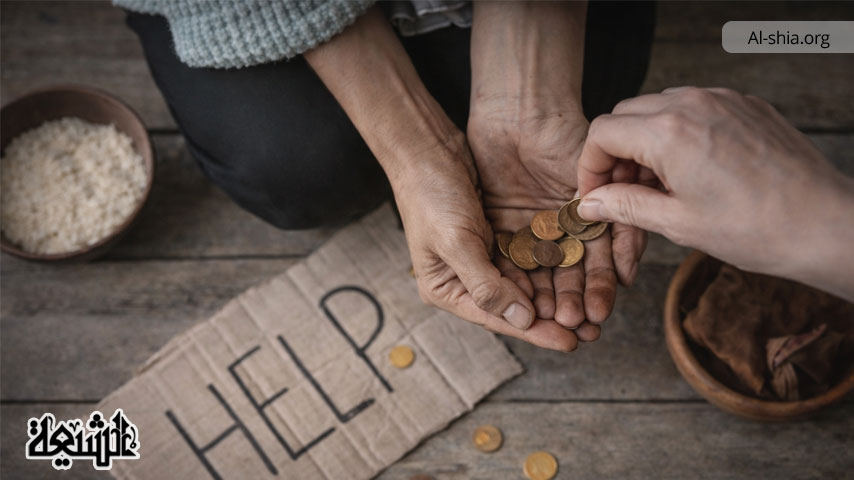

Spending (Infaq) means giving from what a person possesses and is able to share with others. This giving may take the form of knowledge, wealth and property, or even spending through affection, empathy, and emotional support for others.
Such giving can be directed toward either a right or a wrong purpose. There are people who use their wealth, possessions, or knowledge in an improper way, spending them to promote immoral actions or for killing and destroying human beings and nature.
Therefore, not every form of spending can be considered positive. Rather, only that kind of spending is positive and constructive which serves human and divine goals and leads to the moral and spiritual growth of the human being.
1. Not Being Ashamed of Giving a Small Amount
One of the etiquettes of spending is not feeling ashamed of giving a small amount. A person is not always able to give generously, and sometimes their ability is limited to giving only a little. Therefore, one should not deprive oneself of the reward of spending because of misplaced shame or embarrassment. In this regard, the Amir al-Muminin, Imam Ali (AS), said:
“Do not be ashamed of giving a small amount, for deprivation [of the reward of even that small amount] is less than that small amount itself”.[1]
In a narration reported by Abu Jamila from Imam Sadiq (AS), it is also stated that the Messenger of God (PBUH) said:
“Give charity, even if it is one sa of dates, or part of a sa,[2] or a handful, or part of a handful, or a single date, or a piece of a date. And whoever does not find even this, let them give charity with gentle speech [to the needy].
Indeed, one of you will meet God [after death], and God will say to him: Did I not do such and such for you? Did I not give you hearing and sight? Did I not grant you wealth and children? He will say: Yes.
God, blessed and exalted, will then say: So look at what you sent ahead for yourself. Then he will look in front of him, behind him, to his right and to his left, and he will find nothing with which to protect his face from the Fire”.[3]
2. Giving Directly with One’s Own Hand
The best way to deliver charity to a person in need is for one to take responsibility personally and give it directly with one’s own hand, without using an intermediary. This act has special effects and blessings, as expressed in a narration from Imam Sadiq (AS):
“Charity given by one’s own hand prevents an evil death, removes seventy kinds of afflictions, and passes by seventy devils at the side of the jaw, all of whom command the person not to give that charity”.[4]
In the book al-Khisal, the conduct of Imam Sajjad (AS) is described as follows:
“He used to support one hundred families among the poor of Medina. He liked that orphans, the disabled, the incapacitated, and the needy who had no means would be present at his table. He would give to them with his own hand, and for each of those who had dependents, he would take a portion of his food to their family”.[5]
3. Kissing the Gift After Giving It
One of the etiquettes of giving charity is that one should first place it in the hand of the beggar, then take it back, kiss it, and place it again in the beggar’s hand;[6] just as al-Muʿalla ibn Khunays narrates from Imam Sadiq (AS):
“God did not create anything without appointing a guardian to take care of it, except charity, for God, blessed and exalted, is Himself its guardian. Whenever my father gave something in charity, he would place it in the hand of the beggar, then take it back, kiss it and smell it, and then place it again in the beggar’s hand [and say]:
This is because charity reaches the hand of God before it reaches the hand of the beggar. Therefore, I liked to hold in my hand that which God the Exalted has taken upon Himself to receive”.[7]
4. Giving with the Right Hand
One of the etiquettes of spending is to give charity with the right hand, not the left. This practice is part of the tradition of the Noble Prophet (PBUH), for he used to perform his actions, including giving and receiving, with his right hand.
As reported in Makarim al-Akhlaq, citing Kitab al-Nubuwwah, the Amir al-Muminin, Imam Ali (AS), said regarding the Noble Prophet (PBUH):
“His right hand was used for eating, drinking, giving, and receiving; he would neither take nor give anything except with his right hand, and his left hand was used for other bodily needs. Moreover, he liked to give preference to the right side in all his affairs, such as putting on clothes and shoes and dismounting from his mount”.[8]
This is an allusion to cleansing the body with the left hand. The meaning is that since the Prophet used his left hand for bodily purification, he preferred to perform other actions with his right hand.
5. Feeding the Poor and Sharing a Meal with Them
A group of narrations, in addition to emphasizing the virtue of giving charity directly by hand, also highlight the desirability of inviting believing brothers or Muslims to one’s home and feeding them as guests. An example is the narration of Safwan al-Jammal from Imam al-Sadiq (AS), who said:
“That my Muslim brother eats a single meal with me is more beloved to me than freeing a slave”.[9]
Likewise, it is reported in the conduct of Imam Rida (AS):
“Whenever he was alone and his table was spread, he would seat his servants and attendants, even the doorkeeper and the caretaker of his horses, at his table [and share the meal with them]”.[10]
6. Striving to Fulfill the Needs of a Believer
A number of narrations describe the virtue and reward of walking and striving to fulfill the need of a believing brother or a Muslim. From these narrations, one can also understand the importance and desirability of personally undertaking acts of spending and charity.
The late Kulayni (may God have mercy on him) has recorded several narrations on this subject in his noble book al-Kafi.[11] One example is the narration of Abu Ubayda al-Hadhdha from Imam Baqir (AS), who said:
“Whoever walks in order to fulfill the need of his Muslim brother, God will shade him with seventy-five thousand angels. He does not take a step except that God writes for him a good deed because of it, erases a sin from him, and raises him one rank.
Then, when he finishes fulfilling his need, God, Mighty and Exalted, records for him the reward of one who has performed hajj and umrah”.[12]
7. Asking the Recipient for Supplication
Benefiting from the answered supplication of the poor or the beggar is one of the means for resolving worldly and otherworldly difficulties, such as the healing of incurable illnesses. In a narration from Imam Sajjad (AS), it is stated:
“There is no person who gives charity to a weak and oppressed poor person, and that poor person prays for him at that moment for something, except that the supplication is answered in his favor”.[13]
In another narration, reported by Abd Allah ibn Sinan from Imam Sadiq (AS), it is stated:
“It is recommended for a sick person to give charity to a beggar with his own hand and to ask him to pray for him”.[14]
8. Proportion Between Spending and the Moral Status of the Recipient
Another etiquette of spending is observing proportionality between the amount given and the religious knowledge and moral virtues of the recipient, such as their level of awareness, faith, Islam, piety, courage, generosity, forgiveness, and self-sacrifice.
The perfection or deficiency of faith and other moral qualities also leads to an increase or decrease in the amount of spending.
In the words and conduct of the Infallibles (AS), there are also explicit statements regarding the effect of knowledge and understanding on increasing the amount of spending. For example, al-Khwarazmi (d. 567 AH), in his book Maqtal al-Hussain, narrates a story whose summary is as follows:
A Bedouin man who had become responsible for paying a full blood money and was unable to pay it came to Imam Hussain (AS) and asked for help. The Imam made his gift conditional upon the man answering several questions, stating that he would give to him in proportion to the correctness of his answers. He cited a saying of the Prophet (PBUH):
“Goodness (kindness) is according to the level of understanding”.
He then began asking the questions, and after the Bedouin answered all of them correctly, the Imam gave him one thousand gold dinars along with his own ring, whose gemstone was worth two hundred dirhams. He then said: “O Bedouin, give the dinars to your creditors, and use this ring for your living expenses”.[15]
One noteworthy point in this story is the consideration of the petitioner’s knowledge and understanding in determining the amount of charity given to him, along with taking into account his request and his real need.
Another matter mentioned in the words and conduct of the religious leaders, which is also related to the dignity and status of the recipient of charity, is honoring honorable people. The Noble Prophet (PBUH) said:
“When an honorable person from a people comes to you, honor him”.[16]
Therefore, in determining the amount of spending, one should also take into account the dignity and social standing of individuals. This consideration can even be extended to the type and form of spending, as seen in a narration from Imam Sadiq (AS) regarding obligatory zakat:
“The zakat of livestock should be given to the dignified poor, because the zakat of animals is superior to the zakat of wealth, even though all of it is charity and zakat. Dignified people are ashamed to take the zakat of wealth”.[17]
By dignified poor, what is meant are those poor individuals who conceal their poverty and, among people, present their living conditions as good and respectable.[18]
9. Giving Help Secretly
One of the methods employed by the Ahl al-Bayt (AS) to preserve the human dignity of the poor was providing assistance secretly and at night. In the conduct of the Amir al-Muminin, Imam Ali (AS), it is reported that one night Harith al-Hamdani came to him and said:
“I have a need, and I have found you worthy of fulfilling it”. The Imam immediately stood up, extinguished the lamp, sat down, and said: “I put out the lamp so that I would not see the humiliation of need on your face”.[19]
Unfortunately, in our Islamic society today, this important and sensitive principle is sometimes neglected. Those in need are not only repeatedly confronted face to face with individuals or charitable institutions, but sometimes their images are also publicized in the media, thereby trampling what remains of their dignity and honor.
10. Creating a Barrier Between Oneself and the Needy
Another etiquette of spending, and one of the measures used by the Ahl al-Bayt (AS) to prevent direct confrontation with those in need, so that they would not feel embarrassed, was to create a barrier or screen between themselves and the needy person and to help them from behind it.
For example, a man from Khurasan, who was among the followers of the Ahl al-Bayt (AS), went on the pilgrimage to Mecca and ran out of provisions on the way, becoming stranded, even though he was financially well-off in his hometown.
He therefore came to Imam Rida (AS) and, in a gathering attended by many people, asked the Imam to provide him with the expenses needed to return home, so that after reaching his destination he would give that amount as charity on behalf of the Imam (AS).
Imam Rida (AS) asked him to sit down, and after the people in the gathering had dispersed, he went into the inner part of his house and closed the door. Then he extended his hand from behind the door and said to the man from Khurasan:
“Take these two hundred dinars, use them for your travel expenses, seek blessing through them, and do not give charity on my behalf in return for them. Go, so that we do not face each other”.
This statement was made by the Imam in response to the words of the man from Khurasan, who had said: “Give me some money so that when I reach Khurasan, I may give it in charity on your behalf”. That is, this gift or assistance was a gratuitous donation, and it was not necessary for him to give charity on the Imam’s behalf in return.
One of the Imam’s companions who was present there asked: “May I be sacrificed for you! Why did you conceal your face from him?”
The Imam (AS) replied: “For fear that, because I fulfilled his need, I might see the humiliation of asking on his face”.[20]
11. Turning a Verbal Request into a Written One
Another way of preserving the dignity and honor of those in need was to transform their verbal requests into written ones. Naturally, the humiliation of making a verbal request is far greater than that of a written one, because in writing, the pen represents the tongue and the written text replaces spoken words.
This reduces direct confrontation between the giver and the receiver, and as a result, the recipient’s dignity is better preserved.
A man came to the Amir al-Muminin, Imam Ali (AS), and said: “I have a need to present to you”. The Imam (AS) said: “Write it on the ground, for I see signs of distress clearly on your face”.[21]
How good it would be if benefactors and charitable institutions were to learn and adopt this method as a model for their own practice.
Especially today, with the expansion of means of communication such as postal services, telephones, mobile phones, the internet, and ATM services, new measures can be devised to preserve the dignity and honor of those in need, and modern technologies can be put to use for new methods of charitable work.
These are some of the ways of honoring those in need. In addition to the cases mentioned above, there are other practices that the Imams (AS) have recommended or employed to honor the needy;
such as not turning away a beggar, taking the initiative in giving and offering help before being asked, hastening to fulfill the needs of others, directing people away from asking others toward asking the Lord, encouraging work and effort instead of asking from others, and discouraging begging.
Conclusion
Spending is positive and constructive only when it serves human and divine goals and leads to the moral and spiritual perfection of the human being. The principles and etiquettes of spending have also been established with the aim of advancing these very goals.
Some of these etiquettes include not being ashamed of giving a small amount, giving directly and without intermediaries, feeding others in one’s own home and sharing a meal with the poor, turning verbal requests into written ones, creating a barrier between oneself and the needy, and providing secret and nighttime assistance.
When we reflect carefully on the etiquettes of spending, it becomes clear that some of them yield outcomes such as preventing arrogance and self-glorification in the giver and preserving the dignity and honor of the recipient.
Notes
[1] . Sharif al-Radi, Nahj al-Balagha, Wisdom 67.
[2] . Approximately 10 to 12 kilograms.
[3] . Kulayni, al-Kafi, vol.4, p.3, hadith 11.
[4] . Kulayni, al-Kafi, vol.4, p.3, hadith 7.
[5] . Shaykh al-Saduq, al-Khisal, vol.2, p.518, concerning Imam Sajjad (AS).
[6] . Shaykh al-Saduq, al-Muqniah, p.175.
[7] . Shaykh al-Saduq, Thawab al-Amal, p.144.
[8] . Tabarsi, Makarim al-Akhlaq, p.23.
[9] . Kulayni, al-Kafi, vol.2, p.203, hadith 13.
[10] . Shaykh al-Saduq, Uyun Akhbar al-Rida (AS), vol.2, p.184.
[11] . Kulayni, al-Kafi, vol.2, pp. 196–197.
[12] . Kulayni, al-Kafi, vol.2, p. 197, hadith 3.
[13] . Shaykh al-Saduq, Thawab al-Amal, pp. 144–145.
[14] . Kulayni, al-Kafi, vol.4, pp. 3–4, hadith 9.
[15] . Khwarazmi, Maqtal al-Hussain (AS), vol.1, pp. 224–228.
[16] . Kulayni, al-Kafi, vol.2, p.659, hadith 1.
[17] . Shaykh al-Saduq, al-Muqniah, p.260.
[18] . Himyari, Shams al-Ulum, vol.2, p.1177.
[19] . Kulayni, al-Kafi, vol.4, p.24, hadith 4.
[20] . Kulayni, al-Kafi, vol. 4, pp. 23–24, hadith 3.
[21] . Shaykh al-Saduq, al-Amali, pp. 273–274.
References
- Himyari, Nashwan ibn Said; Shams al-Ulum; edited by Mutahhar ibn Ali Aryani, Yusuf Muhammad Abdullah, and Husayn ibn Abdullah Amri, 1st ed., Damascus: Dar al-Fikr, n.d.
- Khwarazmi, Muwaffaq ibn Ahmad; Maqtal al-Hussain (AS), 2nd ed., Qom: Anwar al-Huda, 1423 AH.
- Kulayni, Muhammad ibn Yaqub; al-Kafi (Dar al-Hadith edition); edited by Dar al-Hadith, 1st ed., Qom: Dar al-Hadith, 1429 AH.
- Sharif al-Radi, Muhammad ibn al-Husayn; Nahj al-Balaghah; edited by Subhi al-Salih, 1st ed., Qom: Hijrat, 1414 AH.
- Shaykh al-Saduq, Muhammad ibn Ali ibn Babawayh al-Qummi; al-Amali, 6th ed., Tehran: Ketabchi, 1376 SH.
- Shaykh al-Saduq, Muhammad ibn Ali ibn Babawayh al-Qummi; al-Khisal; edited by Ali Akbar Ghaffari, 1st ed., Qom: Jamiat al-Mudarrisin, 1362 SH.
- Shaykh al-Saduq, Muhammad ibn Ali ibn Babawayh al-Qummi; al-Muqniah, 1st ed., Qom: Imam Mahdi Institute (AS), 1415 AH.
- Shaykh al-Saduq, Muhammad ibn Ali ibn Babawayh al-Qummi; Thawab al-Amal wa Iqab al-Amal, 2nd ed., Qom: Dar al-Sharif al-Radi, 1406 AH.
- Shaykh al-Saduq, Muhammad ibn Ali ibn Babawayh al-Qummi; Uyun Akhbar al-Rida (AS); edited by Mahdi Lajvardi, 1st ed., Tehran: Nashr-e Jahan, 1378 SH.
- Tabarsi, Hasan ibn Fadl, Makarim al-Akhlaq, Qom, al-Sharif al-Radi Publications, 1370 SH.
Source of the article | Adapted from:
Deliri, Kazem, An Introduction to the Style of Generosity: The Principles and Rules of Spending in the Ethical System of Islam; Qom: Research Institute for Islamic Sciences and Culture, 1398 SH.



![The Event of Ghadir and Imam al-Mahdi [afs]](https://en.al-shia.org/wp-content/uploads/2026/06/17221.jpg)