

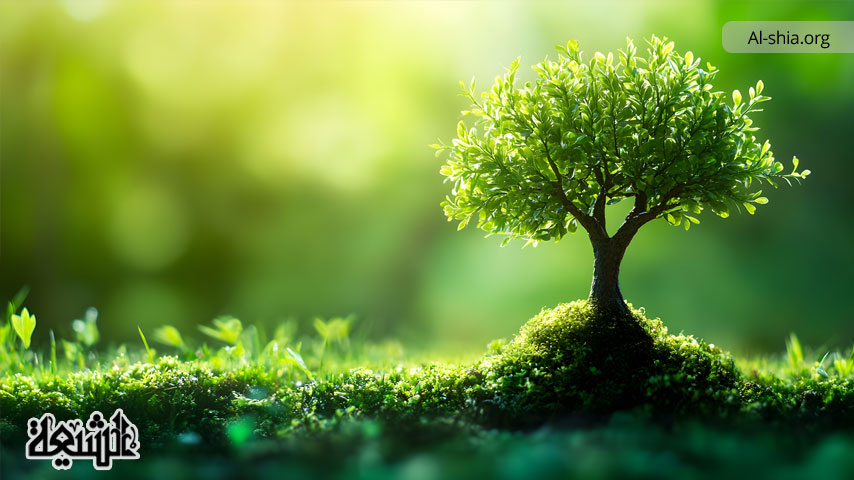

Protecting the environment is a necessity and is vital for the survival of human beings and all other living creatures on Earth. Preserving the environment not only contributes to improving the quality of human life, but also has economic, social, and moral significance. In Islam, the protection of the environment is emphasized as a religious and ethical duty.
Islam stresses that human beings have responsibilities toward the environment and must treat it with respect and use natural resources carefully so that they may be preserved for future generations. This emphasis points to the importance of maintaining balance in nature, safeguarding living beings and natural resources, for the well-being of humanity and the preservation of God’s creation.
The Status of the Environment in Islam
From the perspective of the Holy Quran, the earth is the cradle and resting place of humankind, which God has prepared for them.[1] After creating this cradle and bringing humanity into existence, God revealed: “He brought you forth from the earth and made it your habitation”.[2]
The Noble Prophet (PBUHآ), upon whom God placed the responsibility of explaining the Quran, states: “Protect the earth, for it is your mother; whoever performs a good or bad deed upon it, it will report it”.[3]
On the other hand, we know that the best cradle is a mother’s embrace, which generously bestows love upon her child and protects him from harm. Thus, the earth being described as a cradle likens it to a mother whose well-being, mercy, and protection should be a matter of concern for her child.
In light of these statements about the earth and the environment, along with other similar verses and narrations, it must be understood that the school of divine revelation detests those who destroy the environment. Indeed, it considers the corruption of the earth to be the work of hypocrites and liars who claim to be reformers and to eliminate corruption.[4]
The Quran describes such people as those who, “when he attains authority and takes charge, strives to spread corruption on the earth, destroying crops and offspring; and God does not love corruption”.[5] Based on this fundamental principle, the duties of human beings in their interaction with the environment must be clarified.
1. Striving for Beauty and Pleasant Fragrance in the Environment
Imam Sadiq (AS) says: “God loves beauty and adornment and dislikes disorder and the pretension of poverty. When God grants a blessing to a servant, He loves to see its effects upon him”. It was asked: “How is that?”. He replied: “He should wear clean clothes, use fragrance, plaster his house, sweep the area in front of his courtyard; even lighting a lamp before sunset removes poverty and increases provision”.[6]
Imam Hadi (AS), narrating from his forefathers from his grandfather Imam Sadiq (AS), states: “God loves beauty and being beautiful, and dislikes ugliness and appearing ugly…”. They asked, “How should we be?”. He replied: “Keep your clothes clean, use fragrance, make your home beautiful and clean, and remove waste from your living environment …”.[7]
A city whose people live in such a beautiful and orderly manner, avoid filth, do not tolerate the presence of waste in their living environment, and, in short, are people of light and cleanliness, is clearly wholesome. Such a community enjoys a pleasant and lively life.
2. Cleanliness of the Living Environment
The system of creation is in its most beautiful form. A well-known saying of the Messenger of God (AS) states: “Cleanliness and removing impurity are part of faith”.[8] It is also narrated from Imam Ali (AS): “Purity and cleanliness are half of faith”.[9] Thus, part of faith is achieved through maintaining cleanliness in one’s life and in the environment.
Accordingly, in the Islamic way of life, having a clean land is a necessity. This necessity entails obligation and requires Muslims not to pollute the earth. Beyond the land itself, the air of the living environment must also be clean.
From the Islamic perspective, life is not pleasant without clean air, and clean air must be accompanied by abundant and wholesome water, described as “pure water”,as well as fertile land.
This truth is narrated from Imam Jafar al-Sadiq (AS): “A pleasant and desirable life is not possible except with three things: clean air, abundant and wholesome water, and soft, fertile land”.[10]
The Messenger of Islam (PBUHH) described Islam in these words: “Islam is clean and pure; therefore, be clean and pure yourselves, and know that none shall enter Paradise except one who is clean and pure”.[11] The message of this statement is that a person who is polluted and who pollutes the environment is not worthy of entering the paradise promised by Islam.
3. Preventing Environmental Pollution
Another duty of every Muslim with regard to environmental health is to prevent environmental pollution by substances that are harmful to human health. Among such harmful substances are poisons. The hadith literature clearly indicates that, in Islamic law, the use of toxic substances is prohibited, even in times of war.
Imam Sadiq (AS) narrates from Amir al-Muminin (AS): “The Messenger of God forbade the use of poison in the lands of the polytheists”.[12]
Another harmful pollutant is human waste. For this reason, Islam has provided specific guidelines even for urination, defecation, and the places designated for them, in order to keep the environment clean and to protect the health of human habitats and other living beings.
Imam Sadiq (AS), narrating from Amir al-Muminin (AS), reports from the Messenger of God (PBUHH) that he “forbade relieving oneself near water that people use for drinking, along the banks of streams from which they drink, and beneath fruit-bearing trees”.[13]
The Ahl al-Bayt (AS) never neglected to teach proper conduct in any matter. Imam Kazim (AS) was asked about the correct manner of relieving oneself, and he replied: “…Do not face the direction of the wind, nor turn your back to it”.[14]
The Imam drew attention to the fact that odor and particles of impurity and pollution first spread through the air, and after drying, the waste itself and contaminated soil disperse in the environment. Therefore, it is necessary that waste not be released in the direction of the wind.
In the Islamic lifestyle, travelers and strangers who enter an area are also instructed that they do not have the right to relieve themselves anywhere they wish. A man asked Imam Sajjad (AS): “Where should strangers prepare themselves for ablution and its preliminaries?”.
The Imam (AS) replied: “They should avoid urinating and defecating along water channels, on busy pathways, beneath fruit-bearing trees, and in places that are deserving of curse”. He was asked: “Which places are deserving of curse?”. He replied: “Doorways”.[15]
4. Protecting Water Resources in the Environment
Water, which is the most important factor and the foundation of life and the prosperity of the earth,[16] and which God has made pure, purifying, and a means of ritual cleanliness, must be protected from pollution. Everyone is responsible for striving to prevent its contamination.
If water remains pure as it descends from the sky, it becomes a means for removing satanic impurities and eliminating disease-causing pollution,[17] as well as for the growth of crops and fruits.
In a verse describing the flowing waters of Paradise, God Almighty says: “The description of the Paradise promised to the God-conscious is that in it are rivers of pure water whose taste and smell have not changed…”.[18]
The protection of water is so important that the Noble Prophet (PBUH) even forbade people from spitting into a well from which they drink.[19] Imam Ali (AS) also states in a narration: “Let none of you contaminate water; and whoever does so and suffers harm should blame none but himself, for water has its own sanctity”.[20]
5. Protecting Trees and Expanding Tree Planting
Trees and plants are a fundamental pillar of the environment, without which human life would not be possible. For this reason, protecting them is a divine duty placed upon human beings. Imam Sadiq (AS), addressing al-Mufaddal, says: “O Mufaddal! Take a lesson from the wise and deliberate creation and preparation of things to meet human needs… Trees were created for him, and he must plant them in the earth, water them, and care for them …”.[21]
It is narrated from Imam Sadiq (AS): “Engage in agriculture and plant trees; by God, people perform no act more lawful and purer than this”.[22]
To encourage the expansion of tree planting, Islam presents the highest moral incentives, enduring incentives that ensure eternal reward. The Seal of the Prophets (PBUHH) regarded the planting of fruit-bearing trees as a charitable act and said: “Whoever plants a sapling without injustice or violating the rights of others, as long as the creatures of God, the Most Merciful, benefit from it, the reward will continue for the planter”.[23]
The refinement of the Islamic lifestyle in maintaining a clean and healthy environment becomes evident when we see that it assigns the greatest incentives for creating and preserving green spaces.
The Seal of the Prophets (PBUHH) considered planting fruit trees an act of charity and encouraged it by saying: “Whoever plants a tree, even if no human or creature among God’s creation directly benefits from it, it is still counted as charity for him”.[24]
Today, everyone clearly understands that trees produce oxygen, and that visible or direct use is not the sole criterion for an act to be considered charity. The oxygen produced and the other benefits of a planted tree, which contribute to the cleanliness and purity of the earth and the human living environment, constitute a continuous charity that flows as long as the tree lives and is recorded in the planter’s record of deeds.
In Islam, not only is tree planting recommended, but watering and caring for trees are also strongly emphasized. It is narrated from the Noble Prophet (PBUHH): “Whoever waters a tree in the desert or a lote tree is like one who quenches the thirst of a believer”.[25]
Islam strongly forbids harming trees and cutting them down without justification. The Messenger of God (PBUHH) would advise military commanders and their forces before any engagement not to cut down any tree unless it was absolutely necessary.[26]
An important point to note is that, according to the Ahl al-Bayt (AS), planting trees is considered an act of worship. It is reported that they would remember God, supplicate, or recite verses from the Quran while planting saplings, and they encouraged others to follow their example.
In a narration, we read that when planting a tree or sowing crops, one should recite this verse: “A good word is like a good tree, whose roots are firm and whose branches are in the sky; it gives its fruit at all times by the permission of its Lord”.[27]
6. Protecting Animals and Wildlife
Paying attention to all dimensions of the environment is encouraged by the sacred religion of Islam. Animals, both domestic and wild, constitute another important component of the environment. God Almighty draws human attention to animals and, in numerous verses, calls people to reflect upon their creation, presenting them as signs of His power, wisdom, and mercy.[28]
In Surah al-Nahl alone, while describing livestock, the Quran mentions several important roles these animals play in human life, such as providing clothing, food, beauty and adornment of the environment, and transportation. In verse 8 of this surah, three animals, horses, mules, and donkeys, are mentioned in particular for the benefits of riding and beautifying the surroundings.[29]
Amir al-Muminin (AS) states: “Fear God regarding His servants and His lands, for you are responsible even for the lands and the animals”.[30] This statement clearly expresses human responsibility toward animals.
Islam places such importance on animals that books of hadith devote specific chapters to the rules and regulations concerning animals and living creatures. By studying these texts carefully, one realizes how sensitive Islam is regarding the environment, the rights of living beings, and their protection.[31]
Divine leaders showed kindness to every harmless living creature whose existence caused no harm to anyone or anything, and they encouraged others to do the same. It is narrated that Jesus Christ (AS), while passing along the seashore, threw some of his own food into the sea.
Some of his disciples asked: “O Spirit of God, why did you do this?”. He replied: “For the animals of the sea to feed on it, and the reward of this act is great with God”.[32]
In the Islamic lifestyle, the sense of responsibility toward the thirst of animals is the same as the sense of responsibility toward human beings. It is narrated from Imam Muhammad Baqir (AS): “Relieving a burning, thirsty liver is an obligation; and whoever quenches the thirst of a thirsty animal or any other living being, God will shelter him under His shade on the Day when there will be no shade except His”.[33]
Umm Kulthum (SA), while describing the event of the martyrdom of Amir al-Muminin (AS), states that he gave instructions regarding some ducks that had been brought as a gift for her brother Hussain (AS). He said: “My daughter, by my right over you, release them. You have confined creatures that have no tongue and cannot express their hunger or thirst. Therefore, either provide them with food and water or release them so that they may obtain their sustenance from the earth”.[34]
Regarding the care of animals, Imam Sadiq (AS) narrates from the Messenger of God (PBUH): “Do not remove or hunt young birds that have not yet grown feathers and cannot fly from their nests”.[35]
Islam’s view of animals is such that no one has the right to kill an animal without purpose. It is narrated from the Messenger of God (PBUH): “Whoever kills a sparrow without just cause, on the Day of Resurrection that bird will cry out against him, saying: O God, so-and-so killed me in vain and not for any benefit”.[36]
7. Preserving Environmental Tranquility
In the Islamic system, a desirable environment is one that enjoys security and assured tranquility: “God sets forth a parable: a town that was secure, calm, and at ease” (for those who are ungrateful for blessings).[37]
In several verses, God, Exalted and Glorious, counts the night as a blessing and a time for rest and tranquility.[38] Tranquility is of such importance that in Surah al-Qasas He says: “Who other than the One God can create something like the night, in which you find rest?”.[39]
In another verse, God describes the home as a place of tranquility; for this reason, the house and sleeping place of a person is called maskan (a place of rest). In verse 80 of Surah al-Nahl, we read: “It is God who has made your homes for you a place of rest”.[40]
In the Islamic way of life, God does not allow anyone to disturb the tranquility of others. To ensure this, He addresses the believers: “O believers, do not enter houses other than your own unless you announce yourselves and seek permission”.[41]
This right is not limited to human beings. Preserving environmental tranquility, especially at night, is also necessary for animals and birds. Imam Sadiq (AS) narrates from the Messenger of God (PBUHH) regarding disturbing birds, particularly at night and during their rest:
“At night, do not remove chicks from their nests, and do not take a bird from its nest for slaughter while it is sleeping until morning”. A man asked: “When is its time of sleep?”. The Prophet (PBUHH) replied: “The night is its time of rest; therefore, do not approach it at night, wait until morning”.[42]
Environmental tranquility may also be disturbed by noise pollution and auditory disturbances. God Almighty, quoting Luqman’s advice to his son, says: “Lower your voice; indeed, the most unpleasant of sounds is the braying of donkeys”.[43]
Conclusion
Islam is the religion of purity and cleanliness. Accordingly, any behavior that leads to corruption or pollution in the realm of the environment is prohibited in Islam. On the other hand, for the well-being and health of the environment, numerous recommendations are found in the verses of the Holy Quran and the words of the Ahl al-Bayt (AS).
These include encouragement to beautify and fragrance the environment, maintain cleanliness in living spaces, prevent environmental pollution, protect water resources, trees, and animals, and preserve environmental tranquility.
Notes
[1] . Al-Taha:53; Al-Zukhruf:10.
[2] . Al-Hud:61.
[3] . Payandeh, Nahj al-Fasahah, p. 380, hadith 1130.
[4] . Al-Baqarah:11.
[5] . Al-Baqarah:205.
[6] . Tabarsi, Makarim al-Akhlaq, p.41.
[7] . Majlisi, Bihar al-Anwar, vol.37, p.175, vol. 3.
[8] . Payandeh, Nahj al-Fasahah, p.791.
[9] . Maghribi, Daaim al-Islam, vol.1, p.100.
[10] . Ibn Shubah al-Harrani, Tuhaf al-Uqul, p.329.
[11] . Payandeh, Nahj al-Fasahah, vol.2, p.998.
[12] . Kulayni, Al-Kafi, vol.5, p.28, hadith 2.
[13] . Saduq, Al-Khisal, vol.1, p. 97.
[14] . Kulayni, Al-Kafi, vol.3, p.15, hadith 3.
[15] . Kulayni, Al-Kafi, vol.3, p.15, hadith 2.
[16] . Al-Anbiya:30.
[17] . Al-Anfal:11.
[18] . Muhammad:15.
[19] . Saduq, Man La Yahduruhu al-Faqih, vol.4, p.10.
[20] . Ibn Shubah al-Harrani, Tuhaf al-Uqul, p.97.
[21] . Mufaddal, Umar, Tawhid al-Mufaddal, p.86.
[22] . Saduq, Man La Yahduruhu al-Faqih, vol.3, p.250, hadith 3907.
[23] . Nuri, Mustadrak al-Wasail, vol. 31, p. 260, hadith 15895.
[24] . Payandeh, Nahj al-Fasahah, vol.2, p.563.
[25] . Hurr al-Amili, Wasail al-Shia, vol.17, p.42.
[26] . Kulayni, Al-Kafi, vol.5, p.27, hadith 1.
[27] . Kulayni, Al-Kafi, p.264, hadith 7.
[28] . Al-Baqarah:164.
[29] . Al-Nahl:5–8.
[30] . Sharif al-Radi, Nahj al-Balagha, sermon 197.
[31] . Kulayni, Al-Kafi, vol.7, p.367.
[32] . Hurr al-Amili, Wasail al-Shia, vol.9, p.40.
[33] . Kulayni, Al-Kafi, vol.2, p.58, hadith 6.
[34] . Nuri, Mustadrak al-Wasail, vol.8, p.306, hadith 9511.
[35] . Kulayni, Al-Kafi, vol.6, p.216, hadith 3.
[36] . Muttaqi, Kanz al-Ummal, vol.15, pp. 37–38, hadith 39971.
[37] . Al-Nahl:112.
[38] . Al-Yunus:67; Al-Anam:96; Al-Naml:86; Al-Ghafir:61, etc.
[39] . Al-Qasas:72.
[40] . Al-Nahl:80.
[41] . Al-Nur:27.
[42] . Kulayni, Al-Kafi, vol.6, p.216, hadith 2.
[43] . Luqman:19.
References
- The Holy Quran.
- Hurr al-Amili, Muhammad ibn Hasan, Wasail al-Shia, Qom, Al al-Bayt (AS) Institute, 1409 AH.
- Ibn Shubah al-Harrani, Hasan ibn Ali, Tuhaf al-Uqul, Qom, Jameeh-ye Modarresin, 1363 SH.
- Kulayni, Muhammad ibn Yaqub, Al-Kafi, ed. Ali Akbar Ghaffari, 3rd ed., Tehran, Dar al-Kutub al-Islamiyyah, 1367 SH.
- Maghribi, Qadi Numan, Daaim al-Islam, Egypt, Dar al-Maarif, 1383 AH.
- Majlisi, Muhammad Baqir, Bihar al-Anwar, ed. Miyyanji and Behboudi, Beirut, Al-Wafa Institute, 1403 AH.
- Mufaddal, Umar, Tawhid al-Mufaddal, Beirut, Al-Wafa Institute, 1404 AH.
- Muttaqi, Ali ibn Husam al-Din, Kanz al-Ummal, ed. Shaykh Bakri Hayani, Beirut, Al-Risalah Institute, 1409 AH.
- Nuri, Hussain, Mustadrak al-Wasail, Qom, Al al-Bayt (AS) Institute, 1408 AH.
- Payandeh, Abolqasem, Nahj al-Fasahah, Tehran, Donyaye Danesh, 1382 SH.
- Saduq, Muhammad ibn Ali ibn Babawayh, Al-Khisal, ed. Ali Akbar Ghaffari, Qom, Jameeh-ye Modarresin Publications, 1362 SH.
- Saduq, Muhammad ibn Ali ibn Babawayh, Man La Yahduruhu al-Faqih, ed. Jafar Shams al-Din, Beirut, Dar al-Taaruf, 1411 AH.
- Sharif al-Radi. Nahj al-Balagha, arranged by Subhi al-Salih, Qom, Dar al-Hijra, 1414 AH.
- Tabarsi, Hasan ibn Fadl, Makarim al-Akhlaq, Qom, Sharif Razi Publications, 1370 SH.
Source of the article | Adapted from: Mirarab, Farajollah, Conduct Toward the Environment Based on the Teachings of the Quran and the Ahl al-Bayt (AS), Research Institute for Islamic Sciences and Culture, pp. 32–55.



![The Event of Ghadir and Imam al-Mahdi [afs]](https://en.al-shia.org/wp-content/uploads/2026/06/17221.jpg)