

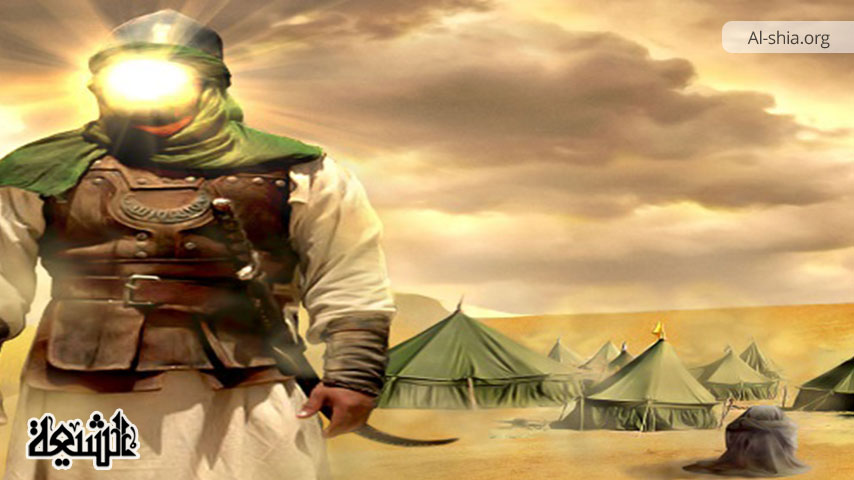

The bravery and courage of Imam Hussain (AS) on the battlefield of Karbala is clearly evident. With only a small number of companions, he stood against the vast army of Yazid and fought with complete courage.
This bravery was not only physical but also spiritual and psychological. Imam Hussain (AS), fully aware of the outcome, chose the path of martyrdom. Through this decision, he showed the world that a human being can stand against oppression and defend his values.
The bravery and courage of Imam Hussain (AS) is not only visible on the battlefield, but also in the realm of diplomacy and dialogue. Throughout his life, he made great efforts to reform society and struggle against injustice. Through writing letters and engaging in discussions with various individuals, he sought to enlighten public awareness.
The following are examples of the bravery and courage of Imam Hussain (AS) in the battlefield and in diplomacy, from his childhood to the moment of his martyrdom:
Scenes of Bravery and Courage of Imam Hussain (AS) in Childhood
Imam Hussain (AS) was known for his bravery and heroism from childhood, and he demonstrated these qualities even in the face of enemies such as Abu Bakr and Umar. His courage, shown in the sensitive political circumstances of that time, was unparalleled and inspiring in defending the guardianship and leadership (wilayah and imamate).
During the caliphate of Abu Bakr, when Imam Ali (AS) had been pushed into isolation and people had become accustomed to silence and compromise, Imam Hussain (AS) repeatedly defended the rights of himself and his noble father with complete courage.
One of the most famous examples is his entry into the Prophet’s Mosque (PBUHH) on a day when Abu Bakr was sitting on the Prophet’s pulpit delivering a sermon. Imam Hussain (AS), in a loud voice and a firm tone, said to Abu Bakr: “This pulpit belongs to my father, not your father”.
Stating this truth in that political atmosphere of Medina was extremely shocking; therefore, Abu Bakr became deeply disturbed, bowed his head, and knelt down, effectively lowering himself in acknowledgment of his weakness, inability, and the injustices he had committed. He said: “You have spoken the truth; this pulpit belongs to your father, not my father”.[1]
The Courage of Imam Hussain (AS) in His Youth
Even during his teenage years, Imam Hussain (AS) defended the guardianship of his noble father, the Commander of the Faithful (AS), with remarkable boldness. This courage emerged at a time when, after the passing of the Prophet (PBUHH), the caliphate had been transferred to Umar ibn al-Khattab.
In such circumstances, the Imam boldly stood against the unjust and improper policies of the rulers of that era. For example, on the day when Umar ibn al-Khattab ascended the pulpit of the Medina mosque and falsely claimed that he was the most deserving person for the caliphate, Imam Hussain (AS) practically rejected his claims.
When Imam Hussain (AS), now a young teenager, heard Umar’s claim, he stood up courageously and shouted: “O great liar! Step down from the pulpit, for this is the pulpit of my father, the Messenger of God, not the pulpit of your father”.
The brave cry of Imam Hussain (AS) in the Prophet’s Mosque deeply affected Umar. The people of Medina were well aware of the virtues and bravery of the Imam, and this valiant declaration transformed the atmosphere of the mosque.
Umar, who was then the caliph, had no choice but to acknowledge the truth of the Imam’s words. The bravery of Imam Hussain (AS) in political and military matters was well-known to everyone.
Umar replied to Imam Hussain (AS): “By my life, this pulpit belongs to your father, not my father. Hussain, who taught you these words?” Imam Hussain (AS) then referred to the event of Ghadir Khumm, reminding him of the legitimacy of Imam Ali’s (AS) leadership.
At that critical moment, the courage of Imam Hussain (AS) forced Umar to step down from the pulpit. He then hurried to the house of the Commander of the Faithful (AS) and asked permission to enter. After entering, he said to Imam Ali (AS) in a pleading tone: “Ali! What hardships I suffered today from your son Hussain! He loudly shouted at me in the Prophet’s Mosque and stirred the people against me”.[2]
During the caliphate of Uthman, the unequal distribution of authority and positions among his relatives and close associates caused widespread dissatisfaction and public unrest. On the day of the uprising, when public anger had reached its peak, Imam Hasan (AS) and Imam Hussain (AS), with exemplary courage, stood in front of Uthman’s house and, using the influence of their words, prevented a bloody incident.[3]
The Courage of Imam Hussain (AS) in Confronting Muawiya
The firmness and courage of Imam Hussain (AS) in facing the oppression of Muawiya is well-recorded in history. One of the most prominent examples of this courage is his reaction to the horrific crime committed by Muawiya in the mass killing of the loyal companions of the Commander of the Faithful (AS), including Hujr ibn Adi.
After carrying out this atrocity, Muawiya arrogantly came to Imam Hussain (AS) and, with a tone of mockery, said: “O Abu Abdullah! Have you heard what we did to Hujr and his companions, who were followers of your father?” The Imam asked: “What did you do?” Muawiya replied: “After we killed them, we shrouded them and performed the funeral prayer over them”.
The Imam smiled and said: “O Muawiya! These people will dispute with you on the Day of Resurrection. By God, if we had power over your followers, we would neither have shrouded them nor prayed over them. O Muawiya! I have been informed that you insult my father and act against him, and through finding faults, you attack Banu Hashim. “O Muawiya! If you do this, then examine yourself and measure it against the truth and reality. If you do not find great faults within yourself, then you are not faultless. It is true that we have enmity between us, but you are shooting arrows from someone else’s bow, aiming at targets others have set for you. “You have taken a close position of hostility against us. By God, you obey a man, Amr ibn al-As, who has no merit in Islam, whose hypocrisy is not new, and whose opinion is not even your own. O Muawiya! Look at yourself and abandon this hypocrite”.[4]
One of the examples of courage of Imam Hussain (AS) in political and military situations is that although he honored the terms of the peace treaty during the disgraceful rule of Muawiya, he continued the struggle with courage through various political and defensive means.
For this reason, when he learned that the tax revenue of Yemen was being transported to Syria, he intercepted the caravan, brought it to Medina, and distributed the wealth among the poor of the city. Then he wrote this letter to Muawiya:
“From Hussain ibn Ali (AS) to Muawiya son of Abu Sufyan. After praising and thanking God: A caravan of camels loaded with goods passed by us from Yemen, carrying abundant wealth, ornaments, amber, and perfumes for you, so that you may store them in the warehouses of Damascus and use them to satisfy the thirsty desires of your father’s children. I was in need of them, so I took all of it. Salute”.[5]
The Bravery and Courage of Imam Hussain (AS) on the Battlefield
The combat skills, courage, and battlefield leadership of Imam Hussain (AS) in political and military arenas are renowned among all people. Just as he defended Islam, the guardianship (wilayah), and the Muslim community with unmatched bravery and courage in matters of governance and political guidance, he also showed extraordinary valor in warfare and in breaking the enemy’s lines.
Like the other sons of the Commander of the Faithful (AS), Imam Hussain (AS) stood alongside his father in battles against oath-breakers and oppressors. Whenever his noble father did not prevent him from charging, he would personally fight the enemies of God and the Muslims.
In the Battle of Jamal, Imam Ali (AS) gave the standard to Muhammad ibn al-Hanafiyya, the left wing to Imam Hasan (AS), and the right wing of the army to Imam Hussain (AS), placing Ammar ibn Yasir in command of the camp. The courage of Imam Hussain (AS) identifies him as one of the commanders and heroic warriors of Imam Ali’s (AS) army. Thus, he displayed remarkable acts of bravery.[6]
The courage of Imam Hussain (AS), especially in the Battle of Siffin, is well known. As he held a command position, he fought alongside his father against the enemies of Islam. However, according to some narrations, Imam Ali (AS), fearing that the lineage of the Prophet (S) might be cut off, gave orders to prevent Hasan and Hussain (AS) from entering the battlefield.[7]
Likewise, during the critical moments of the Battle of Nahrawan, when some naïve soldiers of Imam Ali (AS) became angry and deviated due to the incident of arbitration and rebelled against him, Imam Hussain (AS) boldly held the position of commander. With maximum bravery and courage, he fought alongside his noble father against the enemy.[8]
Exposing the Hypocrisy of Yazid
After the death of Muawiya, the political strategists of Banu Umayya launched a widespread propaganda campaign to legitimize the oppressive rule of Yazid. One of their efforts was to compel Yazid to compose poetry praising Banu Hashim and promoting peace and reconciliation.
However, Imam Hussain (AS), with exemplary insight and courage, ended this propaganda game. With a decisive response, he revealed the true face of Yazid and the hypocrites to the world.
When the poems were brought to the Imam (AS), he responded with utmost bravery: “In the name of God, the Most Compassionate, the Most Merciful. If they tell lies about you, then say to them: I have my conduct, and you have your conduct. You are displeased with my conduct, and I am displeased with yours”.[9]
Scenes from the Day of Ashura
The courage of Imam Hussain (AS) was inherited from his grandfather, the Prophet (S). For this reason, such bravery was displayed by the Imam on the Day of Ashura that it became proverbial.[10]
On the Day of Ashura, after the companions of Imam Hussain (AS) were martyred, the Imam stood alone, prepared for battle. He entered the battlefield and said to Umar ibn Sad: “I am one man, and you are one man; let one person fight me at a time”.
Tamim ibn Qahṭaba, one of the military commanders of Syria, came forward and said: “O son of Ali! How long will you continue your enmity toward Yazid?”
Imam Hussain (AS) replied: “Was it I who came to fight you, or did you come to fight me? Did I block your path, or did you block mine? You killed my brother and my children. Now the sword shall judge between us”.
With great audacity, he said to Imam Hussain (AS): “Come near me so I may show you what courage is”. The courage of Imam Hussain (AS) on the battlefield struck fear into the hearts of the enemy. He faced the army of Kufa with absolute bravery and resisted until the final moment.
Another commander named Yazid al-Abṭaḥi shouted: “All of you are kneeling before one man!” Known himself for bravery, he stepped forward to fight the Imam (AS). The Imam said to him: “Do you not know who I am that you approach me without fear?” The man did not respond and attacked. The Imam struck him with such force that his body split into two and fell to the ground.[11]
On the Day of Ashura, Imam Hussain (AS) stood so bravely before the enemy army that his name became eternally known in history as a symbol of courage. After the martyrdom of his companions and children, he charged like an enraged lion toward the enemy and shattered their ranks with his unsheathed sword.
His courage that day was so immense that no one dared face him alone. With complete selflessness and love for martyrdom, he fought until the final moment.
Abdullah ibn Amr ibn Yaghuth narrates: “By God, I had never seen a brave man who, like Hussain ibn Ali (AS), was killed yet became so afflicted with calamities. When his children, companions, and family members were killed, he fought with unmatched courage. He struck with his sword with such force that sparks of fire flew from its blows, and even the boldest warriors fled before him. He paid no attention to anyone and thought only of his Beloved (God) while fighting the enemy. At that moment, Umar ibn Sad shouted: O people! This is the one who has crushed the oppressors of the Arabs, the son of Ali (AS), the killer of Arabs, who has fought with the sword for forty years! Then he ordered an attack on the tents of Imam Hussain (AS). Four thousand soldiers surrounded the tents and blocked any possibility of help”.[12]
Conclusion
The courage of Imam Hussain (AS) does not only mean fighting with a sword; rather, it encompasses many dimensions, courage in speaking the truth, courage in facing the enemy, courage in accepting martyrdom, and courage in defending values. Through his bravery, he taught the world that a human being can stand against oppression and defend his principles.
The courage of Imam Hussain (AS) in both battlefield and diplomacy has served as a model for all people throughout history. Through his bravery and self-sacrifice, he showed humanity that one can resist injustice and uphold one’s values. The message of Imam Hussain (AS) will remain eternal in history and will continue to inspire all free-spirited individuals.
Notes
[1] . Nuri, Husayn. Mustadrak al-Wasail, vol.15, p.165.
[2] . Khatib al-Baghdadi, Ahmad ibn Ali. Tarikh Baghdad, vol.1, p.141.
[3] . Masudi, Ali ibn al-Husayn. Muruj al-Dhahab, vol.1, p.328.
[4] . Hurr al-Amili, Muhammad ibn al-Hasan. Wasail al-Shiah, vol.2, p.704.
[5] . Lisan al-Mulk Sepahr. Nasikh al-Tawarikh, vol.1, p.195.
[6] . Ibn al-Athir, Izz al-Din. Al-Kamil fi al-Tarikh, vol.3, p.167.
[7] . Rasuli Mahallati, Sayyid Hashim. The Life of Imam Husayn (AS), p. 47.
[8] . Rasuli Mahallati, Sayyid Hashim. The Life of Imam Hussain (AS), p.48.
[9] . Ibn Asakir, Ali ibn al-Hasan. Tarjamat Rayhanat Rasul Allah (S), p.203.
[10] . Shushtari, Muhammad Taqi. Khasais al-Hussainiyyah, p.56.
[11] . Dashti, Muhammad. The Sayings of Imam Husayn (AS): A Lexicon, p.184.
[12] . Tabari, Muhammad ibn Jarir. Tarikh al-Tabari, vol.2, p.259.
References
- Dashti, Muhammad. The Sayings of Imam Hussain (AS): A Lexicon. Qom: Amir al-Muminin (AS) Research Institute, 1390 SH.
- Hurr al-Amili, Muhammad ibn al-Hasan. Wasail al-Shiah. Qom: Al al-Bayt (AS) Institute, 1409 AH.
- Ibn al-Athir, Ali ibn Muhammad. Al-Kamil fi al-Tarikh. Beirut: Dar Sadr, 1385 AH.
- Ibn Asakir, Ali ibn al-Hasan. Tarjamat Rayhanat Rasul Allah (S): al-Imam al-Hussain (AS) min Tarikh Madinat Dimashq. Tehran: Nashr-e Tak, 1395 SH.
- Khatib al-Baghdadi, Ahmad ibn Ali. Tarikh Baghdad. Beirut: Dar al-Kutub al-Ilmiyyah, 1417 AH.
- Lisan al-Mulk Sepahr, Muhammad Taqi. Nasikh al-Tawarikh. Tehran: Islamiyyah, 1363 SH.
- Masudi, Ali ibn al-Husayn. Muruj al-Dhahab wa Maadin al-Jawhar. Qom: Dar al-Hijrah, 1409 AH.
- Nuri, Husayn ibn Muhammad-Taqi. Mustadrak al-Wasail. Qom: Al al-Bayt (AS) Institute, 1408 AH.
- Rasuli Mahallati, Sayyid Hashim. The Life of Imam Husayn (AS). Qom: Daftar-e Nashr-e Farhang-e Islami, 1376 SH.
- Shushtari, Shaykh Jafar. Khasais al-Husayniyyah. Tehran: Ahsan, 1401 SH.
- Tabari, Muhammad ibn Jarir. Tarikh al-Tabari. Tehran: Nashr-e Asatir, 1401 AH.
Source of the article | Adapted from:
A Group of Authors, Ashura Culture, vol. 1, “The Personality and Life of Imam Husayn (AS)”, article “The Courage and Bravery of Imam Husayn (AS)”, by Muhammad Ali Kalhor, Qom, Ahl al-Bayt (AS) World Assembly, 1382 SH.