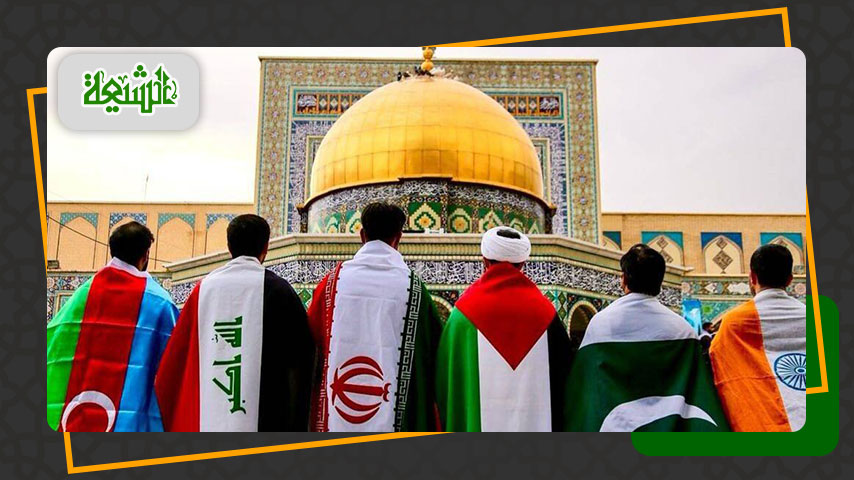




Society Unity are elements that serve as foundational pillars for the stability of every society. If the components of a society fall into division and fragmentation, its structure collapses and it will descend into disorder. A unified and coherent society is the aspiration of every reform-minded and free-thinking individual.
A brief look at the history of societies shows that the communities which enjoyed dignity and honor were those whose members acted in society unity. Imam Ali (AS) considers the greatest cause of dignity and elevation for past nations to be their unity, and the greatest cause of their defeat, humiliation, and downfall to be division and separation.
The Approach of the Amir Al-Muminin (AS) to Society Unity
The Amir Al-Muminin (AS) emphasizes in Nahj al-Balagha the central role of the leader and Imam in society. Indeed, it was through this central role that Muslims attained honor and nobility during the time of the Noble Messenger of Islam (PBUHH).
In Nahj al-Balagha, Imam Ali (AS) identifies the great Prophet of Islam (PBUHH) as the source of society unity among the people and the extinguisher of turmoil and conflict.[1] In this regard, He (AS) states: “The Almighty God granted no good to anyone among the predecessors or their descendants as a result of division and separation”. [2]
People who, due to baseless thoughts, sever ties with their fellow believers and their brothers, turning the purity and sincerity of life into bitterness, imagine that they will gain some benefit through this behavior and obtain some advantage.
Imam Ali (AS), with complete clarity and honesty, warns them that their assumption is false and the path they have chosen is a deviation from the right course. He tells them that they will ultimately reach a destination and outcome they do not desire and that stands in opposition to their aims. He urges them to awaken and return to their senses.
The Imam (AS) discusses the causes of rise and fall, and the factors of defeat and victory of governments in one of his sermons, and identifies society unity as one of the most important causes of rise and victory, and division as one of the most important causes of downfall and defeat.
In Nahj al-Balagha, he (AS) states: “I have been informed that Busr ibn Abi Artat gained control over Yemen. By God, I knew that the people of Sham would soon overpower you, because they are united in supporting their falsehood, while you are divided in defending your truth. You disobey your Imam in what is right, and they obey their leader in what is wrong. They are loyal to their leader, and you are treacherous. They are engaged in reforming and developing their cities, while you are occupied with corruption and ruin. (You are so base that) if I were to entrust one of you with a wooden bowl of water, I would fear that you would steal its strap.” [3]
In this passage, the Imam (AS) enumerates four major factors of victory and four major factors of defeat and collapse of governments:
Four Factors of Victory
1. Society unity;
2. Obedience to and following the leadership of society;
3. Fulfilling trusts and remaining loyal to the covenant and pledge made with the leader;
4. Reform and development.
Four Factors of Defeat
1. Division and disunity;
2. Disobedience to the commands of the leader and ruler of society;
3. Betrayal of trusts and breaking allegiance and covenants with the leader;
4. Corruption within society.
These factors apply to all governments and nations and are not exclusive to an Islamic government or nation.
Society Unity and Imamate
Imam Ali (AS) considers the Imamate to be a factor of cohesion and society unity, for the Imam and leader move the society forward, resolve the people’s problems, and unite them against enemies.
However, even if the leader is resolute, he will not succeed unless the people follow him, just as occurred during the time of the Amir Al-Muminin (AS).
Imam Ali (AS) believes that observing the rights of the government and the rights of the people strengthens the bond, harmony, and unity between them; meaning that the cohesion of the community and its leader is achieved through mutual observance of rights.
In Nahj al-Balagha, He (AS) refers to this truth with a beautiful analogy: “The position of the religious leader and ruler of the state is like the string of a prayer bead in relation to its beads: it gathers them and holds them together. When the string breaks, the beads scatter, each rolling away to a corner, and they can never be gathered again.” [4]
This is an undeniable truth: the order and stability of a society unity between the community and its leader.
The obedience of the community to its Imam, along with the guidance and enlightenment provided by the leader at all times, especially during periods when turmoil and conflict ignite, can manifest the society unity and the Imam.
This unity is the most important factor in strengthening the community and the Islamic government and serves as the greatest barrier against the enemies of Islam.
The Quran and Society Unity
A brief overview of the Quran’s social discussions shows that the Quran considers society unity to be among the most fundamental factors of prosperity and perfection for any society, and division to be among the most important causes of its decay and downfall. One researcher writes: “On every page of the Quran that is opened and in every chapter that is read, either explicitly or implicitly, it is stated that society unity are factors of elevation and victory, while discord and fragmentation are factors of downfall and misery”.[5]
The Noble Quran considers holding fast to the divine rope to be the most important factor in maintaining society unity among the Islamic community: “Hold firmly to the rope of God, all together, and do not fall into division and factionalism. And remember God’s favor upon you: when you were enemies, He brought your hearts together, and through His grace, you became brothers. And know that you were on the edge of a pit of fire, from which God saved you”.[6]
Qurtubi, in his commentary on this verse, writes: “Indeed God has commanded affection and harmony, and prohibited division; for unity and harmony are means of salvation, while division is a means of destruction”.[7]
Tantawi also writes: “Do not distance yourselves from the axis of truth, for this causes conflicts and division among you”.[8]
Muhammad Abduh writes: “Among human beings, nothing is more harmful than discord!”.[9]
Allamah Tabatabai (RA) states: “The ‘blessing’ mentioned in the verse refers to unity, and the fruit of this unity is brotherhood and the bonding of hearts. The ‘fire’ mentioned at the end of the verse refers to the conflicts and wars before Islam”.[10]
Division, Disunity, and the Denial of Unity: Barriers to the Prosperity of Nations
It is clear that the advancement of societies occurs through unity, national solidarity, and the harmony of their members. As Martyr Mutahhari (RA) states: “We must not doubt that social progress comes through agreement, harmony, cooperation, mutual adaptation, and collective compatibility, not through disputes, conflicts, quarrels, and contradictions… In reality, the more a society’s multiplicity and differences move toward unity, and the more disputes and contradictions give way to cooperation and harmony, the more complete that society becomes”.[11]
Thus, Imam Ali (AS) warns everyone against division, saying: “Beware of division and separation”,[12] and he considers goodness and prosperity to lie in abandoning discord, saying: “The Almighty God has never granted goodness or prosperity to anyone through division”.[13]
A society whose foundation is built upon differences and scattered tendencies will inevitably live under the rule of conflict and struggle, and the path to its destruction remains open.[14]
Imam Ali (AS), while considering division a cause of humiliation for societies, states: “Reflect well upon the outcome of past nations: when they turned toward division and fragmentation and when their affection and friendship disappeared, their words became inconsistent (their interpretations diverged), their hearts separated, and they split into various factions and groups, facing one another in hostility. God then removed from them the garment of honor and leadership, took away their blessings, and cast them into difficulties”.[15]
He then emphasizes that division breaks the backbone of the community, advising: “Avoid everything that breaks the backbone of nations and weakens their strength, such as resentments, hostilities, and people fleeing from one another, and similar behaviors”.[16]
When the Noble Quran mentions divine punishments for nations, it considers factionalism and division as forms of punishment, declaring: “God is able to punish you from above you or from beneath your feet (with heavenly or earthly punishments), or He may punish you by making you into groups that oppose one another”.[17]
And in another verse, He says: “Do not be like those who became divided and differed from one another after clear signs had come to them; for them is a great punishment”.[18]
One should note that the reason for such strong emphasis on avoiding disunity and dispersion is that discord is the root of corruption, and any nation afflicted with internal division is pushed toward misery.
According to the Quran, they face a painful punishment whose least consequence is the transformation of a prosperous life into one filled with wretchedness and humiliation.
The Quran considers one of the characteristics of the polytheists to be religious division and factionalism based on differing interpretations of religion, and it warns Muslims against this behavior: “Do not be among the polytheists, those who have divided their religion and become factions; each group is pleased with what it holds”.[19]
In this verse, the Quran describes the polytheists by their most defining characteristic: that they are divided and fragmented into groups within their religion.[20]
Regarding the harm of division and discord and the necessity of confronting anyone who seeks to break the unity of Muslims and create fragmentation among them, Imam Ali (AS) makes the final and most explicit statement. With complete clarity, he declares the instigator of sedition and division deserving of death.
He not only considers the current spreader of division worthy of such punishment, but even someone who merely raises the slogan of division, taking the first step toward splitting the Muslim community or whispering phrases of discord, is regarded as deserving of death.
He (AS) states: “Follow the opinion of the majority of the elders of Islam, for the hand of God is with the community. Avoid isolation and separating yourself from the group, for separation from the community becomes the prey of Satan, just as the sheep that strays from the flock and shepherd becomes the prey of the wolf. Know with certainty that whoever raises the slogan of division is deserving of death, kill him, even if this slogan comes from beneath my turban and from my own mouth”.[21]
Clearly, the slogan of division leads to sedition, and the Almighty God has stated in the Quran: “Sedition is worse than killing”,[22] because sedition destroys people through torment.
Conclusion
Imam Ali (AS) considers the greatest factor of dignity and honor for past nations to be Society unity, and the greatest cause of their defeat, humiliation, and downfall to be division and separation.
The core axis of Society unity is leadership, and it was through this axis that Muslims attained honor and nobility during the time of the Noble Messenger (PBUHH). The Imamate is a factor of cohesion, for among the roles of the leader is the formation of a community, and a community means a nation with a unified purpose.
Notes
[1] . Sharif al-Radi, Nahj al-Balagha, Sermon 96.
[2] . Sharif al-Radi, Nahj al-Balagha, Sermon 176.
[3] . Sharif al-Radi, Nahj al-Balagha, Sermon 25.
[4] . Sharif al-Radi, Nahj al-Balagha, Sermon 146.
[5] . Mostafavi, Unity (book); “Unity in Nahj al-Balagha” (article), p.120.
[6] . Al-Imran:103.
[7] . Mostafavi, Unity (book); “Unity in Nahj al-Balagha” (article), p.56.
[8] . Tantawi, Al-Jawahir, vol.2, p.138.
[9] . Rida, Al-Manar, vol.4, p.21.
[10] . Tabatabai, Al-Mizan, vol.3, p.371.
[11] . Mutahhari, A Critique of Marxism, p.276.
[12] . Sharif al-Radi, Nahj al-Balagha, Sermon 127.
[13] . Sharif al-Radi, Nahj al-Balagha, Sermon 176.
[14] . Musavi Hamadani, Translation of al-Mizan, vol.6, p.283.
[15] . Sharif al-Radi, Nahj al-Balagha, Sermon 192.
[16] . Sharif al-Radi, Nahj al-Balagha, Sermon 192.
[17] . Al-Anam:65.
[18] . Al-Imran:105.
[19] . Al-Rum:31–32.
[20] . Musavi Hamadani, Translation of al-Mizan, vol.31, p.242.
[21] . Sharif al-Radi, Nahj al-Balagha, Sermon 127.
[22] . Al-Baqarah:191.
References
- The Holy Quran.
- Musavi Hamadani, Sayyid Muhammad Baqir. Translation of al-Mizan fi Tafsir al-Quran, Qom, Dar al-Intisharat al-Islamiyyah (affiliated with the Society of Seminary Teachers of Qom), 1378 SH.
- Mutahhari, Morteza, A Critique of Marxism, Tehran, Sadra Publications, 1399 SH.
- Rida, Muhammad Rashid, Tafsir al-Quran al-Hakim al-Manar, Beirut, Dar al-Marifah, 1414 AH.
- Sharif al-Radi, Nahj al-Balagha, ed. Subhi Salih, Qom, Dar al-Hijrah, 1414 AH.
- Tabatabai, Muhammad Husayn, Al-Mizan fi Tafsir al-Quran, Qom, Jamiah-ye Mudarrisin, 1383 SH.
- Tantawi Jawahiri, Al-Jawahir fi Tafsir al-Quran al-Karim, Beirut, Dar al-Kutub al-Ilmiyyah, 1425 AH.
Source of the article | Adapted from:
Seyahat Esfandiyari, Abedin, Applied Ethics with an Emphasis on Nahj al-Balagha, Qom, Qaseem Publications, 1395 SH.