

Dahw al-Ard, also known as the “Spreading of the Earth” in Islamic tradition, is an observance primarily recognized by Shia Muslims. Various Hadith and narrations from Shia Imams that highlight the significance of Dahw al-Ard can be found in classical Islamic texts. For instance, in “Mafatih al-Jinan” by Sheikh Abbas Qummi, which is a widely used Shia prayer manual.
Dahw al-Ard commemorates the event in Islamic belief when the earth was spread out for the first time and made habitable. It therefore serves both as a religious observance and a time for reflecting on environmental and ecological responsibilities within the Islamic faith.
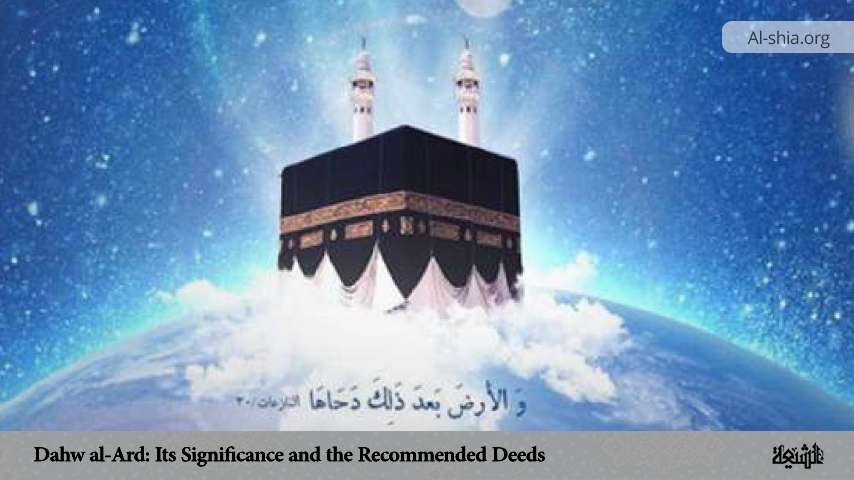
Etymologically, the term “Dahw” means to spread[1], to expand[2], to remove something from its place[3], and the phrase, “Dahw al-Ard,” means the spreading of the Earth. Therefore, by “Dahw al-Ard” is meant the coming of the lands out of the water which used to cover the Earth. According to hadiths and old Islamic sources, the Earth was first completely covered with water, and the lands later came out[4]. The day on which the lands came out of water is called “Dahw al-Ard”. According to accounts of the local history of Mecca, the first land that came out of the water was the Ka’ba in Mecca[5].
Historical Significance
According to hadiths and books of fiqh, the date of Dahw al-Ard is Dhu l-Qa’da 25[6]. It therefore holds significant historical and religious importance in Islamic tradition, particularly among Shia Muslims. It commemorates a pivotal moment in Islamic cosmology, emphasizing the sanctity of the earth’s creation, the centrality of the Kaaba, and the theological themes of divine omnipotence and environmental stewardship. Meanwhile, the following is a detailed look at its historical significance:
1. Creation of the Earth: Dahw al-Ard is believed to mark the day when Allah spread the earth from beneath the Kaaba in Mecca. According to Islamic tradition, the earth was initially created in a condensed form, and on this day, it was spread out to make it habitable for humans and other creatures. This event is seen as a foundational moment in the creation of the world.
2. Association with the Kaaba: The Kaaba, located in Mecca, is the most sacred site in Islam. It is believed that the earth was spread out from a point beneath the Kaaba, known as the “navel of the earth.” This emphasizes the spiritual and geographical significance of the Kaaba as the center of the earth in Islamic cosmology.
3. Qur’anic References: Although the event of Dahw al-Ard is not explicitly detailed in the Qur’an, various verses are interpreted by scholars to allude to the process of the earth’s formation and spreading. For instance, verses from Surah An-Nazi’at (Qur’an 79:30) and Surah Al-Ghashiyah (Qur’an 88:20) discuss the spreading out of the earth, which are often associated with this event.
4. Prophetic Traditions: Various Hadith of the Prophet Muhammad (PBUHH) and narrations from Shia Imams (PBUT) elaborate on the significance of this day. These traditions highlight the sanctity of the day and encourage acts of worship and reflection.
5. Theological Implications: The event underscores the belief in Allah’s omnipotence and the intricate design of creation. It serves as a reminder of God’s provision and the sustenance provided by the earth, encouraging gratitude and responsibility towards the environment.
Spiritual Reflection
Dahw al-Ard provides a profound opportunity for spiritual reflection, focusing on several key themes within Islamic belief. By engaging in these reflections, Muslims can deepen their spiritual understanding and enhance their relationship with Allah, while also fostering a more conscientious approach to life and the environment. Here are the primary aspects of spiritual reflection associated with this observance:
1. Gratitude for Creation: Believers reflect on the marvel of Allah’s creation, recognizing the earth as a divine gift. This day encourages Muslims to express gratitude for the sustenance and resources provided by the earth, acknowledging that everything originates from Allah’s will and mercy.
2. Divine Omnipotence: The event underscores Allah’s omnipotence and the intricate design of the universe. Contemplating the spreading of the earth leads to a deeper appreciation of Allah’s power and wisdom in creating a perfectly balanced world for human habitation.
3. Environmental Stewardship: Dahw al-Ard serves as a reminder of the Islamic teaching that humans are stewards of the earth (Khalifah). This day calls for reflection on how one’s actions impact the environment, urging believers to adopt sustainable practices and to protect and preserve the natural world.
4. Spiritual Cleansing: Engaging in fasting, prayers, and recitation of the Qur’an during Dahw al-Ard promotes spiritual cleansing. It is a time to seek forgiveness for past wrongdoings, purify the heart, and renew one’s commitment to live a life in accordance with Islamic principles.
5. Humility and Dependence on Allah: This observance emphasizes human dependence on Allah for sustenance and survival. It cultivates humility, reminding believers that despite advancements and achievements, humans are ultimately dependent on divine grace for the earth’s continued ability to sustain life.
6. Contemplation of the Hereafter: Reflecting on the creation and the temporality of life on earth can lead to a greater awareness of the Hereafter. Dahw al-Ard encourages Muslims to think about their spiritual journey and to prepare for the eternal life by performing righteous deeds and adhering to Islamic teachings.
7. Renewed Purpose: The day provides a moment to reassess one’s life purpose and goals. It’s an opportunity to realign personal and spiritual objectives with the broader framework of serving Allah and fulfilling duties as a caretaker of the earth.
Cultural Aspects
Dahw al-Ard, while primarily a religious observance, also has various cultural aspects that enrich its significance and the ways in which it is marked among the Shia Muslims. These cultural aspects highlight the communal and holistic nature of Dahw al-Ard, making it not only a day of religious significance but also a time for community building, education, and environmental consciousness. Here are some cultural dimensions of Dahw al-Ard:
1. Community Gatherings: On Dahw al-Ard, it is common for communities, especially in predominantly Shia regions, to come together for special prayers, sermons, and discussions. These gatherings often take place in mosques, community centers, and homes.
2. Educational Activities: In some communities, educational programs are organized to teach the significance of Dahw al-Ard, focusing on the creation of the earth, environmental stewardship, and spiritual reflection. These programs may include lectures, workshops, and discussions led by religious scholars.
3. Charitable Events: Acts of charity are emphasized, reflecting gratitude for the earth’s resources. Community members may organize food drives, distribute necessities to the poor, and support environmental initiatives. This practice not only aids those in need but also fosters a sense of community and shared responsibility.
4. Environmental Awareness: Dahw al-Ard is increasingly being associated with environmental awareness and sustainability. Some communities use this day to promote ecological practices, such as tree planting, clean-up drives, and discussions on how to better care for the planet. This aligns with the Islamic teaching of being stewards of the earth.
Recommended Deeds
In Islam, Dahw al-Ard counts as a virtuous day of the year. The hadiths strongly recommend some religious practices on this day. Therefore, many Shia Muslims engage in various religious practices to commemorate the event and seek blessings. These practices help believers connect spiritually with the event of Dahw al-Ard, fostering a sense of gratitude, responsibility, and devotion to Allah. The key practices include:
1. Fasting: It is common for Shia Muslims to fast on Dahw al-Ard. Fasting on this day is believed to bring numerous spiritual benefits and is highly recommended in various Hadith[7]. It is amongst the four most important fasts of the year. According to a narration, to observe fasting on this day is equal to seventy months fasting and erases the sins of seventy years.
2. Ritual bath [Ghusl]: According to some narrations, ritual cleansing is highly recommended on this day.
3. Prayers and Supplications: Special prayers (Salat) and supplications (Dua) are performed. These include reciting specific prayers dedicated to Dahw al-Ard, seeking forgiveness, and asking for blessings[8].
4. Charitable Acts: Acts of charity and helping those in need are encouraged. This reflects the gratitude for the earth’s resources and the sustenance provided by Allah.
5. Reflection and Meditation: Believers use this day for introspection, contemplating the significance of the earth’s creation, and their responsibilities towards it. This includes reflecting on themes of environmental stewardship and the blessings of the natural world.
6. Ziyarah of Imam Ali Rida (PBUH): Sayyid al-Damad mentioned the Ziyarah of Imam Ali Rida (PBUH) as the most preferable act on this day[9].
Conclusion
Dahw al-Ard is a significant observance in Shia Islam, commemorating the day when Allah spread out the earth, making it habitable for all creatures. This day, observed on the 25th of Dhu al-Qa’dah, serves as a profound reminder of Allah’s omnipotence, the blessings of the earth, and the responsibilities humans have as its stewards. It therefore integrates spiritual, communal, and environmental aspects, encouraging believers to deepen their faith, strengthen community ties, and adopt a more conscientious approach to the natural world.
References
[1] . Bayhaqī, Aḥmad ibn ʿAlī, ‘’al-Tāj al-Maṣādir’’, vol. 1, p. 90.
[2] . Khalīl ibn Aḥmad, ‘’Kitāb al-ʿayn’’, vol. 3, p. 280.
[3] . Rāghib al-Iṣfahānī, Ḥusayn ibn Muḥammad, ‘’al-Mufradāt’’, under the word “Dahw”.
[4] . Mazrūqī Iṣfahānī, Aḥmad ibn Muḥammad, ‘’al-Kitāb al-azminat wa l-amkina’’, p. 35.
[5] . Ibn Ḥayyūn, ‘’Sharḥ al-akhbār’’, vol. 3, p. 477; Ṣadūq, Muḥammad ibn ʿAlī, ‘’Man lā yaḥḍuruh al-faqīh’’, vol. 2, p. 241.
[6] . Ṭūsī, Muḥamamd ibn al-Ḥasan, ‘’al-Miṣbāḥ al-Mutahajjid’’, p. 669.
[7] . cf. Sheikh Abbas Qummi, “Mafatih al-Jinan”, Section on the Recommended Deed in Dhul al-Qadah 25.
[8] . ibid.
[9] . Ṭūsī, Muḥamamd ibn al-Ḥasan, ‘’al-Miṣbāḥ al-Mutahajjid’’, p. 671-699; Ibn Ṭāwūs, ʿAlī b. Mūsā, ‘’Iqbāl al-aʿmāl’’, vol. 2, p. 27-29.


![The Event of Ghadir and Imam al-Mahdi [afs]](https://en.al-shia.org/wp-content/uploads/2026/06/17221.jpg)